



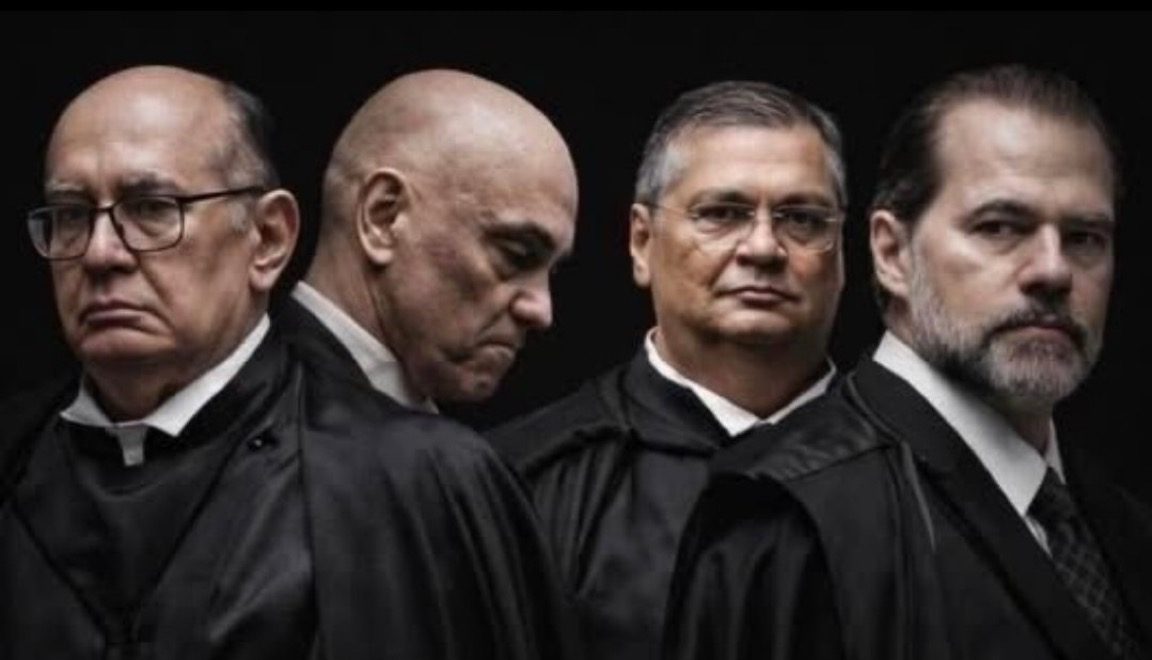
Brazil: When the Referee Is Also a Player-A quiet scandal
By Hotspotnews
Brazil’s highest court is no longer merely judging the country. It is judging itself — and the public can see which rules apply to whom.
The latest flashpoint is not abstract. Eduardo Tagliaferro, former chief of the TSE’s Special Advisory for Combating Disinformation under Alexandre de Moraes, leaked or confirmed internal messages that he said showed an informal machine feeding political cases. The Prosecutor General charged him with breach of official secrecy, obstruction, coercion in a pending case, and even an attempt to abolish the democratic rule of law. The First Panel accepted the indictment. Moraes remained rapporteur. Tagliaferro lives in Italy under an extradition request. That is the record reported by Agência Brasil, Veja, Gazeta do Povo, and Revista Oeste.
His defense, led by Paulo César Rodrigues de Faria, filed two formal motions of suspicion — AS 239 and AS 240 — arguing the obvious: a justice who is alleged victim, political target of the disclosures, and trial judge at the same time is not a neutral magistrate. Fachin rejected the first wave on a five-day internal-rule deadline and treated later agravos as untimely, while the defense invoked the Code of Civil Procedure’s fifteen-day clock from knowledge of the fact. Those files have sat for months. That, too, is on the public dockets.
Then came Saturday, 12 September 2026.
Fachin pulled PET 16.662 — the Federal Police material on messages attributed to Daniel Vorcaro and a phone linked to Moraes — from André Mendonça and assigned it to the Presidency. The cited ground was Article 144, IV of the Code of Civil Procedure: a judge must not sit when he, a spouse, or a close relative is a party. In the same movement he ordered the Master and INSS fraud files sent to the Presidency, freezing two of the largest financial scandals in the country until he decides who will report them. Plenary on whether to open an inquiry into Moraes remains set for 15 September; the file on Mendonça’s own conduct was parked until 23 September. Correio Braziliense, Valor Econômico, G1, Migalhas, and Deutsche Welle all recorded the sequence.
Causes
The crisis did not fall from the sky. It grew from a decade of exceptional criminal dockets concentrated in a handful of chambers, a culture in which the same justice who feels injured also writes the first vote, and a habit of treating procedural clocks as elastic when the target is inconvenient and rigid when the target is a colleague. After 2022 the TSE’s disinformation apparatus and the Supreme Court’s fake-news inquiry blurred the line between referee and player. Tagliaferro was useful while he produced reports. He became a defendant when the reports pointed inward. That inversion is the conservative complaint in its simplest form: power that investigates itself will always find the whistleblower guiltier than the system.
The Vorcaro-Master track added a second cause. A justice whose family law firm appeared in a nine-figure contract conversation, and who then sits on related secrecy and criminal files, was always going to detonate the court. Mendonça lifting secrecy forced the contradiction into public view. Fachin’s answer was to recentralize paper, not to apply one conflict rule to every minister.
Is Fachin sweeping dirt under the rug?
A charitable reading exists. The Presidency must prevent two justices from using monocratic orders as weapons. Separating calendars, invoking the internal rule on inquiries against sitting members, and citing Article 144 can be described as institutional hygiene. Parts of the mainstream press have already called it a step toward transparency.
A stricter reading is harder to dismiss. The same Presidency that discovered a conflict rule overnight for Mendonça has left Moraes as judge in a case where he is the alleged injured party. The same Presidency that can move PET 16.662 on a Saturday left AS 239 and AS 240 idle since February and March. The same Presidency that froze Master and INSS — files that touch banks, pensions, and political financing — did so on the eve of a televised vote about Moraes. If the dirt is the appearance that some ministers are judged by law and others by calendar, then yes: moving boxes to the Presidency without deciding the suspicion motions is how dust gets pushed under the carpet. It is not a conspiracy theory. It is a comparison of two dockets.
What happens next — and why trust is already damaged
Three dates now matter more than any speech from the Court.
On 15 September the full bench decides whether to open an inquiry into Moraes over the Vorcaro messages. On 23 September it is scheduled to look at Mendonça’s conduct. Sometime after that, Fachin must say what he will do with the frozen Master and INSS files, and with the two Tagliaferro suspicion motions that have been sitting on his desk since February and March.
That calendar is the test. If Moraes stays rapporteur in a case where he is the alleged victim, while a conflict rule was fast enough to move Mendonça on a Saturday, the public will not hear “procedure.” It will hear two sets of rules. If Master and INSS stay parked, people will conclude that large fraud cases can wait when they reach a justice’s circle. If the Tagliaferro motions stay unanswered, the equality clause of the Constitution becomes a slogan, not a command.
So is Fachin sweeping dirt under the rug? The honest conservative answer is this: he may be trying to stop a war between two justices, but he is doing it by gathering the files in his own office instead of applying one conflict standard to every minister. Moving paper is not the same as judging the conflict. Silence on Tagliaferro while citing Article 144 in the Vorcaro file is the appearance of protection, whether that was the intent or not.
Public trust does not return because the Court says it is transparent. It returns when a citizen can predict the same result for the same legal problem. Right now that prediction is broken. A court that lectures the country on democracy cannot keep a victim-judge in place and still expect to be believed. Either the same rule that touched Mendonça touches Moraes, or the Court must explain in public why a justice may try a man who accused him. Until one of those two things happens, the rug will look full, and the country will keep walking around it.
Are you feeling odd about all this?
That feeling is understandable. When a court that sits above ordinary politics starts looking like a faction with a story to protect, the facts do feel grim — because the institution that is supposed to settle disputes becomes one of the disputants.
The grave part is not that justices have opinions. It is that the public can no longer tell whether a ruling is law or self-defense. A minister who is alleged victim and rapporteur in the same file; suspicion motions that sit for months; a conflict rule that moves fast for one colleague and barely moves for another; large fraud cases paused on the eve of a vote about a justice — those are not vibes. They are visible mismatches. Once people see two clocks and two standards, they stop asking “what does the statute say?” and start asking “who does this protect?”
A Supreme Court can survive unpopular decisions. It cannot survive the belief that truth is whatever the robe needs it to be. That belief, once it hardens, does not stay in Brasília. It leaks into every police inquiry, every election case, every extradition request. Citizens obey courts they distrust only out of fear or habit, not consent. That is the real institutional cost.
None of this requires treating every accusation as proven. Tagliaferro may be a leaker, a witness, both, or neither in the way his lawyers claim. Vorcaro’s messages may or may not amount to a crime. The point is narrower and harder: the Court has made itself the narrator of facts in which it is a character. Narrators who are also defendants write tidy versions. The country can see the tidy parts.
If public opinion feels heavy, it is because people sense that the last referee has entered the match. Recovering trust would take the opposite of a “version”: one conflict rule, published reasons, and files that move at the same speed whether they inconvenience a minister or an ex-advisor. Until that happens, the unease you feel is not odd. It is what a republic feels when the highest bench starts arguing with reality instead of judging it. Think about it.
Sources: STF records in AS 239, AS 240, PET 16.662 and PET 16.704; Code of Civil Procedure arts. 144 and 146; Constitution art. 5; reporting by Gazeta do Povo, Revista Oeste, Agência Brasil, Correio Braziliense, Valor Econômico, G1, Migalhas, and defense filings by Paulo César Rodrigues de Faria.
#STF #AlexandreDeMoraes #EdsonFachin #Tagliaferro #Isonomia #EstadoDeDireito #BancoMaster #INSS #DueProcess #ConfiancaPublica


