




The STF Lottery That Saved Accountability: How an Attempt to Sideline a Rigorous Minister Backfired in the Lulinha Case
By Hotspotnews
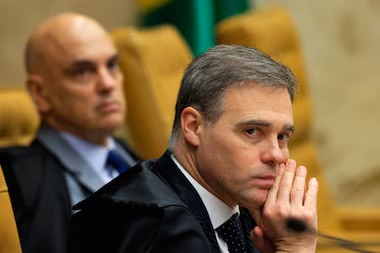
In the halls of Brazil’s Supreme Federal Court, an internal assessment circulating among some justices has raised serious questions about institutional coordination and the equal application of the law. According to reports from multiple outlets, a wing of the STF views recent moves by the Federal Police, the Prosecutor General’s Office, and acting STF President Alexandre de Moraes as a deliberate effort to strip Minister André Mendonça of the rapporteurship over a sensitive new inquiry into Fábio Luís Lula da Silva — better known as Lulinha, the eldest son of President Luiz Inácio Lula da Silva.
The facts are straightforward. Lulinha already faced scrutiny within the broader investigation into fraudulent deductions from INSS retirees’ benefits, known as Operação Sem Desconto, which Mendonça has been overseeing with notable firmness. The Federal Police then sought a separate inquiry into alleged influence trafficking and corruption. Investigators pointed to suspected efforts involving medicinal cannabis commercialization, access to the presidential office, connections with the Ministry of Health, and ties to figures such as the lobbyist known as “Careca do INSS.” A further line of inquiry later touched on Dataprev.
Rather than sending the request directly under the rules of prevention — which would have kept it with the minister already handling connected matters — the Federal Police routed it to the STF presidency for free distribution by lottery. They argued the facts were distinct. During the judicial recess, Moraes held the acting presidency. He sought the opinion of the PGR under Paulo Gonet, which endorsed free distribution. Moraes ordered the electronic lottery. In a remarkable turn of chance, the system selected André Mendonça once again.
Mendonça promptly authorized the opening of the investigation. The outcome frustrated whatever design may have existed to remove the case from his oversight.
This episode did not occur in a vacuum. Tensions between Mendonça’s chambers and the Federal Police had already escalated. The minister had insisted on greater transparency: all investigative acts joined to the process under his supervision, advance notice of any personnel changes among the investigators, and regular progress reports. Such demands for accountability are precisely what one expects from a rigorous judicial officer handling cases involving the highest levels of political power. Yet they apparently generated resentment within parts of the investigative apparatus.
From a conservative perspective that prioritizes institutional integrity, the rule of law, and skepticism toward concentrated power, the sequence of events is troubling. Mendonça, appointed during the previous administration, has demonstrated independence in high-stakes matters. Attempts — or even the appearance of attempts — to shop for a different rapporteur when the target is the son of the sitting president invite legitimate questions about selective justice. When the Federal Police, the PGR, and the acting president of the Court align on a procedural path that would have removed a demanding overseer, citizens are entitled to ask whether the goal was efficiency or insulation.
Brazil’s justice system must treat the powerful the same as ordinary citizens. Investigations into influence peddling, access to the presidential office, and potential corruption schemes involving public resources demand precisely the kind of steady, transparent supervision Mendonça has applied. The electronic lottery’s selection of the same minister stands as a quiet rebuke to any maneuvering. It preserved continuity and accountability.
The larger principle remains clear. No family connection, no political alignment, and no institutional alliance should determine the course of a serious criminal inquiry. André Mendonça’s authorization of the probe was the correct and necessary step. The public interest requires that the investigation proceed without further procedural gamesmanship, with full transparency, and under the same rigorous standards applied to every other Brazilian. Anything less erodes the foundations of equal justice under law.


