




The Court That Will Not Judge Itself
By Hotspotnews
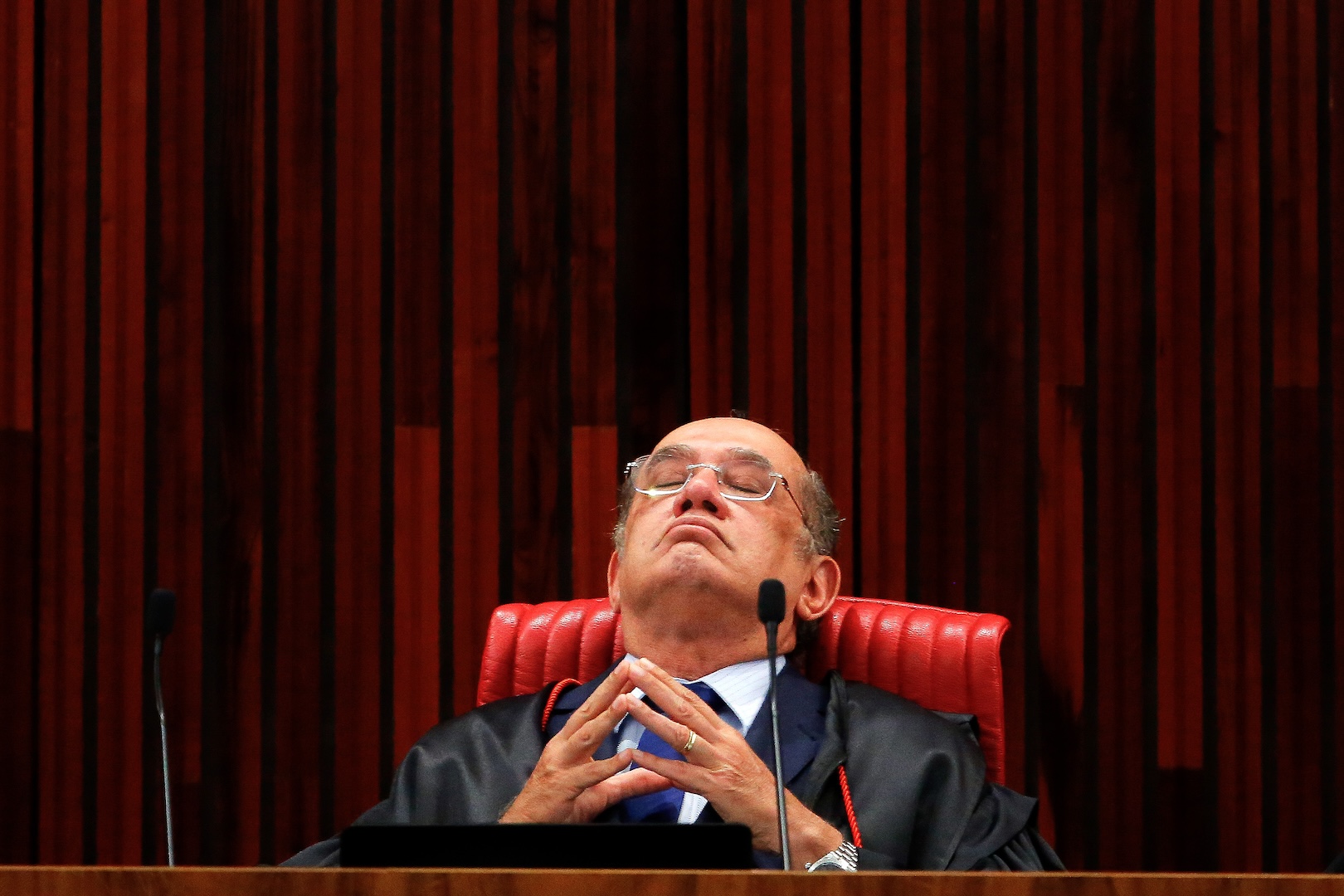
Brazil’s highest court is not debating a technicality. It is staring at a banking collapse, a sitting justice named in a Federal Police file, and a last-minute maneuver to keep the file from becoming a verdict. Six days before the first round of the presidential election, Justice Gilmar Mendes is again attacking Justice André Mendonça and asking the Supreme Federal Court to freeze the proceeding that would decide whether Justice Alexandre de Moraes should even be investigated in the Banco Master scandal. That is not institutional caution. It is institutional self-defense.
The facts already on the public record are ugly enough without anyone adding slogans.
Daniel Vorcaro, the former owner of Banco Master, is in pre-trial detention. The Central Bank liquidated the institution after investigators described a scheme of fraudulent credit-portfolio sales. From Vorcaro’s phone, the Federal Police recovered material that Mendonça later unsealed: a report of more than two hundred pages and fifty-two messages attributed to the banker, sent to a contact saved as “Alexandre de Moraes BRASILIA.” The recovered files show what Vorcaro sent. They do not fully reconstruct Moraes’s replies. That limitation matters. It does not erase the rest.
Two days before Vorcaro’s first arrest, on November 15, 2025, the banker asked whether he already needed to be out of the country by Monday. The next day he wrote that he was in the air and would go straight to the minister. On November 17 he was detained at Guarulhos Airport as he prepared to board a private jet. That same night he messaged the same contact: “Estou online.” Hours later Operation Compliance Zero began and the bank was put into extrajudicial liquidation. In other messages Vorcaro spoke of a “debt of life” to Moraes and his family and of mobilizing “heavy people” while trying to keep the Federal Police and the Prosecutor-General from moving against him. Investigators also recorded in-person meetings in Brasília and São Paulo, including at the banker’s home.
Then there is the money around the robe. The law firm of Viviane Barci de Moraes, the justice’s wife, signed a consulting contract with Banco Master in January 2024. The gross figure reported in the press is about 131 million reais over thirty-six monthly installments of 3.6 million. A second agreement followed in 2025. Federal Revenue data sent to Congress indicated the firm received tens of millions before the bank collapsed. The contract language was not limited to labor memos. It contemplated strategic consulting before the Central Bank, CADE, the Federal Revenue Service, police agencies, and courts. Metadata on a draft recovered from Vorcaro’s phone identified a last edit under the profile “Minister Alexandre de Moraes.” The firm says the minister was asked only about legal impediments, that he never sat on Master cases at the Court, and that the work stopped when the bank was liquidated. Those are defenses. They are not a clean bill of health.
Moraes denies wrongdoing. He has not been charged. Vorcaro has not been convicted. A conservative argument does not require pretending otherwise. It requires refusing the opposite fraud: that a Supreme Court justice can receive this kind of approach from a banker under investigation, appear in the same file as family contracts and flight-week messages, and then treat any demand for an inquiry as an attack on democracy.
What followed was not a sober inquiry. It was a war inside the palace.
Mendonça, then the rapporteur, lifted secrecy on the police report. Moraes answered by accusing Mendonça of abuse of authority, administrative impropriety, and a crime of responsibility — in effect, of running a selective, political investigation. Mendonça had already removed Federal Police Director-General Andrei Rodrigues from office, arguing that intelligence work had been used against the rapporteur himself. Gilmar Mendes called the removal a disgrace, interrupted Mendonça in open session, and spoke of “desfaçatez.” The two men shouted at each other in the plenary. President Edson Fachin scheduled one hearing on Moraes and another on Mendonça, then pulled the second after Gilmar demanded that the cases travel together. Flávio Dino asked for more time. The Court froze.
Now Gilmar has returned with a broader proposal. Identify every magistrate mentioned in the Master papers — not only at the Supreme Court, but at other high courts. Open internal inquiries. Decide who is recused. Merge the Moraes file with the file on Mendonça. Draw a new rapporteur. Give the Prosecutor-General and the named judges time to speak. Until then, suspend the vote on Moraes.
Some of that sounds like due process. In this Court, at this hour, it also sounds like a delay machine. Expanding the circle of the implicated is a classic way to make a specific accusation look like a general fog. Redistributing the case resets the referee. Waiting for sindicâncias pushes any decision past October 4, when Brazilians vote, and perhaps past October 25, if there is a runoff. A Court that spent years lecturing the country about “democratic stability” now cannot decide whether one of its own should face the same investigative standard it applies to everyone else.
Conservatives have said this for years and were called anti-institutional for saying it. A tribunal that censors speech, runs sprawling inquiries, and treats political opponents as security threats will eventually be unable to look at its own members without calling the gaze a coup. Equality before the law is not a campaign phrase. It is the only reason a Supreme Court is tolerable in a republic. The moment justices become a caste that investigates others and postpones itself, the Constitution is being used as a costume.
The law, if anyone still cares to read it, is not mysterious. Ordinary crimes by a Supreme Court minister are judged by the Supreme Court. Crimes of responsibility go to the Senate, which may remove a justice and bar the person from public office. No sitting STF minister has ever been removed that way. Gilmar himself helped narrow the on-ramp, insisting that only the Prosecutor-General may bring a responsibility charge and pushing the Senate toward a two-thirds vote merely to receive a complaint. Paulo Gonet, the current Prosecutor-General, is himself mentioned in the Master orbit and has been publicly defended by Gilmar after attacks on his reputation. So the investigator of last resort is contested, the Court of last resort is divided, and the political body of last resort is in an election.
That is why “if it is proved, they will be punished” is a child’s sentence. Proved by whom? Charged by whom? Removed by whom? The same ten or eleven people who cannot finish a session without insults, recusals, and requests for more time. If the evidence ever became undeniable — money, orders, a quid pro quo no colleague could laugh off — the fight would leave the courtroom and enter the Senate. Until then, the pattern is the one Brazilians already know: secrecy fights, counter-accusations, procedural resets, and no equality.
A conservative conclusion is not that Mendonça is a saint or that every name in Vorcaro’s phone is guilty. It is that the burden has shifted. The public has seen enough to demand a real inquiry with the same severity the Court uses when the target is a deputy, a journalist, or a president it dislikes. If the messages are innocent, the fastest way to say so is to investigate them in daylight. If the contracts are clean, publish the work product and the payments and stop hiding behind “consulting.” If other justices are in the file, name them and recuse them. What cannot be defended is the present spectacle: Gilmar Mendes using seniority to stall a vote on Alexandre de Moraes while the country is asked to treat the Supreme Court as the guardian of republican virtue.
Institutions do not die when they are criticized. They die when they become the one place in the state where evidence does not travel upward. Banco Master is a test of that rule. So far the Court is failing it.
Sources Federal Police report on messages recovered from Daniel Vorcaro’s phone, unsealed by Justice André Mendonça; reporting and document reviews by Estadão, Folha de S.Paulo, O Globo, g1, CNN Brasil, JOTA, Veja, CBN, Agência Brasil, and Gazeta Brasil; public notes from Barci de Moraes Sociedade de Advogados; Constitution of Brazil, articles 52 and 102; Law 1.079 of 1950 on crimes of responsibility; statements and session accounts involving Justices Gilmar Mendes, André Mendonça, Alexandre de Moraes, Edson Fachin, and Flávio Dino; Superior Electoral Court calendar for the 2026 election.
#STF #CasoMaster #AlexandreDeMoraes #GilmarMendes #AndreMendonca #DanielVorcaro #BancoMaster #EstadoDeDireito #ForoPrivilegiado #Eleicoes2026 #Brasil #SupremoTribunalFederal #OperacaoComplianceZero #Republica #Imparcialidade


