




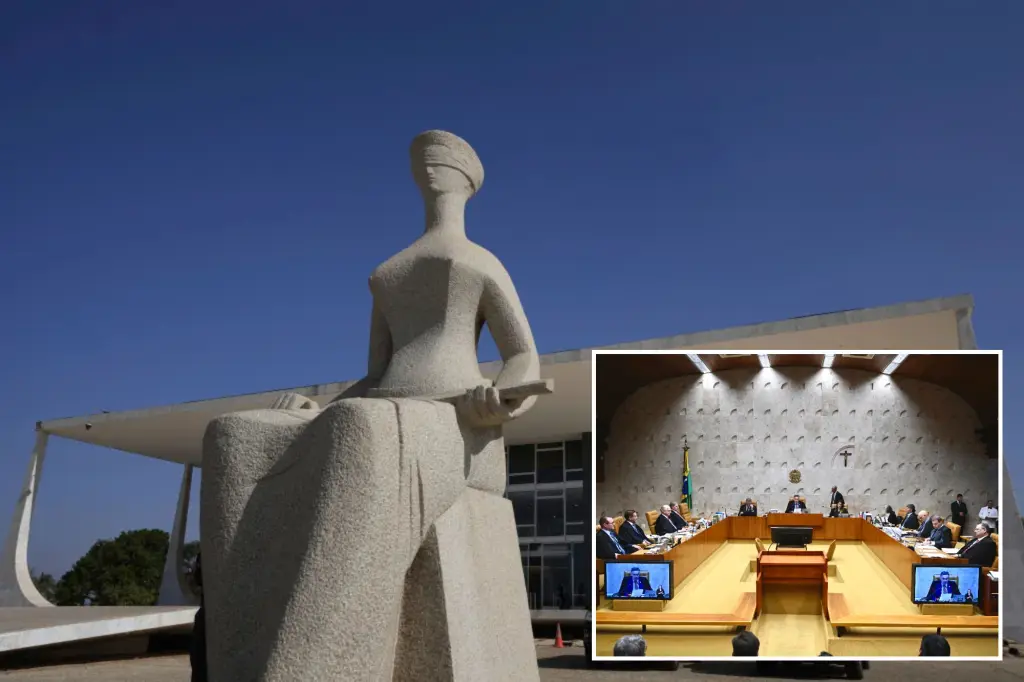
The Erosion of Judicial Integrity: A Conservative Perspective on the STF’s Political Maneuvering
By Hotspotnews
In the heart of Brazil’s political landscape, the Supreme Federal Court (STF) has once again found itself at the center of controversy, not for upholding the rule of law, but for what many conservatives view as a blatant politicization of justice. The recent defense of General Augusto Heleno before the STF encapsulates this troubling trend, where the court’s actions are increasingly perceived as tools for political warfare rather than impartial adjudication.
During the session, Minister Flávio Dino, a former member of the Communist Party of Brazil and now a minister appointed by President Lula, inadvertently highlighted the depth of this issue. Dino questioned the source of a critical headline suggesting that the STF was being used by opposition parties, mistakenly attributing it to an obscure online jurist rather than the esteemed former STF minister, Marco Aurélio Mello. This moment was not merely a slip of the tongue but a revelation of the underlying tensions and the selective memory of those within the court who prefer to dismiss dissent as fringe rather than confront the valid criticisms from within their own ranks.
Marco Aurélio Mello, known for his controversial decisions such as the temporary release of drug lord André do Rap in 2020, has been a vocal critic of the STF’s recent trajectory. His assertion that the court is being manipulated by opposition parties to undermine the government resonates deeply with conservative concerns about the erosion of judicial independence. The irony of Dino’s surprise at Mello’s critique underscores a broader disconnect within the STF, where political allegiance seems to overshadow legal principle.
This incident is part of a larger pattern of concern. The STF, under the leadership of figures like Justice Alexandre de Moraes, has been criticized for overreaching its authority. Moraes, sanctioned by the United States for serious human rights abuses including arbitrary detentions and violations of free speech, embodies the conservative fear that the court has become a weapon against political dissent rather than a guardian of democratic values. His actions, aimed at silencing critics through secret orders and pre-trial detentions, are seen as a direct assault on the freedoms that underpin a healthy democracy.
Conservatives argue that this politicization of the judiciary threatens the very fabric of Brazilian society. The STF’s role should be to interpret the law impartially, not to engage in what appears to be a targeted campaign against political opponents. The defense of General Heleno, where the court’s own procedures and the credibility of its ministers are called into question, is a stark reminder of the stakes involved. When the judiciary becomes a battleground for political scores, the trust of the people in their institutions wanes, and with it, the stability of the nation.
The international community’s response, particularly the U.S. sanctions against Moraes, further validates these concerns. It is a signal that the world is watching, and the actions of the STF are not just internal matters but have implications for Brazil’s standing on the global stage. Conservatives call for a return to the principles of judicial restraint and impartiality, where the law is applied equally to all, regardless of political affiliation.
In conclusion, the events surrounding the defense of General Heleno and the broader criticisms of the STF under Moraes’ influence represent a critical juncture for Brazilian democracy. Conservatives urge a reevaluation of the court’s role, advocating for a judiciary that serves as a check on power, not as an extension of it. The path forward requires not just legal reform but a cultural shift within the STF itself, restoring its integrity and ensuring it remains a pillar of justice rather than a tool of political maneuvering.