





Hezbollah’s Tri-Border Operations: A Persistent Threat in Latin America’s Lawless Frontier
By Hotspot News
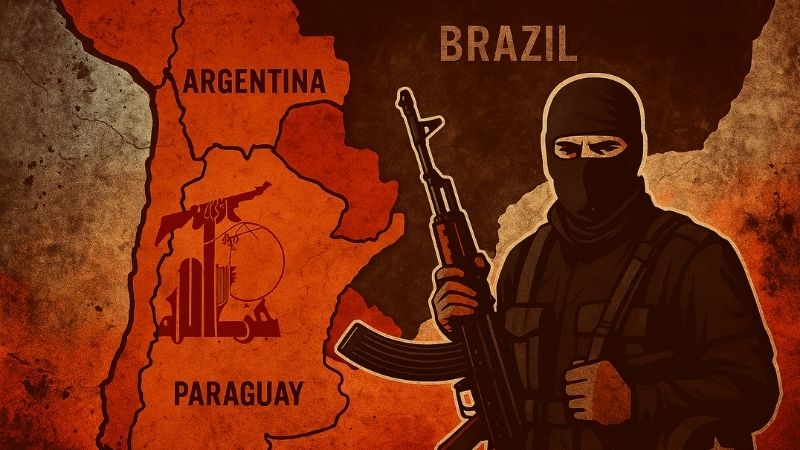
Hezbollah, the Iran-backed Lebanese terrorist organization designated as such by the United States and several other nations, has maintained a deep and enduring presence in South America’s **Tri-Border Area** (TBA)—the convergence of Argentina, Brazil, and Paraguay—for over four decades. This region, encompassing cities like Ciudad del Este (Paraguay), Foz do Iguaçu (Brazil), and Puerto Iguazú (Argentina), serves as one of the group’s most lucrative overseas hubs for fundraising and logistical support. Far from being a mere peripheral operation, the TBA functions as a critical financial lifeline that sustains Hezbollah’s global terrorist activities, including its arsenal in Lebanon and attacks against Western and Israeli targets.
The TBA’s appeal to Hezbollah lies in its notorious lawlessness. Porous borders, weak institutional oversight, and a massive Lebanese diaspora—particularly Shiite communities—provide ideal cover for illicit enterprises. Since the mid-1980s, Hezbollah has exploited these conditions to build sophisticated networks involving **money laundering**, **drug trafficking** (especially cocaine), **arms smuggling**, **counterfeiting**, **intellectual property theft**, and **smuggling of contraband goods**. These activities generate hundreds of millions of dollars annually, with estimates from U.S. Southern Command placing Hezbollah’s South American profits between $300–500 million per year in some periods. Funds are funneled back to support Hezbollah’s military wing, rocket stockpiles, and operations against Israel and its allies.
Key figures like the **Barakat clan**, centered in Ciudad del Este, have long orchestrated these efforts. U.S.-designated terrorist Assad Ahmad Barakat and his associates have operated illicit shopping centers and financial schemes that blend legitimate businesses with criminal ones, creating a robust pipeline for laundering proceeds from narcotics and other crimes. Hezbollah’s “Business Affairs Component” oversees these endeavors, turning diaspora loyalty and local corruption into steady revenue streams.
The group has forged pragmatic alliances with transnational criminal organizations to expand its reach. Notably, Hezbollah-linked Lebanese traffickers have cooperated with Brazil’s **Primeiro Comando da Capital (PCC)**—Latin America’s most powerful prison-born syndicate—in weapons procurement, explosives sales, and protection rackets. These partnerships allow Hezbollah to access international smuggling routes while providing criminal partners with Middle Eastern connections and protection for incarcerated affiliates. Similar ties extend to groups like Colombia’s former FARC elements and Mexican cartels, illustrating a dangerous crime-terror nexus that amplifies threats far beyond the TBA.
Historically, the region has been linked to Hezbollah’s most notorious acts in the Western Hemisphere, including the 1992 bombing of Israel’s embassy in Buenos Aires and the 1994 AMIA Jewish community center attack—both attributed to Iranian direction and Hezbollah execution, with planning rooted in the TBA. While direct attacks in the area have been rare in recent years, the infrastructure remains: sleeper cells, recruitment among diaspora youth, and occasional training activities persist. U.S. intelligence and regional reports continue to highlight Hezbollah’s use of the TBA for fundraising, logistics, and potential operational planning.
Recent developments underscore the ongoing danger. In 2025, the U.S. State Department renewed a multimillion-dollar **Rewards for Justice** offer for information disrupting Hezbollah’s TBA financial networks, signaling persistent concern amid heightened Middle East tensions. Analyses from defense and think-tank sources emphasize that Hezbollah has adapted by diversifying into new zones while retaining its TBA core, especially as pressures mount elsewhere. Weak regional responses—only a handful of Latin American countries officially designate Hezbollah as a terrorist entity—enable these operations to flourish.
The Tri-Border Area stands as a stark example of how terrorist groups exploit ungoverned spaces and criminal economies to project power globally. For the United States and its allies, ignoring or downplaying Hezbollah’s entrenched operations here risks allowing a proven killer network to maintain financial independence, radicalize communities, and position assets for future threats—potentially even closer to American shores. Stronger international pressure, including demands for Brazil and others to designate Hezbollah fully, revitalized trilateral cooperation (the “3+1” mechanism with the U.S.), and aggressive disruption of its funding streams are essential to degrade this longstanding jihadist foothold in the Americas.


