




One Man’s Midnight Audacious Decision to Test Brazil’s Emergency Alert System
By Hotspotnews
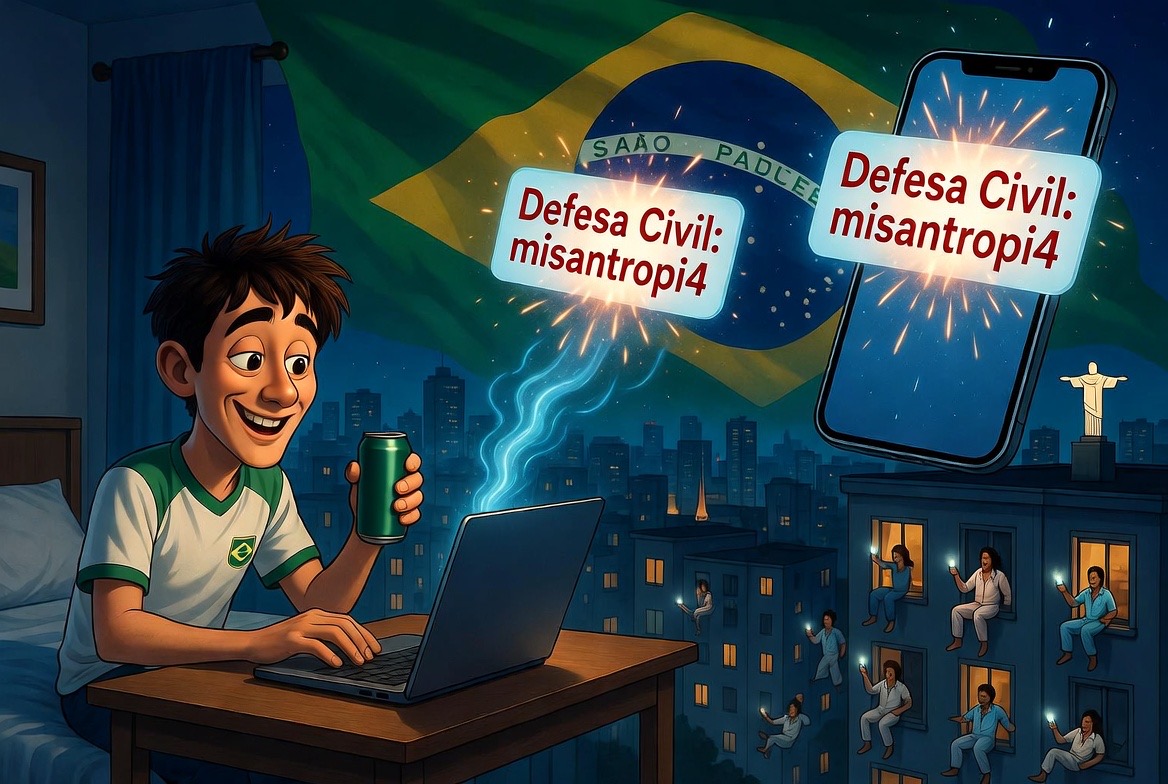
In the early hours of June 20, 2026, phones across multiple Brazilian states suddenly blared with an “Extreme Alert” from Civil Defense. The message was stark and cryptic: variations of “Defesa Civil: misantropi4.” Millions were jolted awake by the loud, overriding notification that bypasses silent mode. For a few tense minutes, it felt like a genuine disaster warning — floods, landslides, or something worse.
It wasn’t. It was the work of one individual who simply decided he could do it.
The platform, Defesa Civil Alerta, is designed for real emergencies. It uses Cell Broadcast technology to push urgent messages directly to phones in targeted areas. On that night, someone remotely triggered multiple alerts without authorization. Authorities quickly confirmed it was unauthorized, shut the system down around 1:30 a.m., and called in the Federal Police. A new, more secure version of the platform, already in development, was fast-tracked.
What stands out is not sophisticated hacking prowess, but pure audacity.
The person behind it — who later posted on X under the handle associated with the incident — described the action in disarmingly casual terms. Leaked or weak credentials were apparently enough. No elaborate zero-day exploit. No months of reconnaissance. Just access that existed because it hadn’t been properly locked down, and the decision to use it. He framed it as something basic, something “anyone with time” could have done, done partly out of boredom after watching a soccer match.
That’s the audacity: the quiet permission he gave himself. In an era of constant warnings about cyber threats, fortified systems, and government digital infrastructure, one person looked at a national emergency alert tool and thought, “Why not?” He didn’t need to be a master hacker. He only needed the system to have left the door ajar — and the willingness to walk through it.
The immediate fallout
The reaction was exactly what you would expect from a system meant to save lives. People in Paraná, São Paulo, Rio de Janeiro, Brasília, and other areas reported panic. Some thought real emergencies were unfolding. The alerts interrupted sleep, conversations, and daily life with the same urgency reserved for genuine threats. Officials were clear: this was not an official message. The platform was taken offline as a precaution while security was assessed.
The exposure was swift and public. Within hours, the incident dominated conversations. It highlighted how a critical public safety tool could be commandeered remotely. It also showed the speed of modern information flow — the same person who triggered the alerts was soon sharing details and commentary online.
Was it worth it?
This is where the story moves from technical breach to judgment call.
On one side, the audacity achieved something real. It forced an immediate response. A system that should have been more robust was exposed in the most public way possible. Authorities acknowledged the intrusion, disabled the affected service, and prioritized security upgrades. In a country where debates about the reliability of public digital systems (including voting infrastructure) are ongoing, a live demonstration that even an emergency alert platform had gaps carries weight. Complacency is expensive; visible failure can be a catalyst.
On the other side, the cost was real disruption and fear. Emergency systems exist precisely because seconds and minutes matter in crises. Triggering them falsely erodes public trust. The next time a genuine alert sounds, some people may hesitate or dismiss it. That trust, once damaged, is hard to rebuild. For the individual involved, the short-term thrill of notoriety and memes comes with longer-term legal exposure. Unauthorized access to critical infrastructure is not a victimless prank in most jurisdictions, and investigations are underway.
The “he allowed himself to do it” element cuts both ways. It reveals how thin the line can be between “secure enough” and “wide open” when basic controls like credential hygiene and access restrictions are neglected. At the same time, it shows the recklessness of exercising that access without regard for consequences. Audacity without accountability often produces spectacle more than sustainable change.
A broader reflection
This episode is a snapshot of our digital moment. Government systems are increasingly central to public life, yet many were built or maintained with assumptions of limited threat or limited curiosity from outsiders. One person’s casual decision punctured that assumption.
Whether it was “worth it” depends on what you value. If the goal was maximum attention with minimum technical skill, it succeeded dramatically. If the goal was responsible security improvement without collateral panic, the method was crude and costly.
The real test will come in the weeks and months ahead. Will the incident lead to meaningful, transparent hardening of critical systems — or just another round of temporary fixes and forgotten lessons? Will the individual face meaningful consequences, or become another fleeting internet legend?
In the end, the story isn’t really about one clever (or opportunistic) person. It’s about how easily systems we rely on for safety can be bent by someone who simply decides the rules don’t apply to them in that moment. The audacity was real. The question of whether it justified the disruption it caused remains open — and probably will for some time.
Brazil’s emergency alert platform will eventually come back online, hopefully stronger. The conversation it sparked about digital resilience, however, may prove harder to turn off.