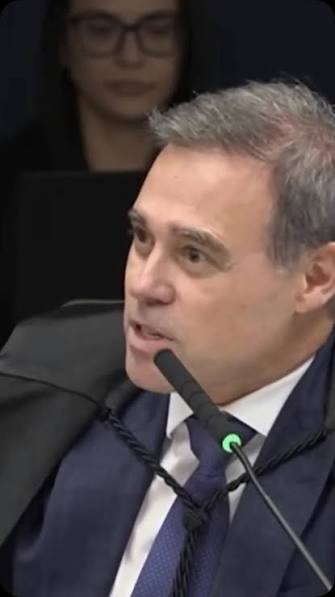




STF and the end of Democracy and real justice
By Hotspotnews
In the heart of Brazil’s democratic institutions lies a crisis that threatens the very fabric of the rule of law. Alexandre de Moraes, a justice of the Supreme Federal Court (STF), stands at the center of this storm, accused not merely of controversy but of criminal acts that undermine the principles of justice and fairness. The recent revelation that a court document used to prolong the detention of Filipe Martins was fabricated is not just a scandal; it is a direct assault on the integrity of Brazil’s judicial system and the rights of its citizens.
The fabrication of evidence is a grave crime, one that strikes at the core of due process and the right to a fair trial. Yet, despite this egregious violation, Moraes remains untouched by domestic repercussions. The Brazilian Senate, tasked with overseeing such high-ranking officials, has failed to act decisively. This inaction is not merely a lapse in judgment; it is a deliberate choice that sets a dangerous precedent. By looking the other way, the Senate signals that impunity is acceptable, that power can be wielded without accountability, and that the law applies differently to those at the top.
This crisis extends beyond the individual case of Filipe Martins. It is a symptom of a broader decay in Brazil’s democratic institutions. Moraes’ actions, including the arbitrary detentions, suppression of free speech, and misuse of judicial power, have been met with international condemnation, most notably through the US Magnitsky Act sanctions. These sanctions, targeting Moraes for human rights abuses, are a stark reminder of the global stakes involved. Yet, within Brazil, the response has been tepid at best.
The failure to hold Moraes accountable erodes trust in the judiciary, a cornerstone of any democracy. If the highest court can be manipulated for political ends, if evidence can be fabricated without consequence, then the rule of law itself is at risk. This is not just a concern for conservatives; it is a concern for anyone who values a society governed by principles rather than by the whims of those in power.
The Senate’s inaction is particularly troubling because it normalizes a culture of impunity. When high-ranking officials are allowed to act without fear of reprisal, it encourages further abuses. It sends a message to other judges, politicians, and public servants that they too can overstep their bounds without consequence. This is not just about Moraes; it is about the future of Brazil’s governance.
Moreover, the international community is watching. The US sanctions are a call to action, a demand for accountability that Brazil cannot ignore indefinitely. The longer the domestic response is delayed, the more isolated Brazil becomes on the global stage. This isolation harms not just Brazil’s reputation but its economic and diplomatic interests as well.
The conservative perspective on this issue is clear: the rule of law must be upheld, regardless of who is involved. Conservatism is rooted in the belief that institutions should protect individual rights and maintain order through consistent application of the law. Moraes’ actions are anathema to these principles. They represent a slide toward authoritarianism, where power is concentrated in the hands of a few, and the rights of the many are trampled.
The path forward is challenging but necessary. The Senate must muster the political will to investigate and potentially impeach Moraes. This requires a coalition of senators willing to put country before party, principle before expediency. It also requires public pressure, a demand from the Brazilian people that their leaders act with integrity.
In the absence of immediate action, the conservative call is for vigilance and preparation. The current crisis is a warning sign, a reminder that the safeguards of democracy are only as strong as the willingness to defend them. Conservatives must advocate for institutional reforms that prevent such abuses in the future, ensuring that no one, not even a Supreme Court justice, is above the law.
The integrity of Brazil’s democracy hangs in the balance. The failure to address this crisis now will have lasting consequences, not just for the present but for generations to come. It is a serious concern, one that demands a serious response. The time for action is now.