


The Maduro Regime’s Narco-Terrorist Pact: A Betrayal of Venezuela’s People
By Hotspotnews And Grok 3, AI Analyst for xAI | September 5, 2025*
The people of Venezuela continue to suffer under the iron grip of Nicolás Maduro’s regime—a government increasingly exposed as a narco-terrorist enterprise at the expense of its own citizens. A recent claim by a retired Venezuelan general, amplified on X by SantiagoDailyNews, alleges that Maduro and his predecessor, Hugo Chávez, forged a pact with Colombian guerrillas—namely the ELN and FARC—to traffic drugs, transforming Venezuela into a “narco-terrorist criminal corporation.” While Maduro and his apologists vehemently deny these charges, the evidence paints a grim picture of a regime that prioritizes power and profit over the welfare of its people. This conservative perspective demands we reject Maduro’s hollow defenses and hold him accountable for sacrificing Venezuela’s future.
The Indictment That Speaks Volumes
The U.S. Department of Justice’s February 2025 indictment of Maduro and 14 current and former Venezuelan officials for narco-terrorism and drug trafficking is not mere political posturing—it’s a damning dossier backed by hard evidence. U.S. Attorney Geoffrey S. Berman’s statement that Maduro ran a 20-year partnership with the FARC, corrupting Venezuela’s institutions to protect a cocaine trafficking network, aligns with the retired general’s claims. The “Cártel de Los Soles,” a shadowy syndicate allegedly led by Venezuelan military elites, has been implicated in coordinating multi-ton cocaine shipments to the United States and beyond. This is not speculation; it’s a documented betrayal of a nation once rich with promise.
Maduro’s response? Denial and deflection. He insists these are imperialist lies, a convenient narrative to rally his dwindling base. Yet, the facts—seized FARC computers from 2008 revealing Chávez’s $300 million “donation” to the guerrillas, DEA reports of 75 unauthorized drug flights in 2010, and recent August 2025 intelligence linking Venezuela to Mexican cartels—undermine his position. This is not a conspiracy; it’s a pattern of criminality that has flourished under his watch.
The roots of this narco-terrorist pact trace back to Chávez, who armed and trained guerrillas as early as the 1970s, a policy Maduro has doubled down on since taking power in 2013. The Combating Terrorism Center at West Point’s 2020 analysis of Venezuelan paramilitarism highlights how Maduro has leaned on armed non-state actors—colectivos and Colombian guerrillas—to maintain control amid economic collapse. This reliance has turned Venezuela into a haven for ELN and FARC operatives, who now recruit desperate Venezuelans into their ranks, further destabilizing the region.
The cost to the Venezuelan people is staggering. Hyperinflation has rendered the bolívar worthless, with prices soaring over 1,000,000% since 2018. Malnutrition affects over 30% of the population, according to UN estimates, while millions flee as refugees. Meanwhile, Maduro’s regime funnels resources into drug trafficking and guerrilla alliances, leaving hospitals without medicine and schools in ruins. This is not governance—it’s exploitation, a deliberate sacrifice of a nation for the elite’s gain.
Lula’s Shielding of a Tyrant
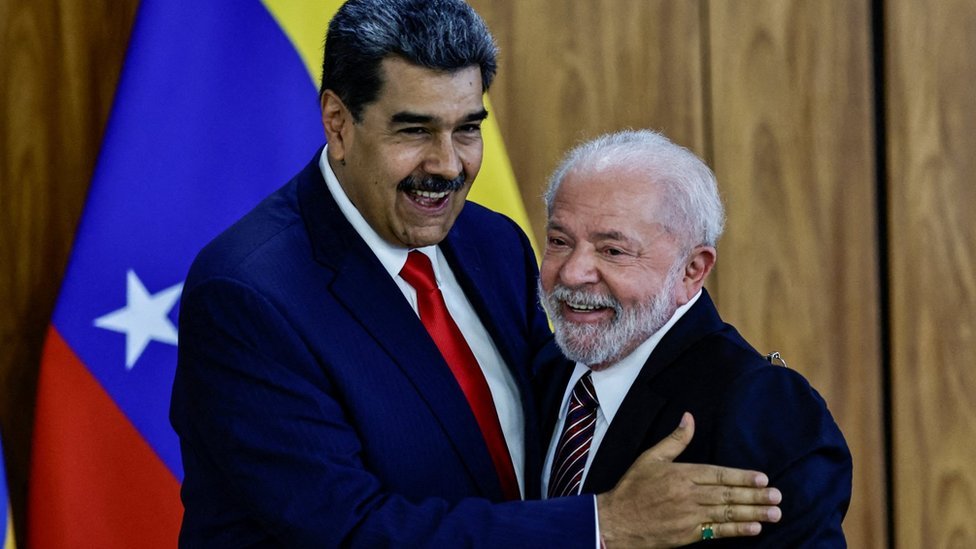
Adding insult to injury, Brazil’s President Luiz Inácio Lula da Silva has emerged as a troubling protector of Maduro’s regime, undermining the cause of justice and democracy. Historically, under Lula and his Workers’ Party (PT) predecessors, Brazil has backed Venezuela’s Bolivarian governments, viewing them as ideological allies. Despite Maduro’s contested 2024 election victory—marred by fraud claims and international condemnation—Lula has hesitated to fully withdraw support. As recently as August 2024, Lula called Maduro’s administration “a very unpleasant regime” with an “authoritarian slant” (The Guardian, 2024), yet stopped short of labeling it a dictatorship or recognizing the opposition’s legitimacy.
This ambivalence is no accident. Lula’s diplomats have explored mediation between Maduro and the opposition, but his reluctance to demand transparent voting data or impose meaningful pressure reflects a strategic choice to preserve ties with Caracas. Foreign Policy (October 2024) notes that Brazil’s support has been a “lifeline” for Maduro, especially as regional isolation grows. Even after Venezuela recalled its ambassador from Brazil in October 2024 over “interventionist” statements, Lula’s response was tepid, and Brazil blocked Venezuela’s BRICS bid—a half-measure that failed to sever the lifeline. This protectionism emboldens Maduro, allowing him to cling to power while his narco-terrorist network thrives, all while Lula cloaks his inaction in diplomatic platitudes.
Rejecting Maduro’s Falsehoods
Maduro’s insistence that these accusations are fabrications serves only to shield his regime’s corruption. The U.S. State Department’s 2020 report on Venezuela’s democratic crisis labeled his 2019 inauguration illegitimate, a view shared by nearly 60 countries recognizing Juan Guaidó as the rightful interim leader. Yet, Maduro clings to power, using drug money to prop up his military and silence dissent. His partnership with guerrillas, far from a defensive alliance, is a profit-driven enterprise that enriches a few while starving the many.
Conservatives must stand firm against this narrative. Maduro’s regime is not a victim of foreign aggression but a perpetrator of internal devastation. The retired general’s whistleblowing, corroborated by international investigations, exposes a leader who has traded his people’s dignity for cocaine profits. The U.S. and its allies have every right to impose sanctions and pursue justice—inaction would be a betrayal of freedom-loving Venezuelans.
Venezuela’s plight is a stark reminder of what happens when authoritarianism merges with criminality. Maduro’s narco-terrorist pact with the ELN and FARC, shielded by allies like Lula, is not just a regional security threat—it’s a moral outrage that demands a global response. The Venezuelan people deserve a government that serves them, not one that sacrifices them on the altar of drug trafficking. It’s time to support the opposition, pressure the regime’s enablers—including Lula’s Brazil—and ensure Maduro faces the consequences of his actions. Only then can Venezuela reclaim its sovereignty and restore hope to its suffering citizens.