




The Miami Conversation: Flávio Bolsonaro on Capture, Fraud Claims, and Remote Opposition
By Hotspotnews
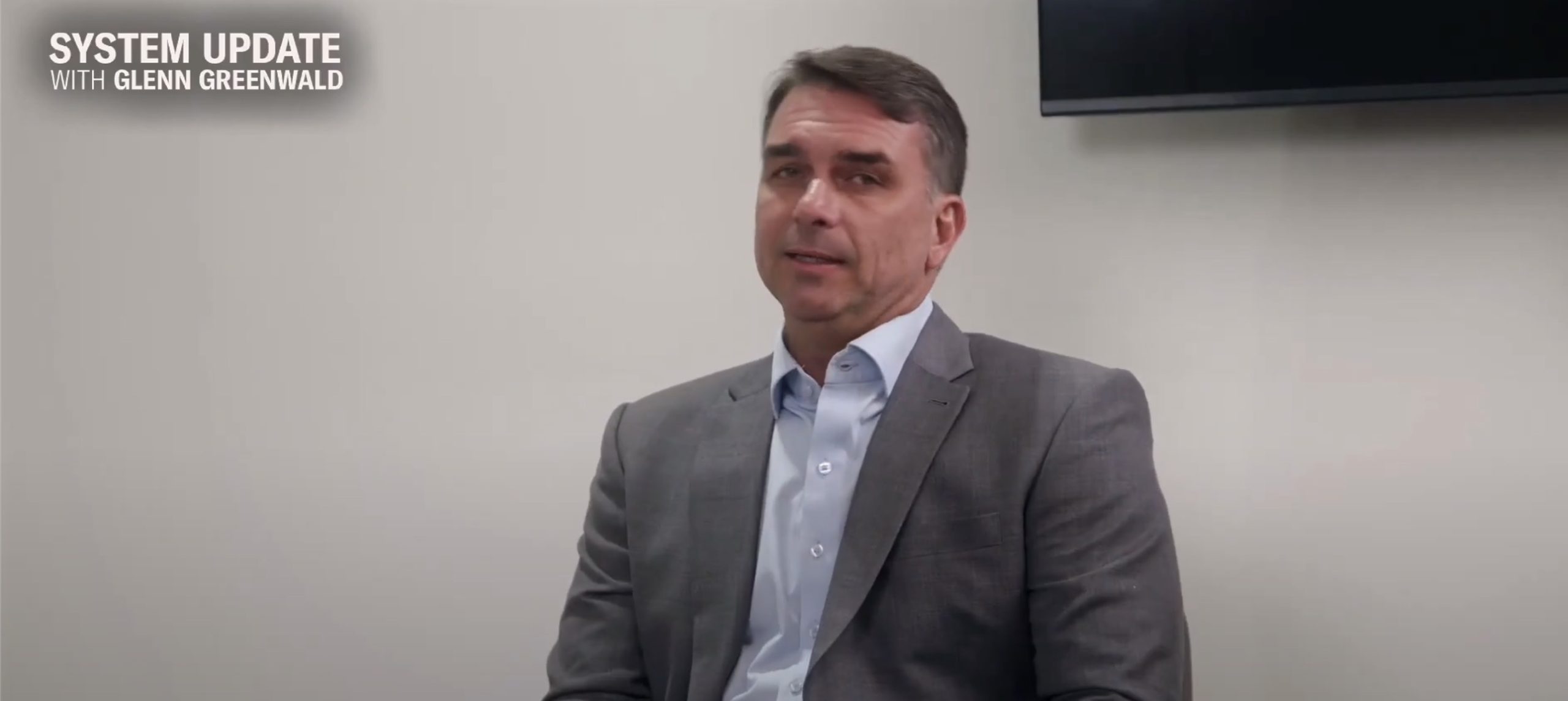
Based on Glenn Greenwald’s interview with Flávio Bolsonaro in Miami
Glenn Greenwald’s interview with Flávio Bolsonaro, recorded in Miami shortly after the Brazilian presidential election, presents the senator’s account of why he left the country, how he views the institutions that remain, and what he intends to do next. The conversation runs nearly an hour and covers the mechanics of his departure, the status of investigations against him and his family, the outcome of the election, and his assessment of the Brazilian state.
Bolsonaro frames his exit as a deliberate choice made with his family after the results were certified. He states that he did not flee because he feared a legitimate investigation but because he concluded that several key institutions—the Supreme Federal Court, the Superior Electoral Court, the Federal Police, and the Federal Public Ministry—had been effectively subordinated to the executive and to Justice Alexandre de Moraes. In his telling, processes against political opponents are no longer genuine inquiries but predetermined outcomes. He cites the sequence involving his father and his brother Eduardo as evidence: once an adversary is identified, the procedural path is already fixed. He notes that Moraes ordered him to surrender his passport within minutes of the electoral court’s formal declaration of the result, which he interprets as confirmation that the measure had been prepared in advance. He adds that he left Brazil with only a driver’s license and entered the United States with his passport, asserting that the departure itself complied with the law even if the surrounding circumstances were hostile.
On the investigations themselves, Bolsonaro denies receiving personal funds from Daniel Vorcaro in connection with a film about his father. He says any money went to the production company under a private investment contract that anticipated a share of profits, and that a later police statement confirmed the resources were used for the film without any public money or quid pro quo tied to his Senate position. He acknowledges that an earlier public denial occurred because of a confidentiality clause. He maintains that he has never been charged or convicted, that he has no criminal exposure on the film matter, and that the broader pattern of inquiries functions as political pressure rather than fact-finding. He further argues that Moraes should be subject to impeachment proceedings under the existing law governing crimes of responsibility by Supreme Court ministers whenever a justice participates in cases in which he is demonstrably interested or conflicted; he cites the alleged involvement of Moraes’s wife with Banco Master as one illustration. He applies the same standard to other ministers, including those appointed by his own father, stating that no one is above the law.
The interview also addresses how Bolsonaro intends to support himself and his family in the United States. He says his principal current income comes from private legal practice and business activity rather than his Senate salary, and he points to a graphene-products company he owns as one example of non-political enterprise. He acknowledges that living costs in Miami are high and that the depreciation of the real increases the burden, but he states that existing reserves are sufficient for the near term while he regularizes his immigration status and continues working. He insists he will not resign his Senate seat and will vote remotely whenever the chamber permits it, citing a recent remote vote on a public-security constitutional amendment as proof that participation remains possible. He declines to detail the logistics or financing of the private aircraft used for the trip, arguing that naming anyone involved would expose them to the same institutional pressure he left behind.
On the election, Bolsonaro does not claim in the final published version of an earlier letter that he is the legitimate winner. He does, however, express strong skepticism about the two-hour extension of voting in Bahia ordered by Justice Zanin minutes after the scheduled close of polls, and about the size of Lula’s second-round vote increase relative to the first round. He notes that the total votes received by all other first-round candidates were roughly nine million, while Lula’s total rose by more than ten million; he finds no campaign event or debate performance that accounts for the shift and observes that the increase occurred in states where his own coalition had performed strongly in gubernatorial and senatorial races. He distinguishes between the narrow set of additional ballots cast during the extension (approximately thirty-four thousand) and the larger question of what occurred inside the electoral authority’s systems during those two hours. He states that he will not pursue a legal challenge inside Brazil on grounds of electronic fraud because prior attempts produced only fines against his party and no independent audit, and because such claims are treated as attacks on democracy. His stated legal strategy is instead to contest what he describes as abuse of economic power: the use of more than 450 billion reais in public spending and benefit expansions during the campaign period. He argues that comparable or smaller uses of public resources have led to the cassation of governors in the past, and that the same standard should apply.
Throughout, Bolsonaro presents himself as continuing a fight that cannot be conducted safely inside the country. He says he left “for Brazil,” not from it, and that he expects to remain abroad until the institutional environment changes. He notes that his brother Eduardo is already in the United States under similar constraints and that his father remains imprisoned after a conviction he regards as the product of a fabricated process. He treats the 8 January events as another element of that process rather than an independent criminal episode. He acknowledges that some allies publicly criticized an earlier draft letter in which he appeared to claim the status of elected president; he attributes those criticisms to fear of institutional retaliation and says he himself has the latitude, outside Brazil, to state his reservations without immediate consequence.
The interview leaves several practical questions open. Bolsonaro provides no independent verification of the film-related contracts or the precise source and amount of the reserves he cites. He offers no documentary evidence of the timing or content of the Moraes passport order beyond his own description of the sequence. His critique of the electoral process rests on statistical anomalies and the absence of a paper audit trail rather than on demonstrated alterations of specific ballots. At the same time, the conversation supplies a coherent internal logic: if the institutions that would adjudicate any challenge are the same ones he regards as captured, then remaining inside their jurisdiction is, in his view, irrational. Greenwald presses on financing, travel logistics, and the consistency of Bolsonaro’s earlier statements; the answers are largely declarative rather than evidentiary. The resulting portrait is of a politician who treats physical presence in Brazil as incompatible with continued political activity, who maintains a residual Senate role at a distance, and who locates the possibility of future electoral competition in a change of institutional conditions that has not yet occurred.
Based on Glenn Greenwald’s interview with Flávio Bolsonaro in Miami, this analysis examines the senator’s account of why he left Brazil, his claims of institutional capture, doubts about the election, and his plans to continue Senate work from abroad.
#FlavioBolsonaro #GlennGreenwald #Brazil #BrazilianPolitics #MiamiInterview #Election #Politics #Bolsonaro #RemoteOpposition #InstitutionalCapture #BrazilElection


