




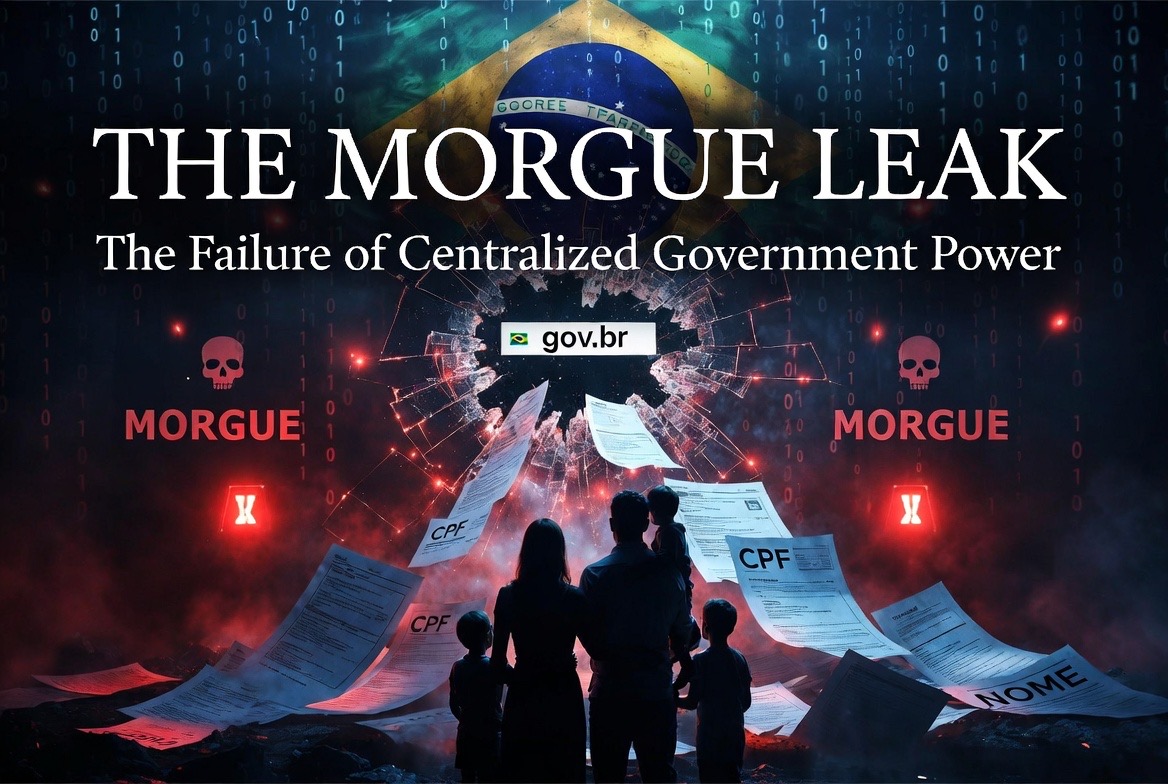
The “MORGUE” Leak: While the Government Centralizes Everything on gov.br, Criminals Laugh and Sell 251 Million Brazilians’ Data for Just $500
By Hotspotnews, Brasília, April 19, 2026
In the age of the so-called “inclusive digital state,” Brazil has once again been reminded of a harsh truth: Big Brother government doesn’t protect citizens — it exposes them. A massive database nicknamed “MORGUE” — containing 251.7 million CPF records, more than Brazil’s entire living population — is now being sold on the dark web for a mere US$ 500 in Bitcoin. Full names, parents’ names, dates of birth, gender, race, place of birth, and even death flags. All allegedly pulled from or linked to the gov.br portal, the government’s much-celebrated “single gateway” for public services.
This is not an isolated incident. It is the latest symptom of a deeply flawed model that concentrates power, data, and responsibility in Brasília, while turning the average Brazilian into an easy target for fraud, Pix scams, and identity theft. The sarcastic post by federal deputy Dr. Paulo Faria on X captured the national mood perfectly: “Legal! Nice going, irresponsible government!”
While the same state that cannot even secure a basic citizen registry continues to push for ever-greater control over Brazilians’ financial lives and elections, conservatives warn: Centralization is not efficiency — it is vulnerability. The more the government hoards data, the more it turns privacy into a public commodity and security into an empty promise.The “MORGUE” Leak: Proof That Big Government Data Centralization Is a Danger, Not a Solution
While the federal government boasts about turning gov.br into the “single entry point” for all public services, reality has just exploded in the face of 251 million citizens: a database called “MORGUE” — larger than Brazil’s living population — is for sale on the dark web for a pitiful $500. Full names, CPFs, family information, dates of birth, gender, race, city of birth, and death flags. The sarcasm from Deputy Dr. Paulo Faria on X summed up the national feeling: “Legal! Nice going, irresponsible government!”This is not the first leak. It is merely the latest chapter in a recurring saga since 2021: Serasa, the Ministry of Health, Receita Federal, and the Superior Electoral Court have all let hundreds of millions of Brazilian records slip away. What changes now is the scale and the arrogance: the very State that centralizes everything in the name of “efficiency” and “digital inclusion” cannot protect even the basics. And it still has the audacity to demand more power — including over cryptocurrencies, Pix, and financial transactions.
From a conservative viewpoint, this is not a “technical accident.” It is the predictable consequence of a statist ideology that treats the citizen as mere data in a government database. The more the government centralizes, the more it turns privacy into a public asset and security into a hollow promise. gov.br is not modernization; it is a colossal single point of failure, an open invitation to criminals, and a systematic violation of the liberal-conservative principle that the State exists to serve the individual, never to control him.
Real Consequences for the Average Brazilian
With a leaked CPF, anyone can:
• Open bank accounts or request payroll loans in your name;
• Commit Pix fraud or “emergency aid” scams;
• Create ghost companies or file fake tax returns;
• Sell your data for personalized phishing attacks.
And the worst part: the citizen is left to prove their innocence afterward. The State, as always, will wash its hands and say it is “investigating.”
Meanwhile, the same government that cannot protect basic personal data insists on maintaining its monopoly on electronic voting machines and swears the “system is inviolable.”
The contradiction is obvious: if they cannot even secure CPF records, how can we trust electoral or digital surveillance systems?
Conservative Alternatives: Less State, More Freedom and Individual Responsibility
Complaining is not enough. Brazilian conservatism, faithful to the tradition of defending private property, family, and limited government, must propose concrete paths. Here are real, urgent alternatives that run counter to petista or progressive centralization:
1. Radical Decentralization of Data End the “everything on gov.br” model. Return management of citizen records to states and municipalities, with minimal and audited interoperability. Less Brasília, more Brazil — exactly as conservatives have defended with “More Brazil, Less Brasília.” Federalism is not decoration; it is the antidote to centralizing inefficiency.
2. Sovereign Digital Identity (Self-Sovereign Identity – SSI) Instead of the government storing all your data, citizens control their own digital identity through blockchain or verifiable credentials technology. You decide what to share and with whom. Countries like Estonia are already advancing this; Brazil, with its strong private tech sector, could lead Latin America. The State only validates — it does not store.3. Mandatory Data Minimization by Public Authorities The LGPD (General Data Protection Law) needs real teeth: severe penalties for government agencies that collect more data than strictly necessary. CPF for voting? Yes. Centralized CPF + race + family + death records for “facilitating services”? No. Less data = less risk.
4. Real Empowerment of the Citizen, Not the Bureaucrat Expand and automate tools like BC Protege+ and CPF protection against unauthorized inclusion in CNPJs. Create a true “right to property over one’s own data”: any government leak triggers automatic compensation to the affected party, paid from the responsible agency’s budget — not the taxpayer’s pocket.
5. Partnerships with the Private Sector and Independent Audits Replace state monopoly with competitive bidding for cybersecurity services to proven private companies. Require mandatory external audits (including by neutral foreign firms) and quarterly public security reports. The market punishes inefficiency; the State does not.
6. Digital Self-Defense Education as State Policy National campaigns teaching Brazilians to use 2FA, password managers, crypto self-custody, and Serasa/Boa Vista monitoring. Conservatives believe in responsible individuals and families — not in the “savior State.”
The conservative message is clear: the problem is not technology. It is the size and arrogance of the State. Every new leak proves that the path of centralization leads to vulnerability, corruption, and loss of freedom. Brazil does not need more gov.br. It needs less government meddling in every citizen’s life.While leftism celebrates the “strong State,” conservatism defends the strong citizen. The “MORGUE” leak is not a technical failure. It is the ideological failure of the centralizing model. It is time to change course — before the next “MORGUE” includes our bank accounts, our votes, and our family privacy.
A Brazil that respects the individual begins with the effective protection of its citizens’ data. Everything else is empty talk from those who want more power.