




- The “No Kings” Movement: Unveiling a Society Without God, Law, Order, or Purpose – A Path to Total Chaos and the Doom of America
By Hotspotnews
The “No Kings” protests that erupted across America on March 28, 2026, were presented by organizers as a noble defense of democracy against tyranny. They claimed millions of participants in over 3,300 events nationwide, drawing on the rhetoric of America’s founding to reject any hint of executive overreach. Yet what unfolded was far more revealing—and alarming—than a simple policy disagreement. Beneath the chants and signs lay a coordinated vision of a society deliberately stripped of God, law, order, and any transcendent purpose. This is not patriotic resistance; it is a blueprint for total chaos that, if unchecked, points straight to the doom of the American republic.
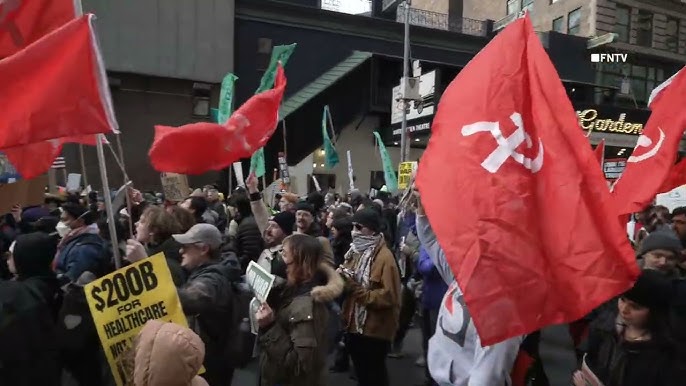
A deep investigation exposed the machinery behind these demonstrations: a network of roughly 500 activist groups boasting an estimated $3 billion in combined annual revenues. Professional logistics—pre-printed signs, training sessions, synchronized digital campaigns, and permits—made clear this was no organic uprising of everyday citizens. Indivisible, a well-funded progressive organization with ties to billionaire George Soros and his Open Society Foundations, coordinated the flagship event in St. Paul, Minnesota. More troubling still, radical socialist and communist factions played a prominent role. These included groups backed by Neville Roy Singham, an American tech tycoon and avowed Marxist now living in China, who has poured hundreds of millions into revolutionary causes over nearly a decade. At events in New York City and elsewhere, participants openly waved hammer-and-sickle communist flags while chanting for “revolution.” In Washington, D.C., and other locations, the flag of Iran’s Islamic Republic appeared alongside anti-Israel and anti-enforcement messaging. The contradiction could not be starker: protesters decrying “kings” in the White House while embracing symbols of atheistic totalitarianism and theocratic oppression.
This coalition did not emerge by accident. It reflects a deeper ideological project that rejects the very foundations of American civilization. The Declaration of Independence affirmed rights endowed by a Creator, not granted by government or majority whim. The Constitution enshrined ordered liberty—freedom restrained by law, morality, and personal responsibility. The Founding Fathers, drawing from Judeo-Christian heritage and classical wisdom, understood that self-government demands self-restraint. Without an internal moral compass—often rooted in faith—external coercion or anarchy fills the void. Yet the radical edge of “No Kings” advances the opposite gospel: absolute personal autonomy with no reciprocal duties. “Allow everything” becomes the mantra—no meaningful borders, minimal law enforcement, no traditional religion in public life, and no conservative leadership defending timeless principles of work, family, and accountability.
Consider the cultural demands interwoven with the protests. Absolutist defenses of abortion treat the ending of developing human life as mere healthcare, downplaying ethical weight and fetal development. pushes for rapid gender medical interventions on minors often bypass parental authority and ignore mounting evidence from Europe—such as the Cass Review in Britain and restrictions in Sweden, Finland, and Norway—highlighting weak long-term benefits, comorbidities like autism or trauma, risks of infertility and regret, and the reality of biological sex as binary for the vast majority. Strict secularism sidelines prayer, faith symbols, or religious objections in schools and institutions, even as the same crowds tolerate or celebrate foreign theocracies. Communist flags at the rallies glorify systems that systematically denied God, closed churches, and slaughtered millions under the banner of class struggle. Iranian regime flags celebrate a government that stones women, hangs gays, and exports terror. This selective blindness—condemning American order while romanticizing failed or oppressive alternatives—reveals not tolerance, but a deliberate erosion of the common good.
Such a society cannot long survive. Human nature and history both testify to the necessity of guardrails. Anarchy, in its pure form or disguised as anti-police disruption, has never scaled. Short-lived experiments in Spain, Ukraine, or the Paris Commune dissolved into infighting and conquest by stronger forces. Socialism, with its central planning and heavy redistribution, has left a trail of devastation: the Soviet Union and Maoist China produced famines and gulags; Venezuela, once Latin America’s richest nation, collapsed into hyperinflation, shortages, mass exodus, and authoritarianism under “21st-century socialism,” with food production plummeting and basic services failing despite vast oil wealth. Pre-Milei Argentina suffered repeated cycles of fiscal irresponsibility and poverty. These were not accidents of circumstance but predictable outcomes when incentives for work and innovation erode, property rights weaken, and elites consolidate power in the name of equality.
Americans sense this truth instinctively. That is why leaders who prioritize law and order have delivered tangible results. In El Salvador, President Nayib Bukele inherited a nation terrorized by gangs like MS-13, with homicide rates exceeding 100 per 100,000. His aggressive crackdown—mass arrests and a state of exception—slashed murders by over 98 percent, turning one of the world’s most dangerous countries into one of its safest in the region. Critics decry due-process concerns, yet Salvadorans rewarded him with landslide reelection because safety restored dignity and hope. In Argentina, Javier Milei confronted near-300 percent hyperinflation and chronic deficits from Peronist-style policies. His austerity measures, spending cuts, and deregulation began reversing the spiral, producing fiscal surpluses and slowing inflation, even amid short-term pain. Voters turned to him after repeated failures of expansive government without accountability. Here at home, President Trump’s emphasis on border enforcement, energy production, deregulation, and rule of law resonates for the same reason: majorities want secure communities, fiscal sanity, controlled immigration, and policies that reward responsibility rather than subsidize disorder.
The “No Kings” vision ignores these lessons at our peril. Many ordinary participants—swept up in social-media validation, slogan energy, or a fleeting sense of moral purpose—struggle to articulate specific alternatives when pressed. They show up for the optics, the community, or even incentives within activist networks, then disperse to the next trending cause, forgetting the disruption left behind. The big-money funders, however, play a longer game. Insulated by wealth, private security, and global mobility, they advance agendas of transformation: weakening national sovereignty, redefining family and human nature, and fostering dependency over self-reliance. They profit from—or at least remain untouched by—the chaos that follows eroded institutions, whether through policy gridlock, cultural fragmentation, or economic strain. Ordinary families bear the cost: higher crime in areas with lax enforcement, strained public services from uncontrolled migration, mental health crises among youth amid rapid norm shifts, and declining social trust that undermines the very progress they claim to seek.
Without God—or any higher moral anchor—conscience atrophies, replaced by relativism where “my truth” justifies any excess. Without law and order, predators thrive while the law-abiding subsidize the breakdown. Without purpose—productive work, stable families raising resilient children, communities bound by shared values—society fragments into isolated individuals chasing fleeting desires. Fertility rates decline, innovation stagnates as accountability vanishes, and resource competition grows desperate. We edge toward the nightmare of a hollowed-out nation: not the vibrant republic of opportunity, but a land where trust evaporates and survival instincts turn primal—”zombies killing each other for food,” as the breakdown of civilization has manifested in collapsed societies throughout history.
This is not innovation or compassionate progress; it is regression dressed in revolutionary garb. Genuine change—advancing technology, expanding liberty, improving lives—thrives under ordered liberty, evidence-based policy, and accountability. It requires debate on merits: secure borders that balance compassion with sovereignty; abortion limits reflecting both women’s dignity and the unborn’s humanity; parental rights and therapy-first approaches for distressed youth rather than ideological pipelines; space for faith without coercion. The “No Kings” movement, by normalizing fringe symbols and “no enforcement” demands, accelerates the opposite trajectory.
Americans do not want this future. Polls and elections consistently show majority support for functional basics: safe streets, strong families, fiscal responsibility, controlled immigration, and the freedom to live by conscience. The successes of Bukele, Milei, and Trump reflect a national hunger for restoration—for self-preservation at the societal level. The “No Kings” spectacle has inadvertently performed a public service: it has unmasked the endgame of radical transformation. A society without God slides into moral drift. Without law and order, predation rules. Without purpose, emptiness and decline follow.
We stand at a decisive crossroads. Will we reaffirm the principles that forged this exceptional nation—personal responsibility, ordered liberty under law, secure borders, strong families, and voluntary moral accountability—or yield to the funded forces of chaos? The protests may fade from headlines in weeks, as participants chase the next cause, but the stakes endure. Corporate America and everyday citizens increasingly recoil from association with communist optics and revolutionary excess. Exposure of the money trail and fringe symbols hastens accountability.
Law and order must prevail through consistent, fair enforcement. Borders must regain meaning to protect communities and resources. Families must be fortified as the primary transmitters of virtue and resilience. Faith, in its free and private expression, must remain a bulwark against nihilism. Anything less invites the very doom the radicals unwittingly advertise. America was not built on license or grievance; it was built on responsibility and purpose. Her people—grounded in common sense and historical memory—must demand a return to those roots before the window closes. The republic’s survival depends on it.