



Lawfare Against Conservative Momentum: The PT’s Legal Offensive Over Milei’s Appearance at the PL Convention
By Hotspotnews
In the opening days of Brazil’s 2026 presidential race, the Workers’ Party (PT) has once again turned to the machinery of the state to confront a rising conservative challenge. Within hours of the Partido Liberal (PL) national convention that formally nominated Senator Flávio Bolsonaro as its presidential candidate, PT lawmakers filed formal complaints with the Procuradoria-Geral da República (PGR) and electoral authorities. Their target: the presence and speech of Argentine President Javier Milei, alongside the exhibition of an artificial-intelligence video featuring former President Jair Bolsonaro.
The episode crystallizes a deeper pattern. When the Brazilian right builds international alliances and projects strength, the left reaches for legal instruments to constrain it. What is presented as a defense of electoral purity functions, in practice, as an attempt to criminalize political expression and transnational conservative solidarity.
The Convention and Milei’s Role
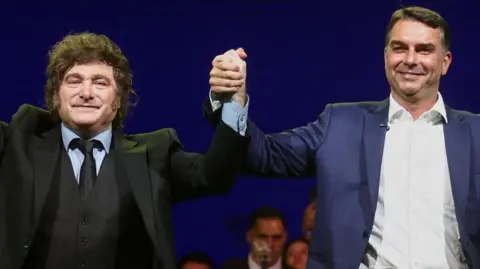
On July 25, 2026, the PL gathered in São Paulo to confirm Flávio Bolsonaro as its standard-bearer against President Luiz Inácio Lula da Silva. The event featured the expected domestic figures—Governor Tarcísio de Freitas, São Paulo Mayor Ricardo Nunes, and party leaders—alongside a clear international signal. Argentine President Javier Milei, the most prominent free-market conservative leader in Latin America, attended as an invited guest.
Milei delivered a forceful address. He praised the ideas of liberty, warned against the failures of socialism, endorsed Flávio as the candidate capable of stopping Lula’s project, and sharply criticized both the Brazilian president and Supreme Court Justice Alexandre de Moraes. He also expressed solidarity with Jair Bolsonaro, describing his detention as unjust. The speech was partisan, unapologetic, and delivered from the stage of a Brazilian party convention. In addition, organizers played an AI-generated video that simulated Jair Bolsonaro’s voice and image offering support to his son.
Milei had been formally invited by PL organizers. Brazilian authorities had been notified through diplomatic channels. The Argentine president’s visit was no secret, and the federal government had previously indicated it saw no inherent problem with his presence, though it reserved the right to respond to comments on domestic Brazilian affairs.
The PT Complaints
PT deputies, led by Lindbergh Farias of Rio de Janeiro and including Dandara Tonantzin and others, moved quickly. They submitted representations to the PGR requesting investigations into several alleged irregularities:
- The participation of a foreign head of state in a partisan Brazilian event, framed as forbidden foreign interference.
- Milei’s explicit endorsement of Flávio, his calls for votes, and his attacks on Lula and the STF.
- The use of AI to simulate the image and voice of Jair Bolsonaro, whose political rights remain suspended.
- Questions about the financing and logistics of Milei’s trip, including whether public resources (Argentine or otherwise) were used for a partisan agenda on Brazilian soil.
- Broader claims that the episode threatened national sovereignty and the equality of the electoral contest.
The legal foundation repeatedly cited is Article 337 of the Electoral Code. That provision criminalizes the participation of foreigners—or Brazilians without political rights—in partisan activities, including rallies and propaganda acts. The penalty is detention of up to six months and a fine. The complaints also gesture toward constitutional principles of sovereignty and the integrity of the electoral process.
Notably, the filings focus less on prosecuting Milei himself (who enjoys head-of-state immunities) and more on the Brazilian organizers—Flávio Bolsonaro, PL leadership under Valdemar Costa Neto, and figures such as Tarcísio de Freitas—who invited and platformed him.
Legal Text Versus Political Reality
Article 337 exists and has a clear textual basis. Brazilian law has long sought to limit direct foreign involvement in internal partisan contests. Yet the selective intensity of its application raises legitimate questions. Foreign leaders routinely comment on Brazilian politics. Diplomatic visits, bilateral meetings, and public statements of preference occur constantly. What distinguishes this case is the combination of physical presence on a nominating stage and the unfiltered content of the speech.
From a conservative perspective, the decisive factor was not abstract legal purity but the political damage Milei’s words inflicted. By naming Lula a “presidiário,” attacking the judiciary, and linking Flávio to a broader regional “blue wave” of conservative victories, Milei performed exactly the kind of international validation that opposition movements seek. The PT’s rapid response treated that validation as a threat requiring legal neutralization.
This is the essence of lawfare: the deployment of formal legal mechanisms not primarily to uphold neutral rules applied evenly, but to harass, distract, and delegitimize political opponents. Brazil has seen this dynamic before—from both sides of the spectrum. When the left faces scrutiny, it denounces “lawfare.” When the right gains momentum, the same instruments are suddenly sacred.
Free Speech, Globalization, and Democratic Confidence
In a world that celebrates globalization, capital mobility, and the free flow of ideas, it is incoherent to treat the public demonstration of ideological affinity by a neighboring head of state as inherently illegitimate. Milei’s appearance signaled future policy alignment, economic philosophy, and resistance to left-wing governance models that have produced stagnation and institutional capture across the region. For Brazilian conservatives, such support reinforces confidence that their project is neither isolated nor provisional.
A candidate’s ability to attract serious international allies is a feature of competitive democracy, not a bug. Restricting it through criminal investigation risks chilling legitimate political association. The people are entitled to see who stands with whom. Attempting to litigate that visibility out of existence does not protect democracy; it narrows it.
The content of Milei’s remarks—however undiplomatic—belongs to the realm of political speech. Democracies that cannot tolerate sharp criticism from abroad, even delivered on a party stage, reveal institutional insecurity rather than strength.
Possible Consequences
If the PGR and electoral authorities pursue these complaints aggressively, several outcomes become plausible.
Legally, investigations could generate prolonged procedural burdens for Flávio Bolsonaro and PL leadership—document requests, depositions, and the constant threat of further actions. Even if no convictions result, the process itself imposes costs in time, money, and public attention. Article 337’s penalties are modest, yet the symbolic effect of treating conservative alliance-building as quasi-criminal is significant. Questions surrounding the AI video could also open new fronts regarding the boundaries of technological political communication.
Politically, the move risks backfiring. It allows the opposition to portray the PT as intolerant of dissent and reliant on institutional pressure rather than ideas. It reinforces the narrative that the left fears open contestation and international scrutiny of its governance record. In a polarized electorate, such actions can harden conservative support and energize turnout.
Diplomatically, the episode has already produced friction. Brazil recalled its ambassador to Buenos Aires for consultations after Milei’s speech. Continued escalation could strain relations with Argentina at a moment when regional economic coordination matters. It also signals to other conservative leaders that visible support for Brazilian opposition figures carries legal risk inside Brazil.
Electorally, the complaints arrive early in the cycle. They may distract Flávio’s campaign from message discipline and coalition-building, yet they simultaneously supply a ready narrative of persecution. History suggests that Brazilian voters often react against perceived overreach by the ruling party’s legal apparatus.
Broader institutional consequences are more concerning. Selective enforcement of electoral rules erodes public trust. When the same actors who denounce “interference” in one direction remain silent about other forms of transnational progressive coordination, the claim of principle collapses into partisanship. Over time, this pattern incentivizes every political force to treat the justice system as an extension of campaign strategy.
Conclusion
The PT’s lawsuit is not merely a technical dispute over Article 337. It is an early test of whether Brazil’s 2026 election will be decided by voters weighing competing visions or by the strategic use of legal process to constrain one side’s ability to organize and signal strength.
Conservative politics thrives on clear alliances, moral confidence, and the free exchange of ideas across borders. Attempting to pathologize those features as foreign interference does not strengthen sovereignty; it weakens the democratic contest itself. The proper response is consistent application of the law—applied to all actors equally—coupled with a robust defense of political speech and association. Anything less confirms that the real offense was not the presence of a foreign leader, but the content of a message the ruling party preferred not to hear.


