




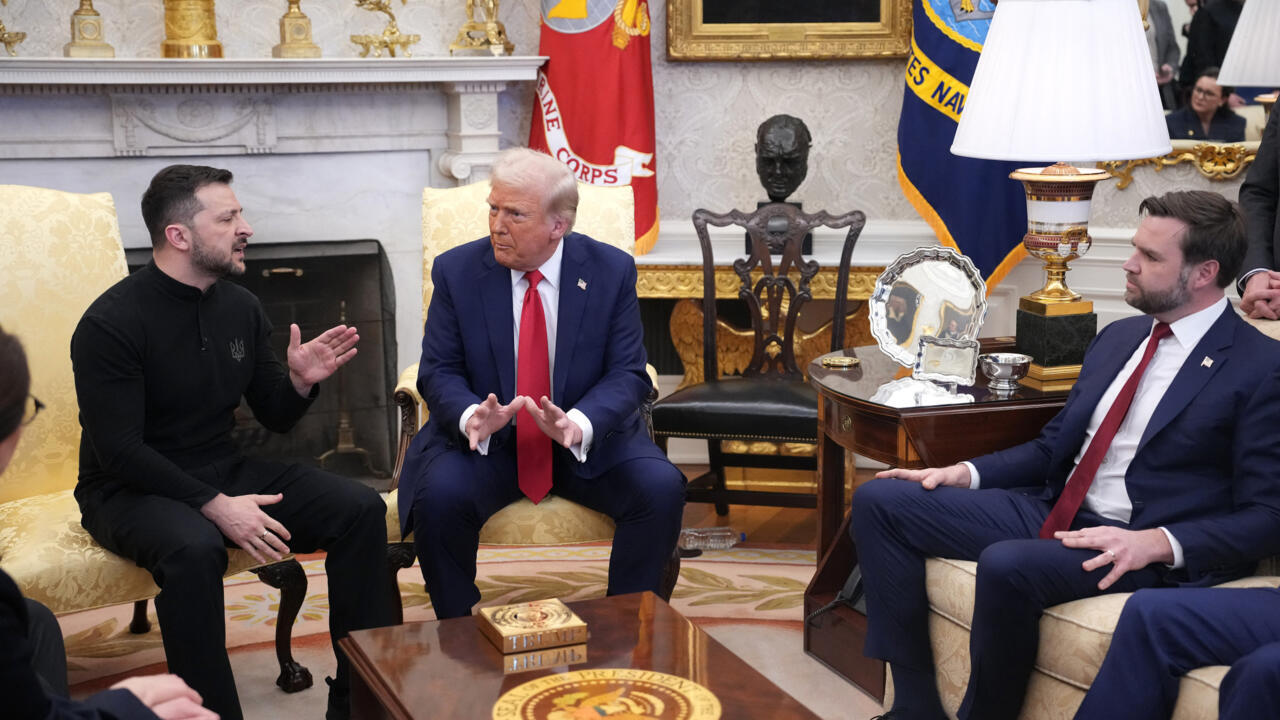
The recent meeting between U.S. President Donald Trump and Ukrainian President Volodymyr Zelenskyy at the White House on February 28, 2025, turned into a highly publicized confrontation that has significant implications for Ukraine’s position in its ongoing war with Russia. This event, marked by a heated shouting match in the Oval Office, unraveled in front of global media, exposing tensions between the two leaders and raising questions about the future of U.S. support for Ukraine.
The meeting was initially intended to solidify a deal granting the U.S. access to Ukraine’s mineral resources in exchange for continued military support—a potential lifeline for Kyiv as it battles Russian forces. However, discussions quickly deteriorated. Trump and Vice President JD Vance accused Zelenskyy of being disrespectful and ungrateful for U.S. aid, while Zelenskyy pushed back, defending Ukraine’s stance and questioning the efficacy of diplomacy with Russian President Vladimir Putin, whom he described as untrustworthy due to a history of breaking ceasefires. The exchange escalated when Trump warned Zelenskyy that Ukraine was “gambling with World War III” and suggested that U.S. support could be withdrawn if Kyiv didn’t align with his peace initiatives, stating, “You’re either going to make a deal or we are out

The confrontation stemmed from differing perspectives on the Russia-Ukraine war. Trump has positioned himself as a neutral broker, aiming to negotiate a swift end to the conflict, a stance he emphasized by claiming he wasn’t aligned with either Russia or Ukraine. He has also initiated direct talks with Putin, sidelining Ukraine and its European allies in early discussions, which has alarmed Kyiv. Zelenskyy, in contrast, argued that Putin’s aggression—evidenced by Russia’s invasion in 2022 and earlier actions like the 2014 annexation of Crimea—cannot be resolved through simple diplomacy, especially given Putin’s track record. This fundamental disagreement fueled the public clash, with Vance further inflaming tensions by criticizing Zelenskyy for not showing sufficient gratitude and for Ukraine’s manpower struggles.
The fallout was immediate and stark. Zelenskyy left the White House without signing the minerals deal, and a planned joint news conference was canceled, leaving the East Room’s preparations abandoned. Trump later declared on Truth Social that Zelenskyy was “not ready for peace if America is involved,” signaling a potential shift in U.S. policy. European leaders, including French President Emmanuel Macron and Spanish Prime Minister Pedro Sánchez, quickly voiced support for Ukraine, emphasizing Russia as the aggressor, while Russia’s Dmitry Medvedev gloated over the spectacle, calling it a “brutal dressing down” for Zelenskyy.
For Ukraine, the implications are dire. American military aid has been pivotal in resisting Russia’s advances, which still control about a fifth of Ukrainian territory despite Kyiv’s efforts, such as the 2024 Kursk incursion. Trump’s threat to withdraw support—coupled with his apparent warming toward Putin—could leave Ukraine increasingly isolated, especially as European allies lack the capacity to fully compensate for a U.S. pullback. The public nature of this dispute has also emboldened Russia, with officials like Maria Zakharova mocking the scene, suggesting it weakens Ukraine’s international standing.
The shouting match itself was unprecedented, described by observers as a dramatic low in U.S.-Ukraine relations. Trump’s insistence that Zelenskyy lacked leverage (“You don’t have the cards right now”) and his framing of the conflict as a personal negotiation rather than a strategic alliance underscored a transactional approach that clashes with Ukraine’s existential fight. Zelenskyy’s defiance, while a necessary defense of his nation’s sovereignty, may have further strained ties with an administration already skeptical of prolonged U.S. involvement.
In short, this clash has left Ukraine more vulnerable. It highlights a fracturing U.S.-Ukraine partnership at a critical juncture, potentially accelerating Trump’s push for a ceasefire that might favor Russia’s terms. For Kyiv, the loss of a unified Western front could undermine its ability to hold the line against Moscow, making an already precarious situation even more uncertain as the war grinds on.
LaizRodrigues
ARTICLE BY : Hotspotorlando News
video by Fox News


