


A Voice from Exile: How One Brazilian’s Bold Stand Exposed the STF’s Injustice
By Hotspotnews
In the heart of Buenos Aires, far from the watchful eyes of Brazil’s powerful elite, a moment of raw truth unfolded yesterday. Simon Castro, a father torn from his family and branded a criminal by his own government, stood up during a fancy seminar and interrupted Supreme Federal Court (STF) Justice Gilmar Mendes. With nothing but his words and his pain, Castro declared himself a political refugee and shouted out for the innocents rotting in Brazilian prisons. It was a cry that echoed across borders, reminding the world that freedom isn’t just a speech—it’s a right that’s been stolen from too many good people.
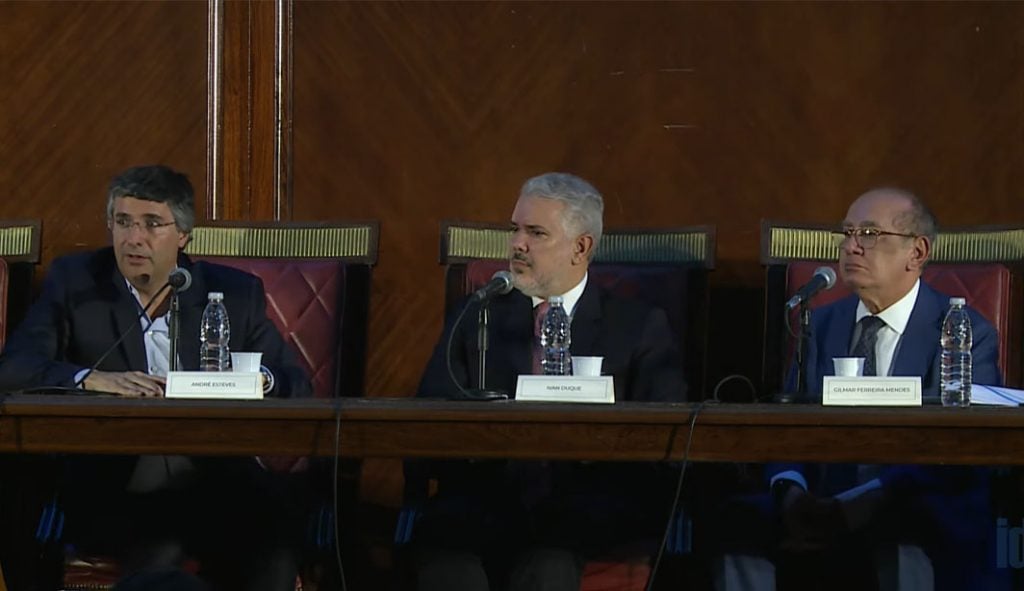
Picture this: Gilmar Mendes, one of the STF’s most influential figures, is lecturing at a joint event between Brazil’s top court and the University of Buenos Aires. The room is filled with academics and officials, sipping coffee and nodding along to talks about “democracy” and “human rights.” Mendes, known for his sharp tongue and long robes of power, is in his element, preaching about justice as if it’s something his court hands out like candy. But then, out of the crowd, rises Simon Castro—a man who’s spent three long years in exile, dodging arrest warrants for daring to protest peacefully.
Castro didn’t sneak in with a sign or a chant. He waited his moment, then seized the microphone. “I’m Simon Castro, a defendant in the January 8 case, accused of 16 crimes,” he began, his voice steady but full of fire. “I’ve been a political refugee in Argentina for three years now. I haven’t hugged my children in over three years because of this.” He laid it out plain and simple: “There is no evidence against me. We’re suffering from this injustice. Many people did commit crimes, yes, and those who did should pay. But not me, Gilmar. You have a role to play here. There’s not even proof that I entered the buildings.”
Turning directly to Mendes, Castro didn’t hold back. “There are good people in prison from January 8 who did nothing wrong! So, Mr. Gilmar, there are innocent folks locked up, and they didn’t break any laws!” He even paused to thank Mendes for the chance to speak, adding, “I’m one of the refugees here in Argentina, and I thank you for receiving me and hearing me out. This is true democracy: the power to speak and express yourself.” The room froze. Security rushed in, cutting the live stream short after just over two minutes. But the damage was done. In that short burst, Castro had cracked open the ugly truth about Brazil’s so-called justice system. Videos of the moment spread like wildfire on social media, racking up thousands of shares from everyday Brazilians fed up with the STF’s heavy hand.
Afterward, Castro didn’t back down. Speaking to reporters, he doubled down: “I have a photo with Minister Gilmar Mendes—I’m not a criminal. If I were, I’d be armed. They didn’t even search me here. I’m not a terrorist, as Brazil claims.” He hammered home the core issue: “In Brazil, there’s no right to defense. They just act and don’t let us defend ourselves—that’s the harsh truth.” Facing 16 wild charges—like attempted coup and terrorism—Castro’s words cut deep, exposing a system that rushes to punish without proof.
To understand why this hit so hard, you have to go back to January 8, 2023. That day, thousands of frustrated citizens marched on Brasília’s government buildings. They weren’t storming the gates with guns or bombs—they were voicing anger over what many saw as a stolen election and a left-wing takeover. Families, workers, and patriots waved flags and prayed for their country. But the media and the STF twisted it into a “coup attempt,” painting peaceful protesters as terrorists. Over 1,400 people faced charges. Some got slapped with sentences up to 17 years in hellish prisons, all based on shaky videos, anonymous tips, and guilt by association.
From a conservative viewpoint, this wasn’t justice—it was revenge. The STF, led by activist judges like Mendes and Alexandre de Moraes, has turned into a political weapon. They’ve censored voices on social media, frozen bank accounts of critics, and even ordered raids on homes without solid proof. Bolsonaro, the man who lifted Brazil’s economy and stood for family values, was barred from running again on flimsy “abuse of power” claims. It’s no wonder folks like Castro fled. He’s not a thug or a plotter; he’s a regular guy who believed in his right to speak up. Now, he’s stuck in Argentina, watching his life unravel from afar.
Castro’s stand wasn’t just personal—it was a beacon for all the “January 8 prisoners.” These are teachers, truck drivers, and moms who showed up to demand fair elections, not to overthrow anyone. Right-wing leaders and everyday conservatives are rallying around them, pushing hard for amnesty. Figures like Congresswoman Carla Zambelli and Senator Flávio Bolsonaro have called the trials a “witch hunt,” arguing that without real evidence, it’s all persecution. On platforms like X (formerly Twitter), the reaction poured in: “Finally, someone said it to Gilmar’s face!” one user posted. Another wrote, “These are heroes, not criminals. Free the innocents!” Posts praising Castro as a “true patriot” hit tens of thousands of views overnight, showing how deep the anger runs.
Mendes? He stayed cool, thanking Castro for speaking as if it was all part of the show. But that polite dodge says it all. The STF talks a big game about rights abroad, but at home, they trample them. Mendes has a history of cozy ties to left-wing causes, from blocking investigations into corruption scandals to defending endless extensions of power. His court has become a one-stop shop for silencing the right, all while claiming to protect democracy. Castro’s interruption laid that bare: How can you lecture on liberty when you’re the one locking up dissenters?
This Buenos Aires moment could spark real change. With midterm elections looming and Bolsonaro’s allies gaining ground in Congress, the push for amnesty is gaining steam. Conservatives argue it’s simple: Drop the charges, let families reunite, and restore trust in the courts. Without it, Brazil risks more division, more exiles, and more cries like Castro’s echoing from foreign lands.
Simon Castro walked out of that room a marked man, but he left with his head high. In a country where the powerful pull the strings, his voice proved that one person’s courage can shake the foundations. For all the good folks still behind bars, his words were a promise: The fight for true justice isn’t over. It’s just getting started. Brazil’s conservatives won’t forget, and neither should the world. It’s time to free the innocent and fix a broken system—before more families pay the price.