

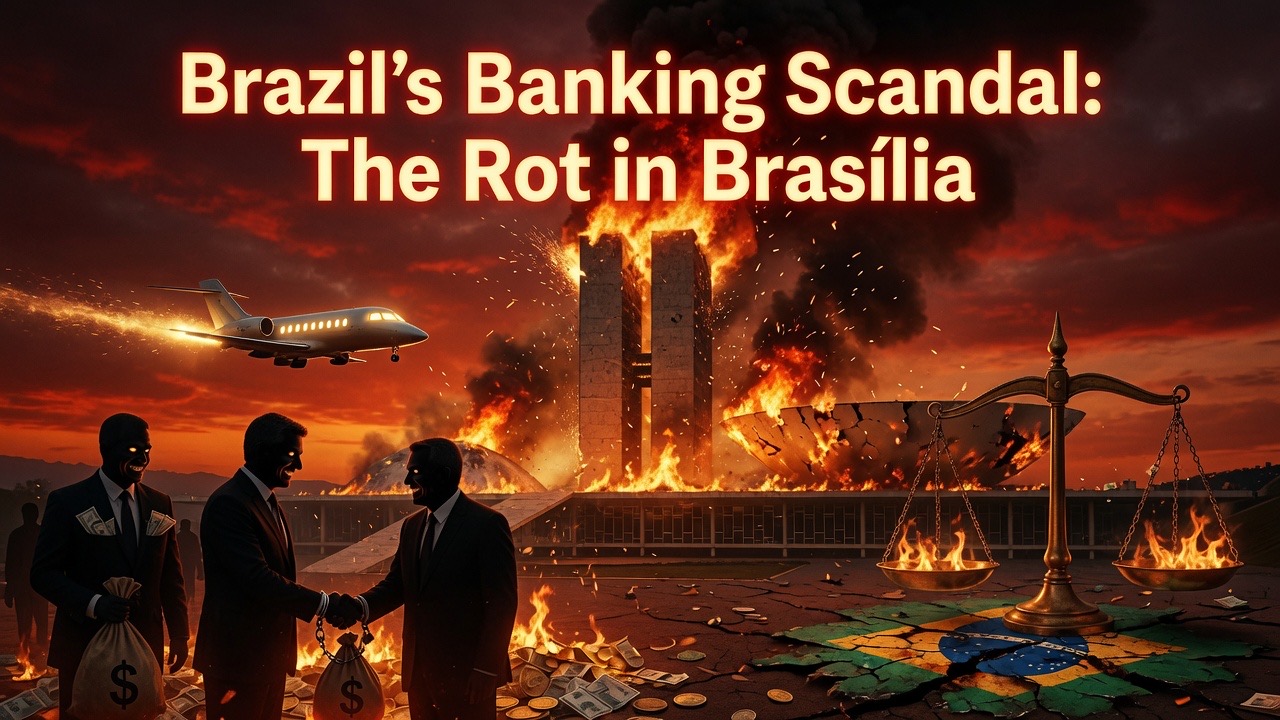

Brazil’s Banking Scandal Exposes the Rot at the Heart of Brasília’s Elite
By Hotspotnews
In the corridors of power in Brasília, where deals are struck over luxury dinners and private jets, a massive financial fraud has ignited yet another firestorm revealing the deep entanglement between big money, politicians, and Brazil’s compromised institutions. At the center stands Daniel Vorcaro, the former controller of Banco Master, now behind bars as authorities unravel what investigators describe as one of the largest bank fraud schemes in Brazilian history—potentially costing the Fundo Garantidor de Créditos (FGC) up to R$41 billion in losses through fictitious credits and diverted funds.5
Vorcaro, arrested multiple times in the Federal Police’s Operation Compliance Zero, built an empire on alleged financial manipulation. His bank was liquidated by the Central Bank amid the chaos. Yet the real story isn’t just the billions vanished—it’s who allegedly benefited from Vorcaro’s largesse while he cultivated influence across the political spectrum.
The Favors Flowed Freely
Police reports and unsealed documents paint a picture of a banker playing host to the powerful. Vorcaro reportedly footed the bill for luxury hotel stays in Lisbon for high-profile figures, including current Chamber of Deputies President Hugo Motta and Senator Ciro Nogueira. Motta has admitted to flying on Vorcaro’s private jet and receiving hotel accommodations, framing it as a last-minute invitation for a forum. Messages intercepted by investigators also show Vorcaro arranging high-end privacy and security for these trips.38
Further revelations detail Motta allegedly requesting a substantial loan—around R$22 million—for a company tied to his family through the very bank at the heart of the scandal. Nogueira, a key Centrão operator, faces even deeper scrutiny: reports suggest monthly payments in the hundreds of thousands, lavish international travel, dinners, and favors totaling millions, all in exchange for legislative muscle on behalf of Banco Master’s interests. Proposals dubbed the “Emenda Master” aimed to expand FGC coverage limits—precisely what would shield a troubled institution like Vorcaro’s.24
These aren’t isolated incidents. The scandal touches broader networks, with mentions of interactions involving former President Lula and efforts to navigate regulatory hurdles. Vorcaro’s family members, including his father and cousin, remain in preventive detention upheld by the Supreme Federal Court (STF) as recently as mid-June 2026, underscoring the gravity—but also raising questions about selective enforcement.31
Cronyism, Not Capitalism
From a conservative viewpoint, this fiasco underscores a fundamental truth: Brazil’s biggest problem isn’t free markets—it’s the cronyism that perverts them. When bankers and politicians scratch each other’s backs with public guarantees like the FGC (ultimately backed by taxpayers and responsible institutions), ordinary Brazilians foot the bill for elite excess. This is the same pattern seen in past scandals: influence peddling, “emendas” tailored to private interests, and a revolving door between finance and power.
The left-leaning establishment under Lula’s orbit loves to lecture about “social justice” while presiding over systems that protect insiders. Here we see Centrão heavyweights—often kingmakers in fragile coalitions—allegedly entangled alongside government-adjacent figures. Where is the outrage from those who demand accountability only when it suits their narrative? The STF’s role in upholding family arrests while the broader web lingers invites skepticism about impartial justice versus political theater.
Vorcaro’s rejected plea deal attempts and the operation’s expansion highlight resistance to full transparency. Brazilians deserve better than this endless cycle of grand corruption, where billions evaporate and the powerful issue denials or “it was just a ride” explanations. True conservatism demands rule of law, limited government to prevent such capture, and leaders who serve the people—not private jets and five-star suites.
As more details emerge from Operation Compliance Zero, one thing is clear: Brasília is on fire because the masks are slipping. The question remains whether Brazil’s institutions will deliver real reform or merely another round of theater to protect the club. The public, weary of these recurring betrayals, should demand nothing less than full accountability—no exceptions for the connected.