


The Scandal of the Century: How Banco Master’s Millions Exposed the Rot at the Heart of Brazil’s Judiciary
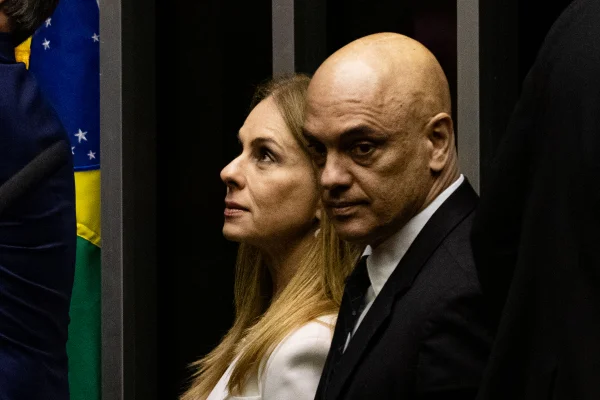
In what can only be described as one of the most damning exposures of elite capture in modern Brazilian history, fresh evidence from the Federal Revenue Service (Receita Federal) has blown the lid off alleged influence peddling at the highest levels of the Supreme Federal Court (STF) and among former power brokers. Documents delivered to the Senate’s CPI on Organized Crime reveal that Banco Master funneled roughly R$80 million to the law firm of Viviane Barci de Moraes—the wife of STF Minister Alexandre de Moraes—between 2022 and 2025. Additional tens of millions flowed to firms linked to former President Michel Temer, ex-STF Minister Ricardo Lewandowski, and others.8
This is not mere coincidence or “standard legal work.” It is a pattern that screams conflict of interest, cronyism, and the weaponization of public institutions for private gain. While ordinary Brazilians struggle with inflation, taxes, and a justice system that often feels stacked against them, a select circle of insiders appears to have turned the STF into a lucrative protection racket.
The Numbers Don’t Lie
Tax records shared with the CPI show Banco Master declared payments totaling over R$80.2 million to Barci de Moraes Associados. The original contract reportedly envisioned up to R$129–130 million over three years at R$3.6 million per month—an astronomical sum for a relatively modest firm, especially given the bank’s later troubles and liquidation.26
These transfers occurred precisely while Banco Master faced regulatory scrutiny, financial irregularities, and investigations tied to organized crime links. The timing raises unavoidable questions: Were these payments for genuine legal services, or were they investments in judicial goodwill and regulatory leniency? Similar large sums reportedly went to offices connected to political heavyweights like Temer and Lewandowski, painting a picture of a bank buying access and protection across the establishment.
Senator Alessandro Vieira, relator of the CPI do Crime Organizado, has highlighted these transfers in dramatic fashion, underscoring how such dealings undermine public trust. Dramatic as the presentations may be, the underlying documents are cold, hard fiscal reality—not conspiracy theory.
Alexandre de Moraes and the Appearance of Impropriety
At the center stands Minister Alexandre de Moraes, one of the most powerful and polarizing figures on the STF. Known for his activist rulings on censorship, political cases, and institutional defense, Moraes now faces the optics of his family’s law firm cashing massive checks from a bank under a cloud. His wife’s firm was allegedly retained to represent Banco Master before the Central Bank, Receita Federal, antitrust bodies, and Congress itself.0
Conservatives have long warned that concentrated power in the judiciary, especially when fused with personal financial incentives, erodes the separation of powers. This case validates those concerns. How can the public believe in impartial justice when ministers’ families profit handsomely from entities whose fates may rest, in part, with those same ministers? The Brazilian people deserve better than a Supreme Court where conflicts of interest are explained away as “normal.”
This scandal also touches broader networks: payments to figures from previous administrations suggest a bipartisan elite consensus that places personal enrichment and institutional preservation above accountability. It is the very definition of the “swamp” that populists and conservatives have fought to drain.
A Symptom of Deeper Decay
Brazil’s judiciary, particularly the STF, has increasingly positioned itself as a super-branch—issuing broad decisions on speech, elections, and policy while shielding itself from scrutiny. The Banco Master affair exemplifies how financial ties can blur lines between regulator, judge, and beneficiary. When a bank suspected of irregularities funnels millions to connected law firms, it doesn’t just smell like influence peddling—it reeks of systemic capture.
The recirculation of these documents via outlets like “O Relator” is a public service. In an era of institutional opacity, sunlight remains the best disinfectant. Brazilians are right to demand full transparency: complete audits of the contracts, disclosure of actual services rendered, and consequences for any violations of ethics or law.
True conservatives stand for the rule of law—not selective enforcement that protects the powerful while hammering dissenters. This “scandal of the century” should serve as a wake-up call. Brazil needs urgent reforms: stricter recusal rules for judges and families, limits on astronomical legal fees in regulated sectors, greater congressional oversight of the judiciary, and an end to the impunity that allows elites to treat public institutions as personal ATMs.
The Brazilian people have had enough of two-tiered justice. If the evidence holds, those involved must face accountability—regardless of robe, title, or political affiliation. The Republic demands nothing less.