

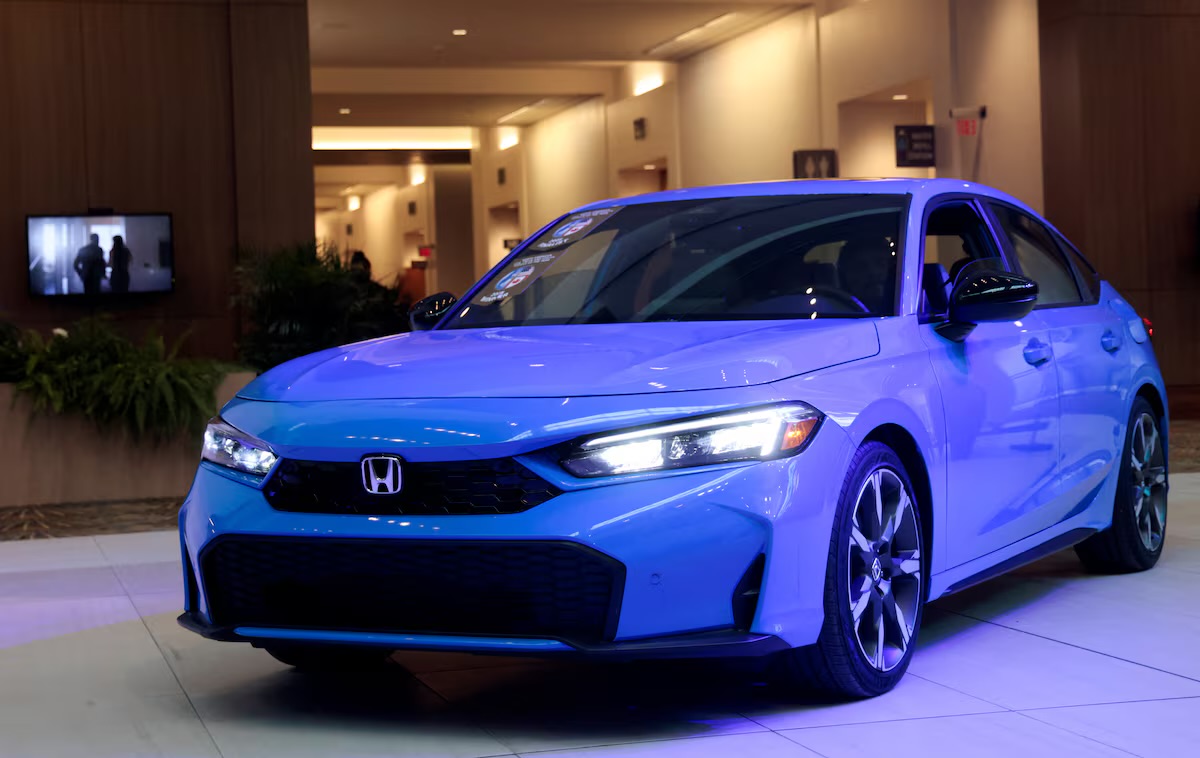

Honda’s decision to produce the next-generation Civic hybrid in Indiana instead of Mexico, driven by U.S. tariffs, signals a potential shift in car manufacturing back to the U.S. The move is a direct response to proposed 25% tariffs on goods from Mexico and Canada, announced by the Trump administration, which aim to incentivize domestic production by making imports costlier.
Honda had originally planned to build the Civic in Guanajuato, Mexico, starting in November 2027, but rising costs in Indiana and Canada had already made Mexico a more economical choice. Now, with tariffs looming, Honda plans to start production in Indiana by May 2028, targeting an annual output of about 210,000 units.
This isn’t an isolated case. The broader context suggests a trend: automakers are rethinking supply chains due to tariff pressures. About 40% of Honda’s U.S. sales currently come from Mexico and Canada, and 80% of its Mexican production is exported to the U.S. With tariffs threatening profitability, shifting production stateside mitigates risk. Other manufacturers face similar pressures—General Motors imports roughly 750,000 vehicles from Mexico and Canada annually, and companies like Ford, Stellantis, Toyota, and Nissan also rely heavily on cross-border production. The threat of retaliatory tariffs from Mexico and Canada could further complicate exports of U.S.-made cars, but for now, the push is toward reshoring.
Is this a full return of car manufacturing to the U.S.? Not quite. The U.S. produced 64% of its new car and light truck sales domestically in 2024, with over a third still imported. Reshoring all 5.3 million vehicles made in Mexico and Canada annually would require massive investment—new plants, retrained workers, and higher labor costs (Mexico’s are significantly lower). Analysts estimate a 25% tariff on a $25,000 vehicle adds $6,250, likely passed to consumers unless absorbed by manufacturers with slim margins (e.g., GM’s 5.3% EBIT in 2024). Some, like S&P Global Mobility, suggest up to 1 million units could realistically shift back without new factories, given U.S. plants operate at 55% capacity. Honda’s Indiana plant, already building Civic hatchbacks since 2021, shows existing infrastructure can adapt.
The counterpoint? Tariffs disrupt decades of integrated North American supply chains under NAFTA and USMCA. Parts still cross borders multiple times before a car’s complete—there’s no “all-American” car. Relocating entire operations isn’t instant; it’s a years-long pivot. Plus, competitors like Hyundai, with no plants in Mexico or Canada, might gain an edge if tariffs hit Japanese firms harder. Still, Honda’s move, alongside warnings from its COO Shinji Aoyama about shifting production, suggests a cautious but real step toward U.S. manufacturing. It’s not a floodgate, but a crack—whether it widens depends on tariff permanence and industry adaptation.
The Hotspotorlando News
source: Grok3, Reuters