

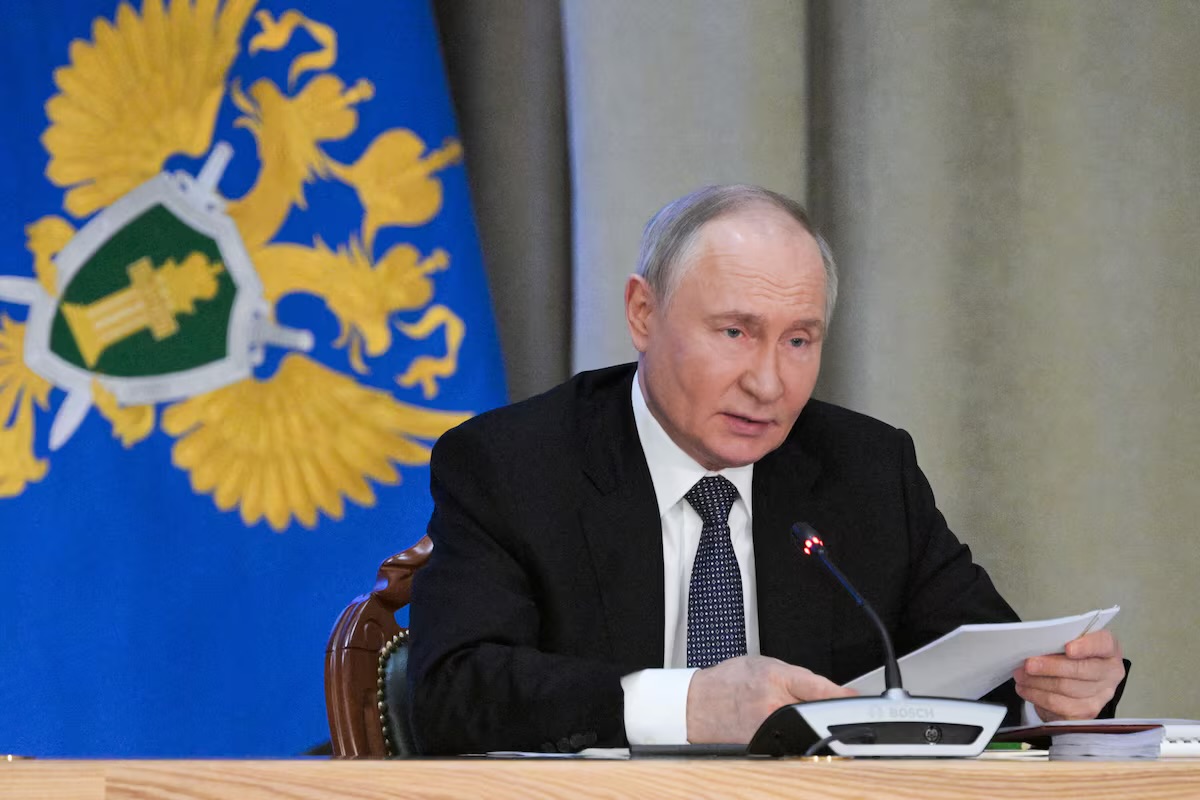

March 28, 2025, Hotspotorlandonews. Russian President Vladimir Putin proposed a temporary administration for Ukraine as a potential step toward ending the ongoing war, which has now stretched beyond three years since Russia’s full-scale invasion began in February 2022. Speaking during a visit to the northern port city of Murmansk, Putin suggested that this administration could be established under international oversight, potentially involving the United Nations, the United States, European countries, and Russia’s partners. The stated goal would be to facilitate “democratic elections” in Ukraine, leading to the formation of a government that, in Putin’s view, would be legitimate and capable of negotiating a peace settlement.
Putin’s proposal appears tied to his long-standing claim that Ukraine’s current leadership, particularly President Volodymyr Zelensky, lacks legitimacy. Zelensky’s term technically ended in May 2024, but Ukraine’s constitution prohibits elections during martial law, which has been in place since the war’s onset. Putin argued that a temporary administration could address this by organizing elections to install a government “enjoying the trust of the people,” with which Russia could then engage in peace talks. He also expressed belief that U.S. President Donald Trump, who has recently pursued improved ties with Russia, genuinely seeks peace—a nod to ongoing U.S. efforts to broker a resolution.
The context for this suggestion is a war that has devastated Ukraine, killed or injured hundreds of thousands, displaced millions, and heightened tensions between Russia and the West to levels unseen in decades. Russian forces currently control roughly 20% of Ukraine, including four regions Moscow has declared annexed, though its military has faced setbacks, such as Ukraine’s incursion into Russia’s Kursk region in August 2024. Meanwhile, diplomatic efforts have intensified, with the U.S. engaging both Moscow and Kyiv separately, and European leaders pushing to bolster Ukraine’s defenses.
Reactions to Putin’s idea have been skeptical. A White House National Security Council spokesperson emphasized that Ukraine’s governance is determined by its own constitution and people, not external imposition. Ukraine has not officially responded, but Zelensky has consistently rejected any challenge to his legitimacy, arguing that wartime conditions make elections impossible and that Putin seeks to prolong the conflict. European initiatives, like a proposed “reassurance force” backed by France and Britain, have been dismissed by Moscow, which opposes foreign troops in Ukraine.
Putin framed his proposal as one of several options, not a definitive plan, and stressed Russia’s willingness to work with various countries—including North Korea, China, and India—toward a resolution. He praised the BRICS group’s efforts while criticizing Europe’s “inconsistent” approach. However, the suggestion of a temporary administration raises questions about sovereignty and intent. Critics might see it as a tactic to undermine Ukraine’s independence or install a pro-Russian government, especially given Putin’s history of maximalist demands, like Ukraine’s demilitarization and ceding of occupied territories.
As of March 28, 2025, the war shows no immediate end. Putin’s proposal, while presented as a path to peace, aligns with his narrative of reshaping Ukraine’s political landscape to Russia’s advantage. Whether it gains traction amid ongoing U.S. and European diplomatic efforts remains uncertain, but it underscores the complex interplay of power, legitimacy, and negotiation in this protracted conflict.
Hotspotorlando News
‘photo by Reuters