


Rubio’s Firm Stance: A Wake-Up Call for Brazil’s Democratic Crisis
By Hotspotnews
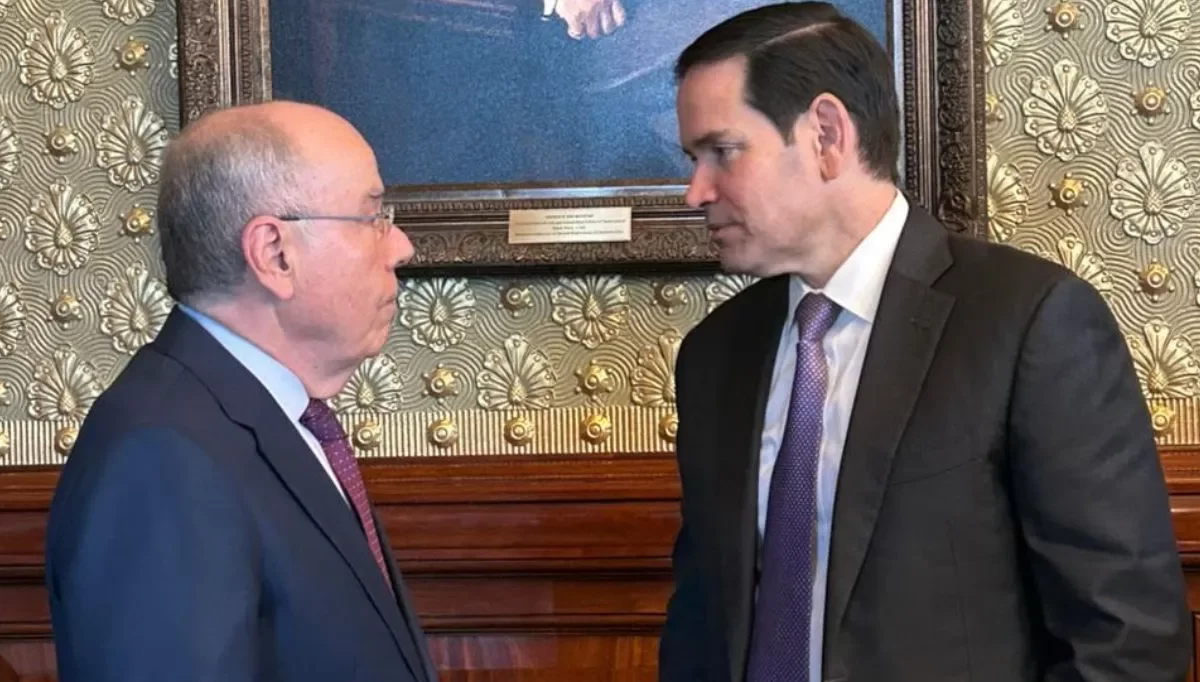
In a world where the lines between democracy and authoritarianism are increasingly blurred, the recent meeting between U.S. Secretary of State Marco Rubio and Brazilian Foreign Minister Mauro Vieira serves as a stark reminder of the consequences of straying from the path of liberty. Rubio’s direct message to Vieira—that there will be no relief from tariffs or the Magnitsky Act until Brazil addresses its judicial oppression—is not just a diplomatic statement; it’s a clarion call for the restoration of democratic principles in a nation that once stood as a beacon of hope in Latin America.
The Brazilian government, under the leadership of President Lula, arrived in Washington with expectations of a different outcome, perhaps naively believing that charm and rhetoric could override the stark realities of their domestic policies. But Rubio, a staunch defender of freedom and a critic of authoritarian overreach, was unequivocal. The world, he asserted, is watching Brazil’s descent into a judicial quagmire where political opponents are silenced, and the rule of law is bent to serve the whims of a few. This is not the behavior of a democracy but of a regime teetering on the edge of tyranny.
The Magnitsky Act, a tool designed to hold accountable those who engage in human rights abuses and corruption, has been rightly invoked against Brazilian officials, including Supreme Court Justice Alexandre de Moraes. This act is not an attack on Brazilian sovereignty but a defense of universal values that transcend borders. The U.S. imposition of a 40% tariff on Brazilian goods further underscores the economic leverage that can be wielded when democratic norms are flagrantly violated. These measures are not punitive for their own sake but are intended to pressure Brazil into reforming its ways, to ensure that the voices of its people are not drowned out by the gavel of an overreaching judiciary.
Lula’s response to these developments has been dismissive, a posture that only deepens the divide. His administration’s insistence on portraying these actions as an assault on Brazil’s sovereignty ignores the fundamental truth: sovereignty is not absolute when it tramples on the rights of its citizens. The international community, led by the United States, has a responsibility to stand against such encroachments, and Rubio’s stance is a testament to that commitment.
The implications of this meeting extend beyond bilateral relations. They signal to the global stage that the U.S. will not turn a blind eye to the erosion of democratic institutions, even among its allies. For Brazil, the path forward is clear: embrace transparency, restore judicial independence, and protect the political freedoms that are the cornerstone of any true democracy. Failure to do so will not only invite further economic and diplomatic isolation but will also betray the very principles that once defined Brazil as a leader in the region.
In this moment, Rubio’s message is a rallying cry for conservatives worldwide. It reaffirms the belief that freedom is not negotiable, that the defense of liberty is a non-partisan imperative, and that the United States will continue to lead by example. For Brazil, the choice is stark: reform or face the consequences. The world is watching, and history will judge. Let us hope that Brazil chooses wisely.