




Accountability Cannot Be Negotiated Away: Alexandre de Moraes Must Answer for the Vorcaro Record
By Hotspotnews
In September 2026, a Federal Police report made public by Supreme Court Justice André Mendonça laid out a detailed account of contacts between Daniel Vorcaro, former controller of Banco Master, and a phone contact saved in Vorcaro’s device as “Alexandre de Moraes BRASILIA.” The material includes at least 52 messages spanning late 2023 to November 2025, multiple reported in-person meetings, and commercial arrangements between Banco Master and the law firm of Moraes’ wife, Viviane Barci de Moraes.
Among the most striking elements are messages sent on 15 November 2025, two days before Vorcaro’s first arrest, in which the banker asked the contact whether he should leave the country. A day earlier he had written of a “dívida de vida” (life debt) owed by his family and partners to Moraes and his family. The same report documents a contract providing for roughly R$130 million in fees over three years, plus a second agreement discussed at up to R$50 million that contemplated payment partly in shares of a jet and helicopter. Metadata recovered by investigators identified a user registered as “Ministro Alexandre de Moraes” as having edited versions of the first contract days before it was signed. Additional records describe travel arrangements and other benefits.
Justice Moraes has rejected the narrative. In a 44-page filing he described the alleged dialogues as a “farsa montada” (fabricated farce) and “diálogos fantasiosos,” asserting that no messages authored by him appear in the recovered material and that the entire episode is political revenge timed to the 2026 electoral calendar. His wife’s firm has stated that Moraes was consulted solely to check for legal impediments and that no improper influence occurred. As of mid-October 2026, no formal criminal charges have been filed against the justice, and several procedural requests inside the Court have been deferred or archived on technical grounds.
These denials do not erase the record. A sitting member of the highest court was the named interlocutor, according to police forensic analysis, of a banker under active investigation who was simultaneously paying tens of millions of reais to that justice’s family firm. The proper response in a constitutional democracy is not a negotiated quiet departure that shields both the individual and the institution. It is a full, public accounting.
Yet that is precisely the direction some recent backstage talk appears to be heading. In mid-October 2026, claims circulated that ministers of the Supreme Court had already begun conversations with allies of Flávio Bolsonaro and had sent the message that Alexandre de Moraes would leave the Court only if Kassio Nunes Marques — also linked in the Vorcaro material — left as well. The stated rationale, according to these reports, is institutional self-protection: the Court would manage its own damage rather than allow selective accountability. Broader commentary has described efforts by some justices to open channels with the incoming political forces precisely to avoid a cascade of removals.
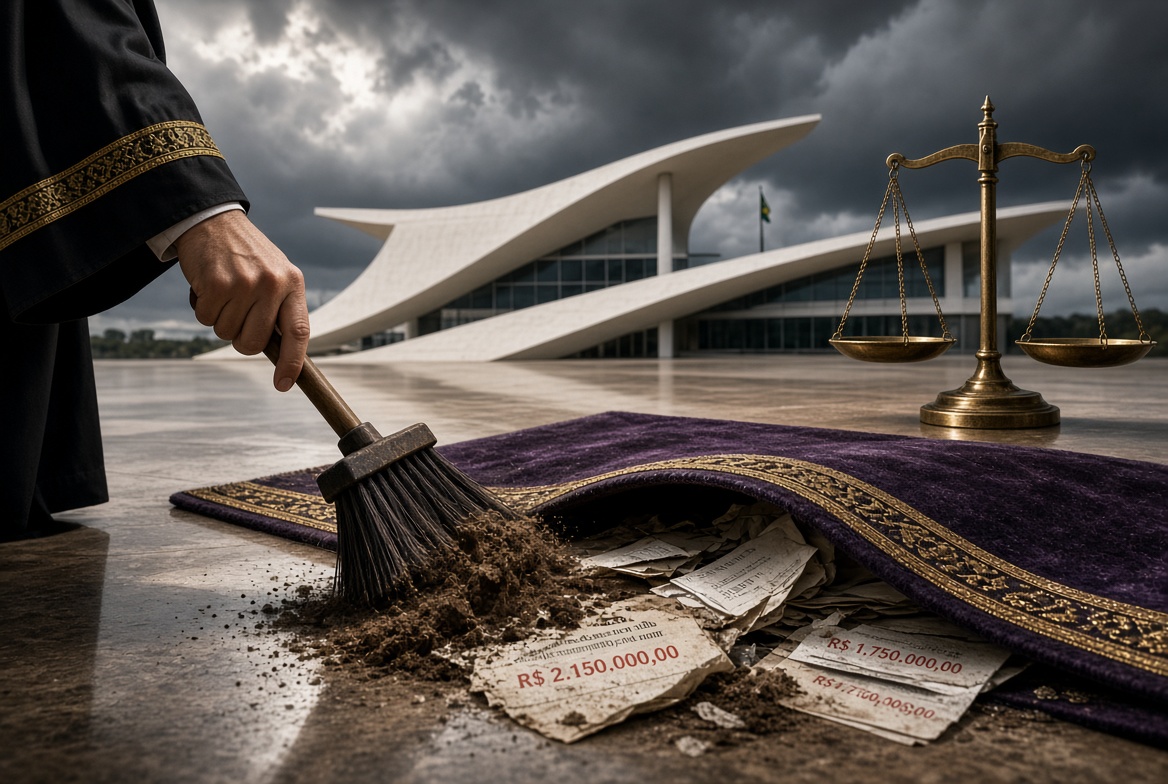
This approach is the opposite of accountability. Pairing the exit of one justice with that of another, or converting documented commercial and personal ties into a bargaining chip for mutual restraint, simply pushes the dirt under the rug. It treats the highest court as a private club whose members may negotiate the terms of their own exposure. Brazilians are entitled to know whether the contracts, the messages about flight, the meetings, and the metadata withstand scrutiny — not whether two justices can leave together so the institution avoids further embarrassment.
Brazil’s Constitution and the Law of Impeachment (Law 1.079/1950) already provide the mechanism: a process in the Senate for “crime of responsibility” if the facts are established. Dozens of such requests citing the Vorcaro material already sit before the upper house. Whether those requests ultimately succeed is a political judgment for senators. What cannot be accepted is the substitution of institutional self-protection for transparent scrutiny. A justice who has exercised extraordinary powers over investigations, social-media orders, and criminal cases cannot treat documented commercial and personal ties of this magnitude as a private matter to be resolved by resignation, paired exits, or mutual non-aggression pacts among colleagues.
The rule of law requires that the same standards applied to others be applied here. Vorcaro’s messages, the contracts, the metadata, and the meetings either withstand examination or they do not. Only an open process — whether through the Senate’s impeachment power, a properly constituted judicial inquiry free of internal conflicts, or both — can settle that question. Anything less leaves the public with the impression that the highest court can negotiate its own immunity. That impression is more damaging to institutional credibility than any single adverse finding.
#STF #AlexandreDeMoraes #CasoVorcaro #Accountability #RuleOfLaw #Brazil
Sources:
Federal Police report released by Justice André Mendonça (September 2026); coverage by Estadão, CNN Brasil, Folha de S.Paulo, G1, JOTA, and Reuters (September–October 2026); Moraes’ written defense of 15 September 2026; contemporary reporting and circulating accounts regarding backstage contacts between STF ministers and political groups (mid-October 2026).