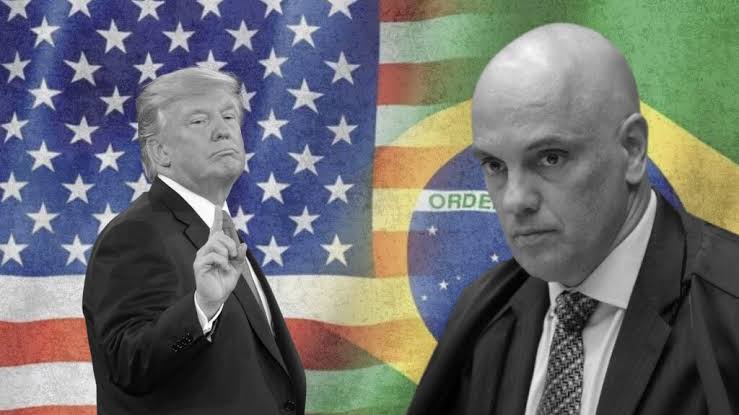
American Justice Strikes Back: U.S. Court Poised to Deliver Default Judgment Against Brazilian Censor-in-Chief Alexandre de Moraes
By Hotspotnews
In a landmark display of American resolve against foreign tyranny, a federal court in Florida is on the brink of entering a default judgment against Brazilian Supreme Court Justice Alexandre de Moraes. This rogue judge, long accused of weaponizing Brazil’s judiciary to silence conservatives, free speech advocates, and political opponents of President Lula’s regime, has failed to personally respond to a civil lawsuit filed by Rumble Inc. and Trump Media & Technology Group.
The lawsuit, filed in February 2025 in the U.S. District Court for the Middle District of Florida, accuses Moraes of unconstitutional extraterritorial overreach. His orders have targeted U.S.-based platforms, demanding the suspension of accounts, the imposition of massive fines, and the handover of user data — all in blatant violation of the First Amendment protections that define American liberty. By suing Moraes in his personal capacity, Rumble and Trump Media are drawing a clear line: no foreign judge gets to export censorship to American soil.
Moraes was properly served via court-authorized email in May 2026 and given the standard 21 days to respond. That deadline came and went on June 15, 2026.
Addressing the confusion: While Brazil’s government, through its Attorney General’s Office (AGU), did file a motion to intervene and dismiss the case on the final day, that filing came strictly on behalf of the Brazilian state — not Alexandre de Moraes personally. The document explicitly states it is made “on its own behalf exclusively” to argue sovereign immunity, foreign official immunity, and international comity. Under U.S. civil procedure, this does not substitute for a personal response from the individual defendant who was sued. Plaintiffs’ counsel has correctly noted that Moraes himself (or his personal attorneys) missed the deadline, keeping the path clear for a default judgment against him in his individual capacity.
What a Default Judgment Would Mean
A default judgment would allow the court to accept the plaintiffs’ allegations as true without a full trial on the merits. This could include:
•A declaratory judgment that Moraes’ censorship orders are unenforceable in the United States.
•Injunctive relief preventing further attempts to coerce American companies into suppressing speech.
•Potential monetary damages for the economic harm inflicted on Rumble and Trump Media through lost revenue, compliance costs, and blocked users.
Even more significant are the broader consequences. A default would send an unmistakable message from the world’s leading democracy: America will not tolerate foreign authoritarians treating our Constitution like a suggestion. It reinforces U.S. digital sovereignty in an era when globalist elites and leftist regimes seek to impose their speech codes worldwide.
The Real-World Impact: A Blow to Global Censorship
Moraes has become a symbol of judicial activism run amok. He has banned prominent conservative voices, fined platforms like X into submission, and targeted supporters of former President Jair Bolsonaro. His actions extend far beyond Brazil’s borders, attempting to police what Americans can say and see online. This is the very definition of lawfare — the use of legal systems as political weapons.
For conservatives who have watched Big Tech and international pressures collude to rig narratives and elections, this case is vindication. Under President Trump’s leadership, America is pushing back. A default judgment adds legal teeth to that stance.
Enforcement challenges remain — Brazil is unlikely to roll out the red carpet for U.S. judgments against one of its own. But the symbolic and practical victories are profound. American companies could gain stronger grounds to resist future demands. International pressure on Brazil’s judiciary would mount. And Moraes himself would carry the stain of a U.S. default judgment, undermining his credibility at home and abroad.
A Warning to Would-Be Censors Everywhere
This episode exposes the fragility of authoritarian control in the digital age. When judges like Moraes overreach, they invite scrutiny from freer nations. Conservatives have long warned that unchecked judicial power, combined with Big Tech compliance, threatens the foundations of liberty. The Rumble-Trump Media suit proves that resistance is not futile — especially when backed by American courts committed to the rule of law.
As the case proceeds, expect the left-leaning global media to downplay it as mere “symbolism” or confuse the public by claiming “Brazil responded.” But the court filings make the distinction crystal clear: the Brazilian government’s sovereignty arguments are separate from Moraes’ personal obligation to answer the complaint. For those who value free speech, national sovereignty, and accountability, this represents something far greater: a decisive stand against the rising tide of international censorship.
The fight for the open internet is far from over. Yet with bold actions like this lawsuit — and the strong possibility of a default judgment against one of the world’s most notorious censors — America is reclaiming its role as the beacon of liberty. Moraes ignored the summons at his peril. The consequences may echo far beyond Tampa.
Freedom-loving Americans should watch this closely. In the battle between sovereignty and suppression, the home of the First Amendment is refusing to back down.