




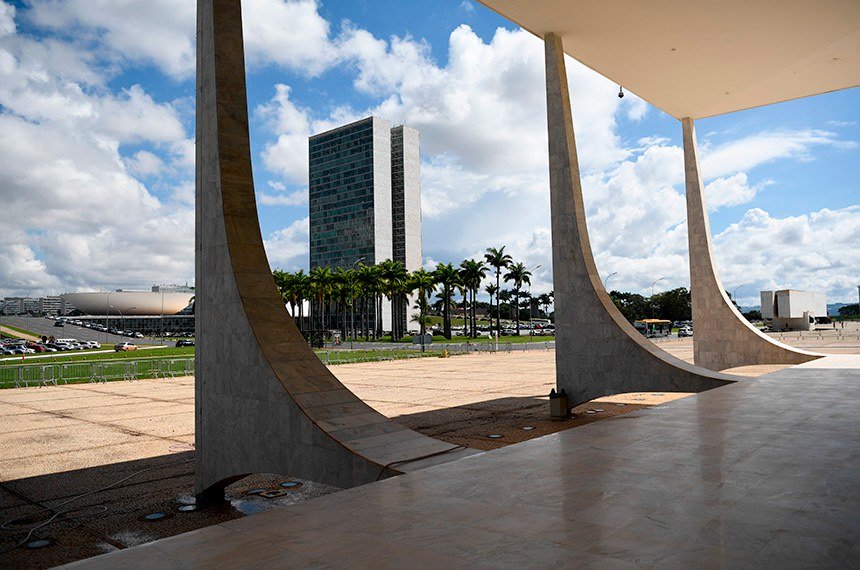
BRAZIL: When the Court’s Own Elders Speak
Thirteen retired ministers of Brazil’s Supreme Federal Court have done what sitting justices have so far refused to do: they have named the moment. In a formal letter to STF President Edson Fachin, they describe the present situation as the most acute crisis in the Court’s history and demand that he convene, with extreme urgency, a public plenary session so the full bench can order an immediate and rigorous investigation, under due process, of the “gravíssimos fatos” whose disclosure is damaging the Court’s prestige, its authority, public confidence, and even the stability of democratic institutions.
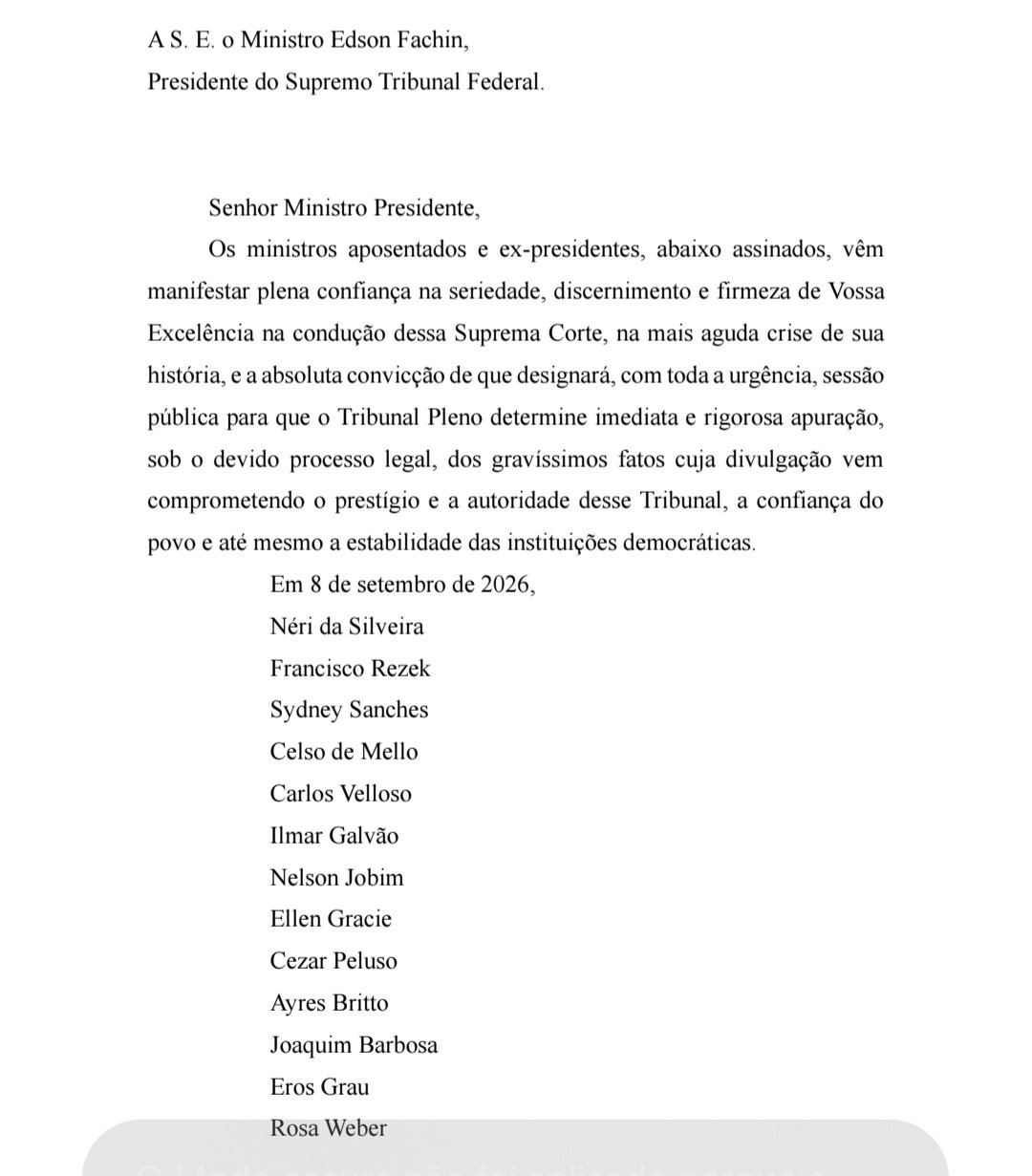

The letter does not name names. It does not have to. Reporting across major Brazilian outlets places the crisis in the unsealed portions of a Federal Police investigation into Banco Master and its former controller, Daniel Vorcaro. Those materials include communications attributed to Justice Alexandre de Moraes. The public discussion that followed has focused on alleged influence, high-value contracts, luxury benefits, and contacts with senior law-enforcement and prosecutorial figures at moments when operations were underway. Whether every allegation holds is precisely what a plenary investigation is for. The retired ministers’ point is that the Court cannot treat the disclosures as a public-relations problem. The damage is already institutional.
From a conservative standpoint, this is the test that every powerful institution eventually faces: will it apply the same standards it applies to everyone else? A supreme court that claims the last word on the Constitution cannot survive on the argument that its members are too important to be examined. Prestige is not self-executing. It is earned by visible adherence to due process, impartiality, and the appearance of impartiality. When former presidents of the Court say those things are now at risk, the claim that criticism is merely “anti-democratic” loses its force.
The letter is also a rebuke of delay. It asks for a public session, not a discreet internal handling. Publicity here is not spectacle; it is the only way to restore the presumption that the Court is still capable of judging its own. Private management of a scandal of this scale would confirm the worst suspicion: that the institution protects its members first and the law second.
None of this requires a verdict in advance. It requires the opposite: a process that can produce one. If the facts are less grave than they appear, the plenary can say so. If they are as grave as the letter implies, the Court has a duty to the public that appointed none of these justices by popular vote. In a republic, that duty is not optional.
The conservative case is simple. Power that cannot be investigated is not judicial power. It is a different kind of authority altogether. Thirteen men and women who once exercised that power have now told the current president that the Court is in the most serious crisis of its history. The proper response is not to dismiss them. It is to put the facts before the full Court, in public, under the rules the Court itself demands of every other Brazilian.
What it represents
The letter represents a late, necessary recovery of an old idea: the Court belongs to the Constitution, not to any one of its members.
It represents a demand for collegial government of the judiciary. A single justice’s secrecy order, a single justice’s inquiry, a single justice’s public war with a colleague—these are the habits of personal power. A plenary session is the opposite. It forces the institution to look at itself as an institution.
It represents equality before the law. Brazil cannot preach republican virtue while treating some robes as untouchable. If ordinary defendants face raids, leaks, preventive prison, and public suspicion, then a minister named in a police report cannot be protected by a culture of silence. Due process is not a shield against inquiry. It is the method of inquiry.
And it represents a warning about democratic stability that should not be dismissed as rhetoric. Courts do not fall only when tanks appear. They fall when citizens conclude that the highest judges live by a different code. Once that conclusion hardens, every ruling—wise or foolish—looks like faction. The retired justices said as much: prestige, public trust, and institutional stability are already in question.
Fachin now has a choice that is larger than managing a news cycle. He can treat the letter as a ceremonial bouquet from retired colleagues and delay until the storm passes. Or he can do what the letter asks and what any conservative understanding of constitutional government requires: call the Court into the open, separate rumor from evidence, and let the plenary decide how a tribunal investigates its own.
The power of this letter is not that it shouts. It is that people who once embodied the Court’s authority have told the present Court, in writing, that authority is no longer self-evident. In a republic, that is not an insult. It is a last chance to prove that the law still binds the men who interpret it.
Source: Contemporary reporting by G1, Folha de S.Paulo, BBC News Brasil, Metrópoles, O Globo, Correio Braziliense, and CNN Brasil on the letter dated 7–8 September 2026 and the surrounding Banco Master disclosures.
#STF #CriseNoSTF #Fachin #AlexandreDeMoraes #EstadoDeDireito #Brasil #Instituições #DueProcess #SupremoTribunalFederal


