




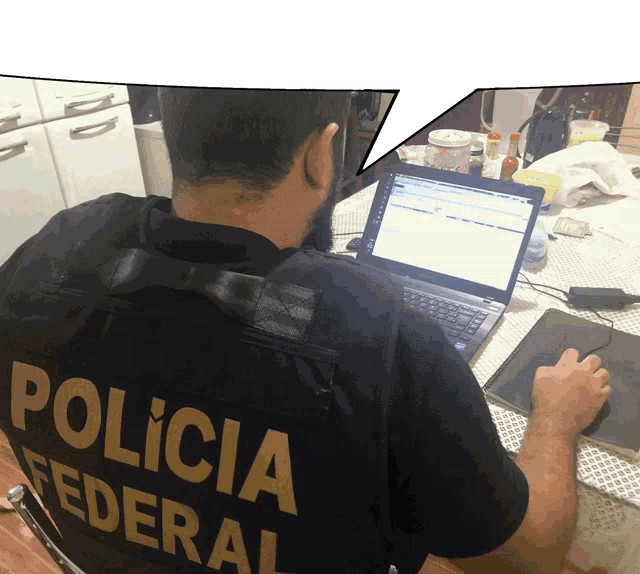
False U.S. Immigration Record at Center of Filipe Martins Case Raises Questions Over Brazilian Federal Police Involvement
By Hotspotnews
A U.S. federal judge has confirmed that a false immigration entry record was used to justify the preventive detention of Filipe Martins, a former special advisor on international affairs in the Jair Bolsonaro government. The development has intensified scrutiny of how the record entered American systems and whether Brazilian Federal Police officers played any role.
In February 2024, Supreme Court Justice Alexandre de Moraes ordered Martins held in preventive custody, citing the record as evidence of flight risk. The document indicated that Martins had entered the United States around late December 2022, coinciding with Bolsonaro’s travel to Orlando. Martins remained detained for approximately six months. His defense consistently maintained that he never left Brazil, presenting commercial flight records, phone location data, and other evidence placing him in the country at the time.
In October 2025, U.S. Customs and Border Protection stated after a review that Martins did not enter the United States on the date in question. The agency described the record as inaccurate and said its inclusion in official systems remained under investigation. CBP also noted that the erroneous information had been cited to support Martins’ months-long imprisonment.
In a March 2026 hearing in the U.S. District Court for the Central District of Florida, Judge Gregory A. Presnell went further. He described the record as false, stated that the U.S. government acknowledges both its falsity and the considerable harm it caused, and emphasized that Martins has the right to know how the entry was created and who was responsible. The judge ordered disclosure of related documents and communications as part of a Freedom of Information Act lawsuit filed by Martins.
Martins’ defense team has stated that it already knows the identities of those involved—both American and Brazilian—and has reviewed related messages and emails. Lawyers say the insertion appears deliberate rather than a simple system error, though full details remain under temporary judicial secrecy. They indicate that some of the individuals may now be in Brazil and that the names are expected to become public in the coming weeks. Circulating reports in Brazilian media have referred to Federal Police officers in connection with the broader investigation or international information channels. These connections have not been formally confirmed as direct involvement in the creation of the CBP record.
The precise method used to place the false record into the CBP system is still under investigation and has not been publicly established. There is no confirmed evidence that it resulted from classic external hacking—such as unauthorized technical intrusion, exploitation of software vulnerabilities, or malware. More consistent with available information are scenarios involving people who already possessed legitimate access, whether through internal CBP systems or official liaison and information-sharing channels, or the propagation of incorrect data from other official sources that was then recorded as an actual entry. Regardless of the exact technique, the deliberate or improper creation of a false official border record constitutes a serious matter.
The Federal Police, after the CBP acknowledgment, suggested in official communications that members of the group under investigation may have simulated the false entry, possibly by exploiting diplomatic or presidential travel procedures, in order to undermine the Brazilian probe. That assertion remains contested by Martins’ lawyers, who describe the original use of the record as central to what they call a constructed case.
Martins was later convicted by the Supreme Court in connection with allegations surrounding the 2022 presidential transition and related events, receiving a lengthy prison sentence. His defense continues to maintain his innocence and argues that the false record formed part of a pattern of flawed or improper evidence. Supporters portray him as a political target; official Brazilian judicial findings treat the broader case as established.
U.S. authorities continue to investigate how the inaccurate record entered CBP systems. Brazilian proceedings and public debate continue in parallel. Judge Presnell’s orders are expected to produce additional clarity on the identities, any coordination involved, and the precise method used.
The episode highlights the intersection of Brazilian domestic investigations with foreign border records and the difficulties that arise when such records prove unreliable.
#FilipeMartins #RegistroFalso #PoliciaFederal #JusticaEUA #AlexandreDeMoraes #CBP #STF #Investigacao
Sources
U.S. Customs and Border Protection public statement, October 2025.
Transcript and orders from U.S. District Judge Gregory A. Presnell, Central District of Florida, March 2026 hearing (reported via Folha de S.Paulo and confirmed by defense).
Statements from Filipe Martins’ defense counsel, including Ricardo Scheiffer, August 2026.
Reporting from Gazeta do Povo, CNN Brasil, and related Brazilian coverage of Federal Police communications.
Official Brazilian Federal Police submissions to the Supreme Court regarding the record and subsequent narrative adjustments.


