




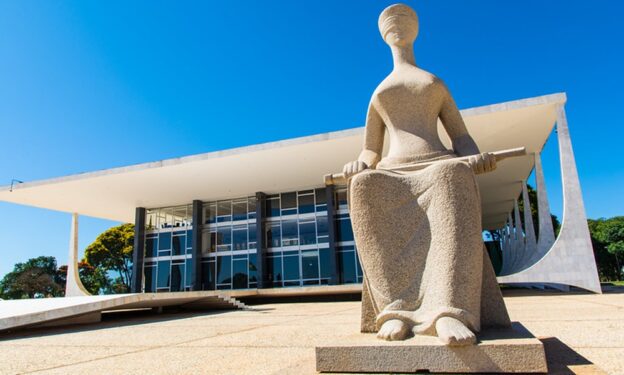
The Naked Double Standard at Brazil’s Supreme Court
By Hotspotnews
In a healthy democracy, the highest court exists to apply the law equally, without fear or favor. What is unfolding right now in the Brazilian Supreme Federal Court (STF) is the opposite: a transparent exercise in selective justice that should shame every citizen who still believes in the rule of law.
Justice André Mendonça, the rapporteur of investigations into Fábio Luís Lula da Silva — better known as Lulinha, the eldest son of President Luiz Inácio Lula da Silva — has signaled he intends to keep those probes inside the STF. The Prosecutor-General’s Office (PGR) asked for the cases to be sent down to ordinary first-instance courts, arguing there is no privileged forum involved. Mendonça’s office has indicated he will reject that request, citing connections to broader inquiries and mentions of authorities with special standing.
A faction inside the Court is already unhappy. According to reporting by columnist Bela Megale, three justices privately warn that by denying the PGR’s request Mendonça is “opening a flank” for criticism and stepping beyond the proper role of a magistrate. They note that until now he has generally followed the recommendations of the PGR and Federal Police. Keeping the cases, they say, also allows him to control the timing of any appeal.
Here is where the hypocrisy becomes impossible to ignore. When those same justices were asked to explain the difference between Mendonça’s stance and earlier decisions by Justice Alexandre de Moraes — who repeatedly rejected PGR requests to close or limit investigations involving Bolsonaro allies and even Bolsonaro himself — their answer was revealing. Moraes’s refusals, they claimed, were justified because they served the higher purpose of “maintaining the democratic rule of law.”
In other words: when the target is the political right, ignoring the PGR is heroic institutional resistance. When the target is the president’s son, the identical institutional posture is suddenly an overreach that must be discouraged.
This is not jurisprudence. This is factional politics wearing judicial robes. Lulinha faces serious allegations of influence peddling tied to government contracts and connections that emerged from the massive INSS fraud investigation. The public has a right to a thorough, independent inquiry conducted under consistent rules. Instead, parts of the Court appear more concerned with managing the political temperature around the president’s family than with equal application of the law.
The pattern is familiar to anyone who has watched Brazilian institutions in recent years. One set of standards for those aligned with the current power structure, another for everyone else. The moment a Bolsonaro-appointed justice begins treating a sensitive case with the same rigor previously applied to the other side, the institutional temperature rises and the warnings begin.
A Supreme Court that cannot apply the same procedural logic to the son of a sitting president that it applied to its political opponents has abandoned the pretense of impartiality. That is not merely regrettable. It is shameful.
The Brazilian people deserve better than a judiciary that changes its principles according to whose interests are at stake. Equal justice under law is not a slogan to be invoked only when convenient. It is the foundation of republican order. When that foundation cracks in full public view, the entire system loses legitimacy.
#RuleOfLaw #EqualJustice #STF #Brazil #NoDoubleStandards #InstitutionalIntegrity
Sources
Bela Megale column published in O Globo, August 2026, detailing the private assessments of three STF justices regarding Mendonça’s handling of the Lulinha inquiries and their explicit comparison with prior decisions by Justice Alexandre de Moraes.
Public reporting on the PGR’s formal request to transfer the Lulinha cases and on the procedural history of related STF investigations.


