

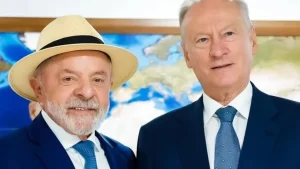


Lula’s Dangerous Embrace of Putin’s Inner Circle
By Hotspotnews
In the final stretch of his current term and just as he launches a reelection campaign centered on “national sovereignty,” Brazilian President Luiz Inácio Lula da Silva has chosen to host one of Vladimir Putin’s most powerful and controversial lieutenants. Nikolai Patrushev, the longtime security hardliner and former head of Russia’s FSB, arrived in Brasília for high-level talks that included a personal audience with Lula himself. The timing could hardly be more revealing—or more troubling.
Patrushev is no ordinary diplomat. He succeeded Putin at the FSB, the successor agency to the KGB, and has remained at the core of the Kremlin’s security apparatus for decades. For years he has been identified by Western governments and independent investigators as a central figure in some of the darkest episodes of Putin’s rise and rule. The 1999 apartment bombings that killed hundreds of Russian civilians and propelled Putin to power remain the subject of persistent and credible accusations that elements of the FSB staged the attacks. One of the most prominent voices making that case was Alexander Litvinenko, the former FSB officer who fled to Britain and was later murdered with radioactive polonium. A British public inquiry concluded that the operation to kill Litvinenko was likely approved by Patrushev. These are not fringe claims; they form part of the documented record of how Putin consolidated power through fear, secrecy, and ruthlessness.
Yet Lula received this man with the full honors of the Brazilian state. Official statements spoke of naval cooperation, energy projects, fertilizers, science and technology, and “international security.” Russia is an important supplier of fertilizers and diesel to Brazilian agriculture, and Brasília has long sought to expand trade and technical partnerships. Those practical interests are real. What is not real is the pretense that this was merely a technical or commercial visit. When a president sits down with one of Putin’s closest security chiefs while his government is simultaneously escalating friction with the United States, the message is unmistakable.
Brazil under Lula has pursued a multipolar foreign policy that treats the United States as just one power among many, often the least favored. The result has been a series of avoidable tensions with Washington: new tariffs on Brazilian goods, reciprocal diplomatic measures including the revocation of the Brazilian ambassador’s visa, and mutual accusations of interference. Lula’s team frames these clashes as the price of defending sovereignty against American overreach. In practice, the policy has imposed tangible costs on Brazilian exporters and complicated investment flows while delivering limited strategic gains in return.
The political calendar makes the episode still more pointed. Lula formally launched his bid for a fourth term only days before Patrushev’s arrival. His campaign rhetoric emphasizes independence from foreign pressure and portrays closer ties with the United States as a form of submission. Hosting a senior Kremlin security official fits neatly into that narrative. It signals to Lula’s base that Brazil will not be intimidated by Washington and will cultivate alternative partners in Moscow and Beijing. It also risks confirming the worst suspicions of those who already view the Workers’ Party as instinctively hostile to the West.
Some defenders of the government argue that Brazil must talk to everyone, that fertilizers matter more than ideology, and that Lula is simply practicing pragmatic non-alignment. There is a kernel of truth in the economic argument. Brazil’s agricultural sector does depend on Russian inputs. Yet pragmatism cuts both ways. Deepening security and defense contacts with a regime that has invaded a neighboring country, conducted systematic repression at home, and targeted critics abroad is not cost-free. It complicates relations with the world’s largest economy and most important security partner in the hemisphere. It also raises questions about judgment. When a leader simultaneously courts Putin’s inner circle and publicly announces his intention to telephone Donald Trump to discuss great-power diplomacy, the inconsistency is hard to miss.
Trump has little incentive to reward such behavior before Brazil’s October election. Engaging Lula now would hand the incumbent a diplomatic photo opportunity and invite accusations of interference from the Brazilian right. Waiting until after the votes are counted is the more logical course. If Lula wins, the United States can deal with a reelected president on the merits. If the opposition prevails, a different conversation becomes possible. Either way, the White House is under no obligation to pretend that Lula’s recent choices are costless.
Brazil is a major democracy with genuine global weight. Its choices matter. Aligning too closely with the security state that surrounds Putin does not expand Brazilian autonomy; it narrows it. It substitutes the appearance of independence for the harder work of building reliable partnerships with free societies that share basic interests in open markets, the rule of law, and stability in the Americas. Lula’s government has repeatedly chosen the former. The meeting with Patrushev is only the latest example. Brazilians will decide in October whether that path still serves their country. The rest of the democratic world is entitled to take note of the company Brazil’s president keeps.


