





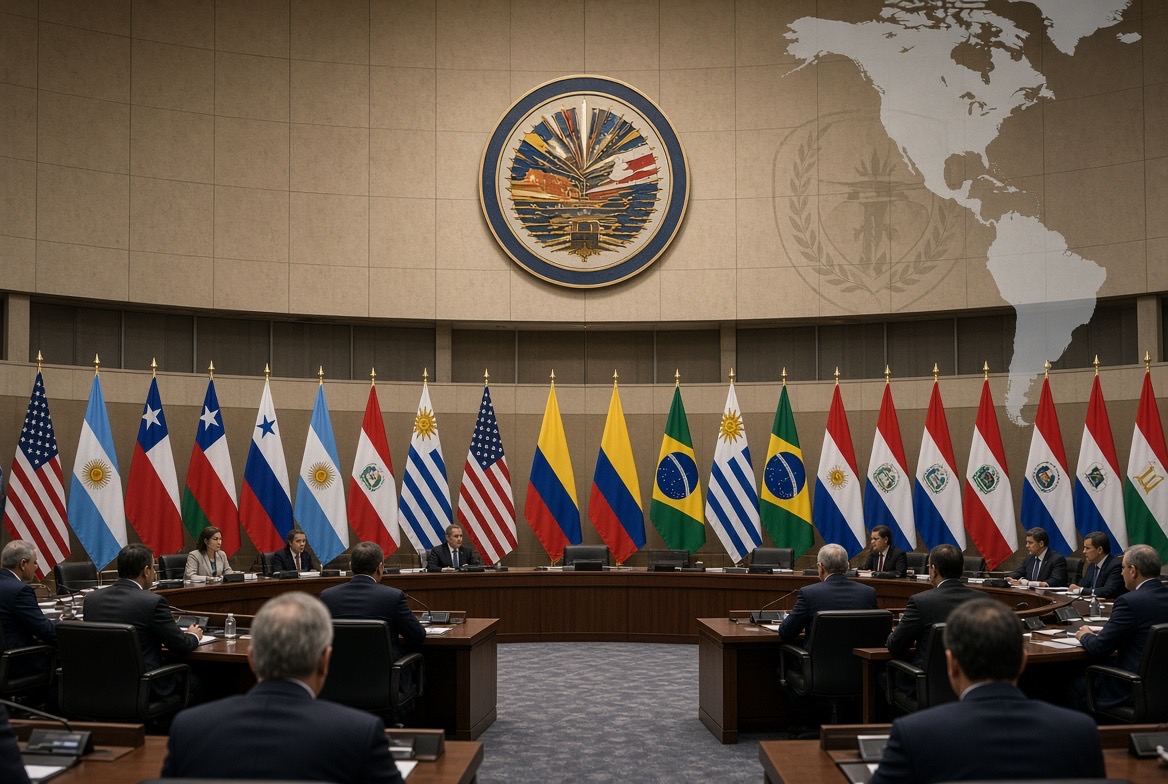
OAS Invokes Cold War-Era TIAR Treaty Against Transnational Crime and “Narcoterrorism,” With Brazil and Uruguay Voting No
By Hotspotnews
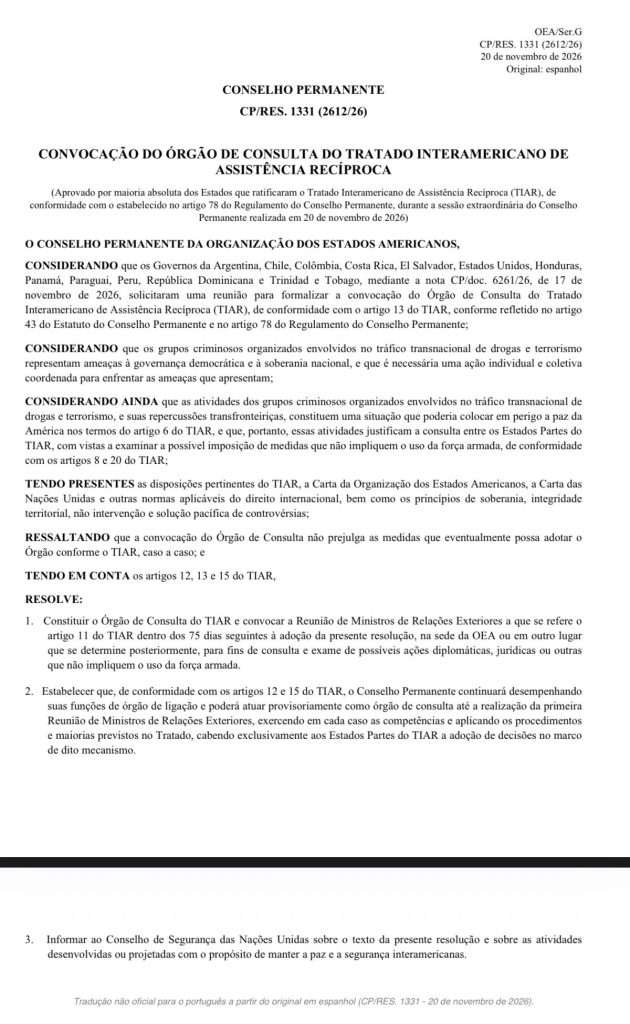
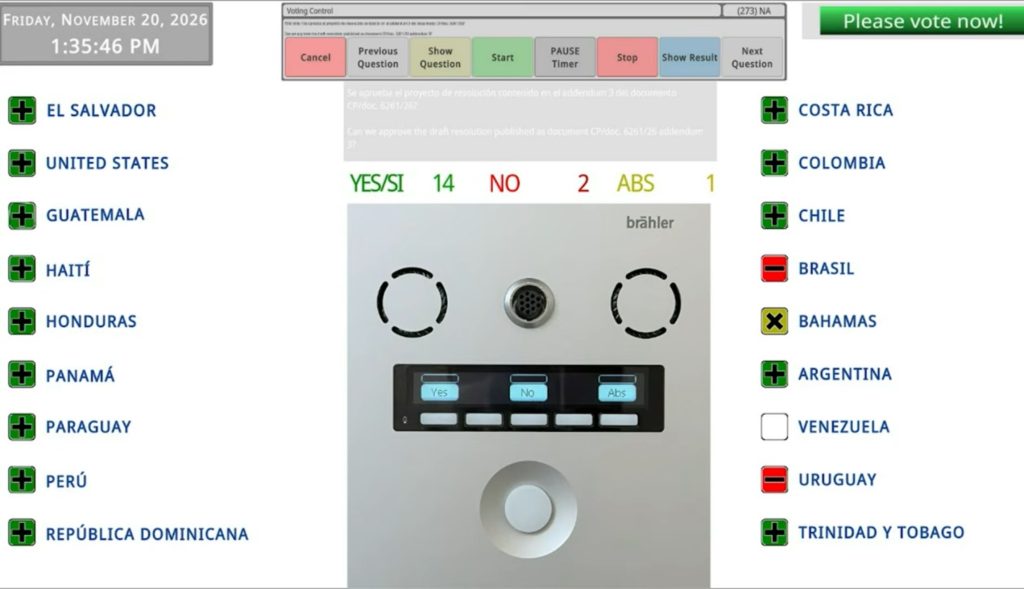
On November 20, 2026, the Permanent Council of the Organization of American States (OAS) approved a resolution convening the Organ of Consultation under the Inter-American Treaty of Reciprocal Assistance (TIAR, also known as the Rio Treaty). The measure passed by a vote of 14 in favor, 2 against (Brazil and Uruguay), and 1 abstention (Bahamas). It opens a formal process for foreign ministers of TIAR parties to meet within 75 days to examine coordinated diplomatic, legal, and other non-military actions against organized criminal groups involved in transnational drug trafficking and terrorism.
The resolution, formally CP/RES. 1331, does not authorize the use of armed force. Instead, it frames the activities of these groups—and their cross-border effects—as a situation that “might endanger the peace of America” under Article 6 of the TIAR, warranting consultation among the treaty’s parties.
What the TIAR Is and Why It Matters
Signed in Rio de Janeiro in 1947 at the start of the Cold War, the TIAR is a collective-defense treaty among American states. Its core logic resembles NATO’s Article 5: an armed attack against one member is considered an attack against all. Article 6, however, is broader. It allows consultation when the sovereignty, territorial integrity, or political independence of a state is affected by aggression that is not an armed attack, or by any other situation that could endanger the peace of the continent.
The treaty’s measures (Articles 8 and 20) can include the recall of diplomatic missions, breaking of relations, interruption of economic or communications links, and other steps short of armed force, as well as the use of armed force with consent. In practice, the TIAR has been invoked rarely and is widely viewed as a product of its era. Its activation for organized crime and drug trafficking therefore represents a significant reinterpretation.
Only states that have ratified the TIAR and remain parties can vote on its consultation mechanism. Mexico withdrew in 2002 and could not cast a ballot, though it strongly opposed the initiative. Venezuela’s vote was not recorded.
What the Resolution Actually Does
The resolution was requested by Argentina, Chile, Colombia, Costa Rica, the Dominican Republic, El Salvador, Honduras, Panama, Paraguay, Peru, Trinidad and Tobago, and the United States. Additional yes votes came from Guatemala and Haiti.
It does three main things:
- Forms the Organ of Consultation under the TIAR.
- Convenes a Meeting of Ministers of Foreign Affairs (or their representatives) within 75 days of adoption—at OAS headquarters or another location to be decided—to examine “possible diplomatic, legal, or other measures not involving the use of armed force.”
- Instructs that the UN Security Council be informed of the resolution and related activities.
The Permanent Council will serve as a liaison and may act provisionally as the Organ of Consultation until the ministerial meeting. The text explicitly states that the convocation “does not prejudge the measures that may ultimately be taken” and reaffirms principles of sovereignty, territorial integrity, non-intervention, and the peaceful settlement of disputes.
The Case for Activation
Proponents argue that transnational criminal organizations have evolved beyond ordinary police problems. They cite groups that control territory, possess military-grade weapons, assassinate officials, and undermine democratic governance and state sovereignty across borders. Chilean Ambassador José Miguel Castro, speaking for the sponsors, described them as among the most serious threats to the security of cities and the sovereignty of states.
U.S. officials and allies have framed the issue under the term “narcoterrorism.” This language is tied to the “Shield of the Americas,” a political and security coalition launched under the Trump administration. In a September 2026 joint declaration associated with that initiative, a group of Latin American and Caribbean countries classified Brazilian organizations such as the Primeiro Comando da Capital (PCC) and Comando Vermelho (CV), along with dozens of other groups, as narcoterrorist organizations. U.S. statements after the OAS vote described the resolution as opening a path for sanctions and other consequences against such groups.
Supporters say the hemisphere can no longer confront borderless criminal organizations through purely national or fragmented efforts. They view the TIAR consultation as a tool for coordinated non-military pressure—sanctions, asset freezes, enhanced legal and intelligence cooperation, and diplomatic isolation—while remaining within the treaty’s framework and international law.
Why Brazil and Uruguay Voted No
Brazil, under President Luiz Inácio Lula da Silva, opposed the resolution on the grounds that a Cold War-era mutual-defense treaty is the wrong instrument for organized crime. Brazilian diplomats argued that the distinction between terrorism, organized crime, and collective defense must be preserved. They also warned that the explicit exclusion of armed force at this stage does not prevent such measures from being discussed later. Brazil had reportedly urged other governments not to support the initiative.


2Uruguay’s Permanent Representative, Edison Lanza, stated that the country takes the impact of organized crime extremely seriously and prioritizes the security of its citizens. However, he argued that the gravity of the problem “does not allow equating delinquency with terrorism nor activating collective mechanisms to intervene in the internal affairs of one or another country.” Uruguay maintained that the TIAR was designed for threats of a different nature—primarily armed aggression from outside the region—and that the proper tools are strengthened police and judicial cooperation within existing OAS mechanisms. Lanza noted Uruguay’s openness to other avenues, including high-level hemispheric conferences on organized crime.
Mexico, though unable to vote, rejected the approach categorically. Its representative, Alejandro Encinas, opposed an “automatic link” between organized crime and terrorism, noting that the terms lack an agreed international definition. Mexico argued that only the UN Security Council is competent to designate terrorist groups, that a Cold War collective-defense mechanism could create a scenario of greater violence, and that the OAS already possesses appropriate cooperation instruments.
Likely Consequences
The immediate practical result is a ministerial-level meeting expected by early February 2027. That gathering can discuss and potentially adopt non-military measures against designated groups and networks. Possible outcomes include coordinated sanctions, restrictions on financial flows, enhanced extradition and judicial cooperation, and shared designations that facilitate asset freezes or travel bans.
The vote strengthens the institutional footing of the U.S.-led Shield of the Americas approach and the “narcoterrorism” framing in regional forums. It demonstrates that a solid majority of TIAR parties are willing to use the treaty’s consultation clause for this purpose.
At the same time, the 14-2-1 outcome (among those eligible to vote) underscores persistent hemispheric divisions. Brazil and Uruguay’s opposition, combined with Mexico’s strong rejection, shows that major regional actors remain wary of stretching a mutual-defense instrument into the realm of internal and transnational criminal threats. Critics worry about the precedent of treating criminal organizations as threats to “the peace of America,” the potential for future expansion beyond non-force measures, and the risk that the process could be perceived as interference in domestic security matters.
For groups already labeled narcoterrorist by participating governments, the process raises the prospect of more systematic regional pressure short of military action. For the broader inter-American system, it tests whether a 1947 treaty can be adapted to 21st-century criminal networks without eroding the principles of sovereignty and non-intervention that the resolution itself reaffirms.
The resolution is a procedural step, not an end in itself. Its real effects will depend on what the foreign ministers decide in the coming weeks and whether the participating states can translate consultation into concrete, coordinated action that does not further fracture the region.
#OAS #TIAR #Narcoterrorism #Brazil #Uruguay #ShieldOfTheAmericas #HemisphericSecurity #OrganizedCrime #DrugTrafficking #RioTreaty
Sources
OAS Permanent Council Resolution CP/RES. 1331 (November 20, 2026); official OAS statements; El Observador (Uruguay); Folha de S.Paulo; Gazeta do Povo; La Diaria (Uruguay); UOL/AFP reporting; statements by the U.S. Assistant Secretary of State for Western Hemisphere Affairs; public interventions by the permanent representatives of Uruguay and Mexico.


