


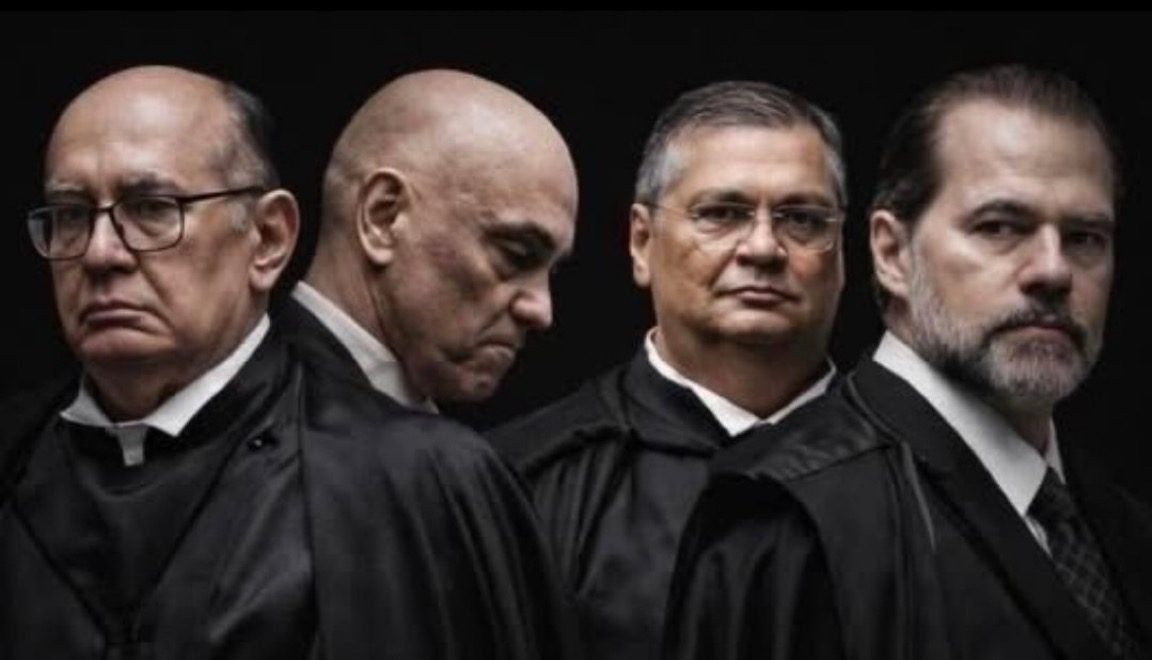
The STF CONVULTION: How Brazil’s Highest Courts Turned an Election Fight Into Institutional Chaos
Brazil is weeks from a presidential vote, and two justices of the Supreme Federal Court are issuing opposite orders about the same posts, the same police chief, and now the same electoral referees. What began as a dispute over a religious rumor has become a rolling collision between the STF and the TSE, with single-judge rulings appearing, vanishing, and reappearing within hours.
That is not normal judicial disagreement. It is a court system improvising power in public.
What exploded this week
On Friday, September 25, Justice André Mendonça, acting as vice-president of the Superior Electoral Court, ordered platforms to take down posts treating as true a claim that Flávio Bolsonaro wanted to strip Nossa Senhora Aparecida of her title as patron saint of Brazil. The Bolsonaro campaign called it a false attack. Mendonça treated it as electoral disinformation and extended the order across similar links.
On Sunday, September 27, Justice Flávio Dino, sitting at the STF, granted a request tied to comedian Antônio Tabet and restored the posts. He went further. He told platforms to put back other content removed on the same ground and signaled that future similar complaints could come to him in the same case. His stated reason: prior restraint, mass censorship, and religious and political speech so close to October 12.
On Monday, September 28, Justice Luiz Fux suspended Dino’s order and put Mendonça’s takedown back in force until the full STF can hear the matter. Fux argued that a single justice should not undo a specialized electoral ruling and then invite every new propaganda fight into the same file.
Same week. Three justices. Three opposite commands. Platforms were told to delete, restore, then delete again.
Reporting on this sequence appeared in G1, CNN Brasil, Valor Econômico, Gazeta do Povo, Veja, Exame, Folha de S.Paulo, and Jornal da Cidade Online.
This was not an isolated spat
The Aparecida fight is the second major Dino–Mendonça collision in September.
Earlier in the month, Mendonça ordered the removal of Federal Police Director-General Andrei Rodrigues after intelligence reports and allegations of improper monitoring. Dino reversed that the next day. He said a political party lacked standing to demand the ouster, that Mendonça was judging a matter in which he himself was named, that the STF president already had the controversy, and that yanking the police command mid-investigation served the investigated more than the law. Veja, Estadão, O Globo, G1, and Folha documented the language: “a party cannot be judge in its own cause.”
Around the same period, the two men sat on opposite sides of the Banco Master scandal, inquiries touching Alexandre de Moraes, and fights over who reports what inside the Court. Dino asked for a full-court session. TSE President Kassio Nunes Marques sent the STF presidency a formal warning about “institutional capture” of the electoral court and about how cases are being steered to preferred justices.
The pattern is the same: one justice issues an emergency order; another justice, often without the full court, undoes it; the presidency of one court complains that the other court is grabbing the steering wheel.
The new request that turned “referee” into the prize
On Monday, Deputy Paulinho da Força of Solidariedade asked Dino to suspend the TSE acts that designated Mendonça, Nunes Marques, and Justice Estela Aranha as auxiliary judges for electoral propaganda. He wanted new names within 24 hours and existing propaganda cases reassigned.
Auxiliary judges of propaganda are not a ceremonial title. They decide takedowns, right-of-reply, forbidden conduct by public officials, and a large share of the daily combat of a campaign. Nunes Marques had placed himself and Mendonça in that pool earlier this year — a move Folha, CartaCapital, and CNN noted was unusual, though not without precedent from Alexandre de Moraes in 2022.
Jornal da Cidade Online framed the petition as Dino being positioned to “remove” Mendonça and touch the election directly. That headline oversells the legal instrument. Dino cannot impeach a colleague. He cannot fire a justice of the STF. What the petition actually seeks is to smash the TSE’s internal assignment of campaign referees and, if granted, open the door for Dino himself — a TSE substitute justice — to sit in that role.
Fux’s Monday ruling already flagged the danger: Dino’s earlier order created a standing doorway for unrelated election requests to skip ordinary distribution and land on a known justice. The Paulinho petition walked through that doorway the next day.
Why this is out of control
First, competence is being treated as optional. The Constitution gives the TSE the last word on electoral administration, subject to STF review when a constitutional right is truly at stake. That review is supposed to be exceptional and, on a question this large, collegial. Here, the exception is becoming the method: petition a friendly chambers, get a weekend order, dare the other side to find another justice before Monday night.
Second, the Court is splitting into camps in public. Coverage in Veja, Brazil Journal, Gazeta do Povo, and Revista Fórum — from opposite political directions — agrees on the map even when they disagree on the villain: Dino aligned with the Moraes wing; Mendonça treated as the opposition justice and Master rapporteur; Fux stepping in as a brake; Fachin trying to keep the building from catching fire. An institution that must certify an election cannot afford to look like two campaign committees in robes.
Third, timing makes every order a campaign act. A takedown or a restoration in late September does not wait for a learned 11-justice opinion in November. Votes move now. That is why both sides reach for the injunction. It is also why the injunction war itself becomes the story, crowding out any calm finding about whether a particular post was false.
Fourth, self-centralization. When a justice restores content and then announces that future like cases should come to him, he is no longer deciding one file. He is redesigning the docket. When a party then asks that same justice to redraw who referees the entire propaganda system, the conflict of role is obvious. Even lawyers who defend Dino’s free-speech holding — CNN quoted constitutionalist João Carlos Souto on STF supremacy — collide with others, such as Rogéria Dotti, who called the precedent “extremely dangerous” because the electoral court must speak last on campaign speech.
Fifth, the public cannot know which order is live. Platforms received delete, restore, delete. Candidates received vindication, then reversal. That is not the rule of law as a citizen experiences it. That is a feed of emergency PDFs.
What a functioning system would do
A functioning system would send the Aparecida dispute to the TSE plenary the same week, send any constitutional challenge to the STF plenary on an emergency calendar, and freeze unilateral redesign of TSE internal assignments until both courts speak as courts. Instead, Brazil is watching named justices write letters about each other while the campaign clock runs.
None of this requires a conspiracy theory. The public record is enough. Mendonça issued an electoral takedown. Dino vacated it from the STF. Fux froze Dino. A party asked Dino to dismantle the TSE propaganda bench. Nunes Marques asked Fachin to stop the capture. Those are documented acts, reported across G1, CNN Brasil, Valor, Gazeta do Povo, Veja, Folha, Estadão, O Globo, Exame, Brazil Journal, and Jornal da Cidade Online.
The out-of-control part is not that judges disagree. They always will. The out-of-control part is that the world’s most consequential court and the court that runs the election are now governing by overnight injunction, personality, and docket shopping, with the first round of voting close enough to touch.
#STF #TSE #Eleicoes2026 #FlavioDino #AndreMendonca #LuizFux #KassioNunesMarques #PropagandaEleitoral #GuerraDeLiminares #Brasil
Sources named in this article: G1, CNN Brasil, Valor Econômico, Gazeta do Povo, Veja, Folha de S.Paulo, Estadão, O Globo, Exame, Brazil Journal, Jornal da Cidade Online, CartaCapital, Revista Fórum.


