

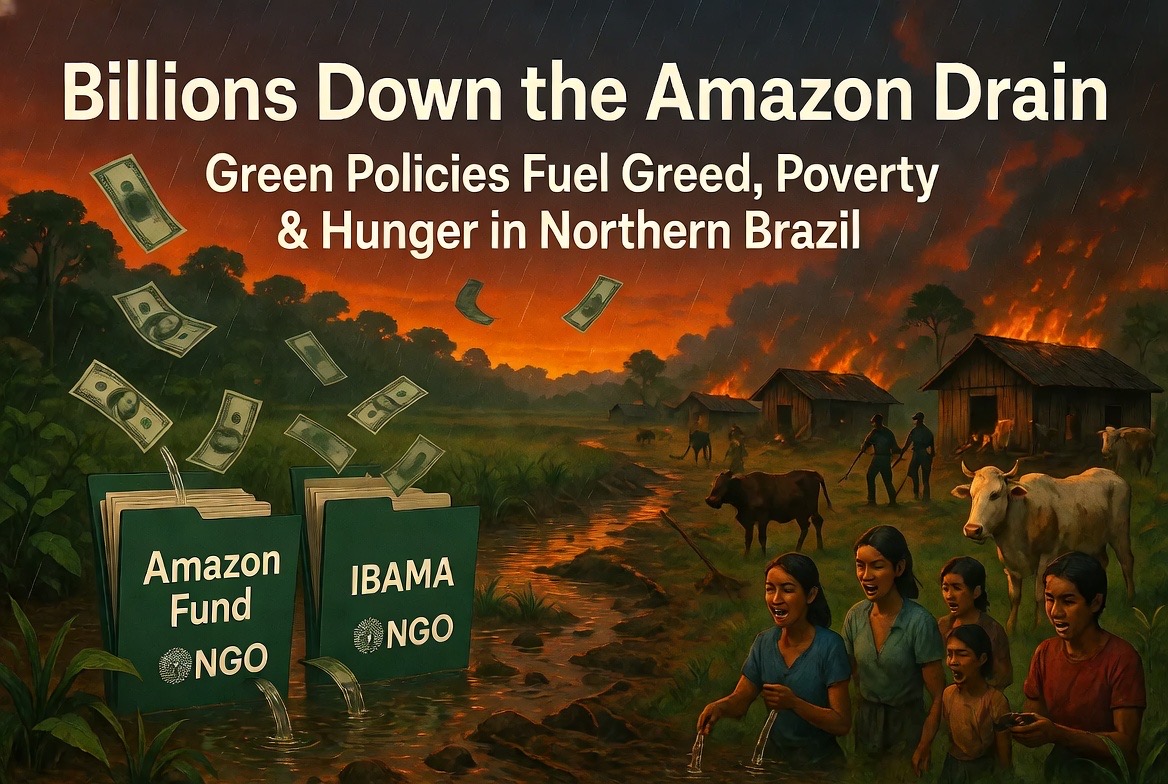

Billions Down the Amazon Drain: How Green Investments Fuel Greed, Bureaucracy, and Hunger in Northern Brazil
By Hotspotnews
While billions in international dollars pour into “saving” the Amazon, the people living there are left poorer and hungrier than ever. Over 80 percent of Northern Brazil’s population faces elevated food exclusion, according to data spotlighted by Senator Plínio Valério. Families cannot afford a basic healthy diet, not because of neglect, but because restrictive environmental policies—enforced by IBAMA, ICMBio, and former Minister Marina Silva—prioritize untouched wilderness over human survival. The tragic irony? Massive foreign funding from governments like Norway and Germany, meant to “protect” the region, has instead bred greed, enriched bureaucrats and NGOs, and deepened poverty.
Norway, the largest donor, has poured billions of Norwegian kroner into the Amazon Fund—totaling over R$ 3.4 billion internalized, with additional pledges like USD 50–60 million in recent years. Germany has contributed around EUR 89.9 million, alongside other donors including the United States, United Kingdom, and others bringing the total past R$ 4.5 billion. These funds flow through Brazil’s BNDES development bank, which administers the scheme, supporting enforcement operations, protected areas, and a web of projects that often benefit connected organizations more than local communities.
These hundreds of millions—and cumulatively billions—support raids by environmental agencies that seize cattle, burn structures, and evict small producers from lands their families have worked for generations. The result? Local economies grind to a halt. Traditional farmers and ranchers, the true stewards of the land, are criminalized as “deforesters” while distant environmental elites, well-connected NGOs, and bureaucratic administrators pocket administrative costs, consulting contracts, and project funding. Senator Valério has repeatedly exposed how these policies show absolute disregard for Amazon residents’ living conditions, as international money flows in but real development stays locked out.
This is not conservation; it is a wealth transfer from hardworking Brazilians and foreign taxpayers to a global green industry. Billions invested yield glossy reports on reduced deforestation metrics, yet the North remains mired in underdevelopment. Infrastructure projects stall under bureaucratic vetoes. Property rights are trampled in favor of exclusion zones. Small-scale agriculture—the very activity that could feed families and build resilience—is strangled by red tape and fines. Instead of empowering locals with clear titles, technical support, and market access, the system creates dependency on aid programs that never address root causes. Greed thrives in the bureaucracy: agencies expand their empires, consultants and NGOs secure lucrative contracts, and foreign donors like Norway and Germany pat themselves on the back at climate summits—all while children in the Amazon go to bed hungry.
True environmental stewardship aligns incentives with people, not against them. Ranchers and farmers who own their land have every reason to manage it sustainably for future generations. But when policies treat them as obstacles, investment flows not into prosperity but into control. The millions and billions spent on enforcement and “payments for environmental services” do little to lift communities out of poverty; they merely subsidize idleness in restricted zones and reward those who navigate the system of permits and prohibitions. Northern Brazil’s food insecurity dwarfs national averages precisely because these top-down schemes lock away resources that could drive real growth.
Brazil’s Amazon belongs to Brazilians, not international climate activists or domestic enforcers chasing quotas and foreign grants. Senator Valério’s warnings highlight a failed model: pouring billions from Norway, Germany, and others into green ideology generates more poverty, resentment, and administrative bloat than solutions. It’s time to redirect priorities toward responsible development—secure property rights, practical farming innovations, and infrastructure that connects producers to markets. Only then can the region balance conservation with the fundamental right of people to feed their families and build wealth. Until policymakers reject this cycle of funded failure, the Amazon’s greatest resource—its resilient people—will continue to pay the price in hunger and lost opportunity.