

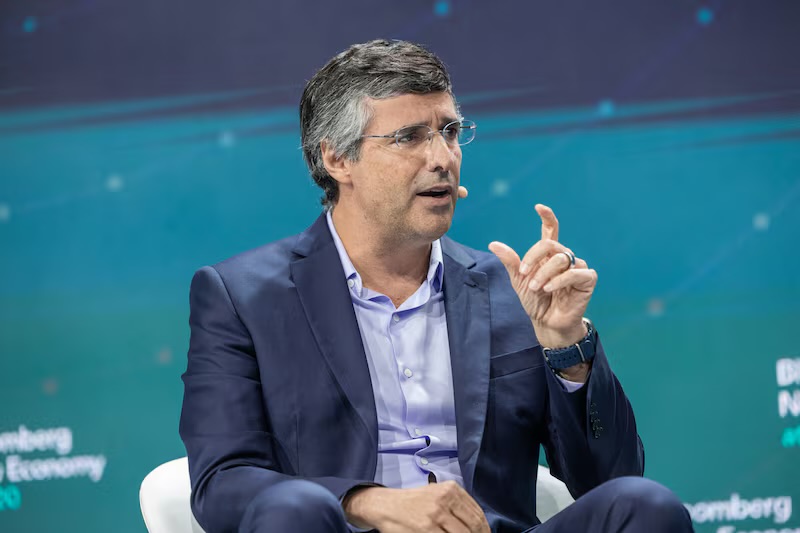

Esteves meets Trump but defended the System
On Saturday, August 29, Brazilian billionaire banker André Esteves sat with President Donald Trump for about 45 minutes at Trump National Golf Club outside Washington. White House chief of staff Susie Wiles was in the room. BTG Pactual confirmed the meeting. Brazilian outlets reported it first through Igor Gadelha at Metrópoles, then Estadão, CNN Brasil, Folha, and Veja.
They talked energy, Latin America, and Venezuela. They also talked about Brazil’s October election. That is the part that matters.
According to Metrópoles, Trump asked Esteves about the Brazilian presidential race. Esteves answered that the electoral system is “reliable” and that the contest is “open.” It is the same formula President Lula gave Trump on the phone on August 21. It is the TSE formula. It is the Brasília formula. It is not the formula the Brazilian right has been trying to put in front of Washington for months.
Trump will read that answer as a left-aligned answer. He should.
The signal Trump actually hears
Donald Trump does not grade Brazilian financiers on Faria Lima pedigree. He grades them on one question that has defined his politics since 2020: do you defend the machines, or do you demand a system a voter can verify without trusting a closed box?
Esteves defended the machines.
That is not a small cultural mismatch. In July, Trump’s own State Department tried to send Riley M. Barnes and Samuel Samson to Brasília to look at election integrity. Itamaraty denied the visas. The Washington Post reported that the trip’s purpose, according to American and Brazilian officials, was to raise questions about transparency in the Brazilian process weeks before the October 4 first round. Brasília treated it as interference. Flávio Bolsonaro had already told diplomats that Brazilian machines shared a lineage with Venezuelan systems and cited a CIA-linked narrative about Smartmatic. The TSE answered that Smartmatic never supplied the urnas or their software, and that the 2025 public security test found no flaw capable of changing a result.
Esteves walked into Trump’s club and sided with the TSE version.
To a president who spent July declassifying U.S. intelligence on election-infrastructure vulnerabilities and who still treats electronic tabulation as a structural risk, that sounds like the other team talking. Not because Esteves wears a red star. Because he repeated the line the other team needs Americans to accept.
He is not a leftist. He is something more useful to the left.
Esteves is chairman of BTG Pactual, Latin America’s largest independent investment bank, a man worth tens of billions who collects energy, fuels, infrastructure, and optionality. He is not a PT militant. He is the type of operator who dines with whoever can clear a deal.
The calendar proves it. On August 19 he had a private dinner with Flávio Bolsonaro at the senator’s house in Brasília’s Lago Sul, according to Metrópoles. Later that week Flávio was working Faria Lima in São Paulo. On August 31, the day the Trump meeting became public, Esteves was due at Lula’s table with other business leaders. Interlocutors told Estadão and Folha he briefed the Planalto before and after he saw Trump.
That is not ideology. That is dual-track insurance.
But dual-track insurance still produces a product. The product Esteves sold Trump on the machines was the product Lula needed sold. A banker who needs licenses, energy concessions, tariff relief, and a functioning relationship with whoever occupies the Palácio does not fly to Washington to tell Trump that Brazil’s electronic system concentrates too much power in a court, that a full nationwide voter-verifiable paper trail still does not exist, or that the 2022 fight never received the forensic airing a conservative electorate demanded. He tells Trump the system is reliable and the race is open.
“Open” is doing a lot of work. Recent polling is tight enough that no serious person should pretend the outcome is settled. BTG/Nexus, Datafolha, PoderData, Indexa/Broadcast and Atlas have shown Lula ahead in most first-round snapshots and a second-round fight inside or near the margin. Esteves’ own bank’s poll, released the morning the meeting leaked, had Lula up in the first round and essentially tied with Flávio in a runoff. Calling that “open” is fair. Calling the machinery beyond legitimate scrutiny is the political choice.
The oil is not a subplot
Metrópoles reported that Venezuela business was on the table and that Esteves has been prospecting oil and gas opportunities there. Other Brazilian coverage framed the same meeting around energy, rare minerals, and data centers — the exact map BTG has been drawing for years.
After the January capture of Nicolás Maduro and the easing of U.S. sanctions, Venezuelan barrels became a hunt. A company backed by Galapagos Capital, founded by a former BTG private-equity partner, has been expanding production in the Orinoco Belt. Brazilian groups, including the Batista orbit, have moved on Venezuelan assets. Esteves has spent a career building energy exposure at home — Cosan/Raízen fuels and ethanol, Eneva power, earlier African oil with Petrobras — and talking about Brazil as a low-cost energy and commodities platform.
So the meeting was not a seminar on civic virtue. It was a 45-minute window with the man who now shapes who gets to buy, finance, and move Venezuelan crude. Private diplomacy is the polite name. Looking after the book is the accurate one.
A conservative does not have to invent a conspiracy to see the conflict. The same person asking Trump to treat Brazil’s electronic election as settled is the same person who needs Washington’s Venezuela energy architecture to stay open to Brazilian capital. Truth-telling about voting systems is not how you keep that door open with Brasília.
How Trump should file him
File Esteves as what he is: a market animal who will praise institutions when institutions control the permits. Do not file him as a left-wing ideologue. Do not file him as a Bolsonaro ally either, despite the Lago Sul dinner. File him as the Brazilian establishment’s preferred translator — the man who can tell Washington the race is competitive while insisting the count itself is beyond politics.
That is the most useful service Lula’s system can receive from a non-leftist. It does not need another militant. It needs a billionaire who sounds like a grown-up and tells the American president the machines are fine.
Trump has heard this voice before, in other countries and in his own. The voice always says the same three things: the system is robust, the questions are dangerous, and the people raising them are the problem. In Brazil those questions did not vanish because a banker repeated the TSE talking points on a golf course. They exist because a closed electronic count, run by a court with enormous political power, was asked to certify its own work after 2022 and then to police the speech of the people who refused to clap.
Flávio Bolsonaro has been clumsy and sometimes sloppy in how he makes the case. That does not make the underlying demand illegitimate: more transparency, more observation, a paper trail a citizen can audit without taking a minister’s word for it. Esteves did not carry that demand into the room. He carried the opposite.
If Trump wanted a briefing from the Brazilian right, he did not get one. He got a briefing from the class that lives between Lula’s dinner and Flávio’s dinner and always leaves both with the same sentence: the system works.
Believe the deals. Discount the civics.
Sources Metrópoles, Igor Gadelha columns, Aug. 28 and Aug. 31, 2026 (Esteves-Flávio dinner; Esteves-Trump meeting, elections and Venezuela) Estadão, Aug. 31, 2026 (confirmation, 45 minutes, Susie Wiles, briefings to Lula) CNN Brasil, Aug. 31, 2026 (BTG confirmation, economic and regional agenda, Lula dinner) Folha, Mônica Bergamo, Aug. 31, 2026 (Planalto informed; energy, rare minerals, data centers) Veja, Aug. 31, 2026 (meeting confirmed; commercial talks backdrop) Washington Post via Brazilian coverage, July 25, 2026 (planned U.S. election-integrity visit; visas denied) TSE statements and 2025 public security test reports (official position on urna security) BTG/Nexus, Datafolha, PoderData, Indexa/Broadcast, AtlasIntel polling, August 2026 Bloomberg / InvestNews, April 2026 (Galapagos/Alvorada Venezuelan oil expansion; former BTG partner)
#Brazil2026 #Trump #AndreEsteves #BTGPactual #FlavioBolsonaro #Urnas #ElectionIntegrity #Venezuela #AmericaFirst #LatAm