

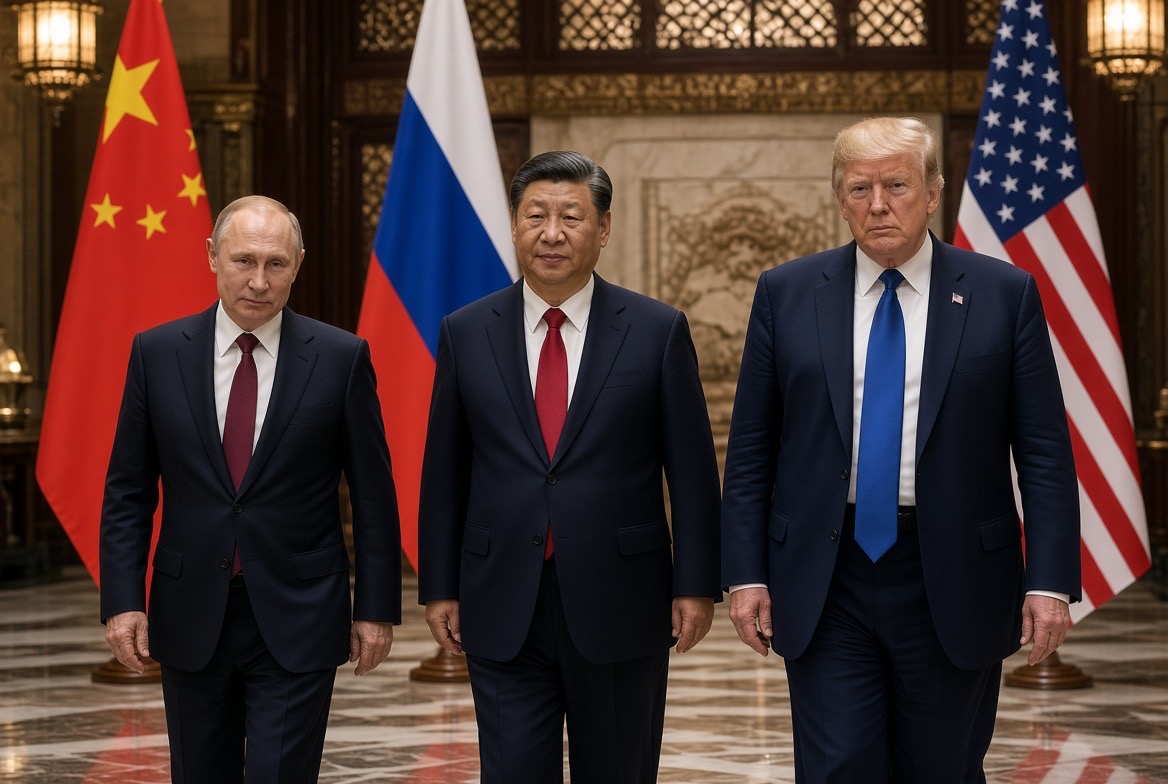

Historic Trilateral Summit in Shenzhen Signals Symbolic Shift Toward Multipolar Dialogue
By Hotspotnews
On November 19, 2026, the leaders of the United States, China, and Russia convened in Shenzhen for the first-ever trilateral summit of their kind. Hosted by Chinese President Xi Jinping on the sidelines of the Asia-Pacific Economic Cooperation meetings, the gathering brought together Xi, U.S. President Donald Trump, and Russian President Vladimir Putin at Kylin Villa. The session lasted roughly an hour and twenty minutes and produced a short joint document titled the China-Russia-US Heads of State Declaration toward Peace.
The meeting carried immediate symbolic weight. Never before had the heads of state of the three largest nuclear powers sat together in this exclusive format. Chinese and Russian officials had long described the international system as moving toward multipolarity, a term they use to describe a world in which influence is more evenly distributed and no single power sets the rules. Xi and Putin used the occasion to restate that view. Xi spoke of a transformation not seen in a century that is accelerating and called for cooperation grounded in respect for each country’s interests and red lines. He emphasized mutual respect, peaceful coexistence, and recognition of core concerns. Putin expressed gratitude for the Chinese hosting and framed the encounter as a new page in diplomacy among permanent members of the United Nations Security Council.
Trump, for his part, described the three nations as sharing a special responsibility to maintain dialogue and address global challenges. He noted that the United States, Russia, and China possess by far the world’s largest nuclear arsenals and are uniquely positioned to discuss reducing nuclear risks. He also raised concerns about what he described as overreach by certain international institutions, including the International Criminal Court, arguing that they have strayed beyond their proper jurisdiction and threaten national sovereignty.
The resulting four-point declaration was modest in substance and largely restated longstanding positions. First, the three leaders, as permanent members of the Security Council, committed to reform of the United Nations so that it can respond more effectively to global challenges while fulfilling its core mission of international peace and security. Second, they announced plans to increase the production and supply of refined petroleum products for the benefit of all nations and reaffirmed the importance of stable energy flows. Third, they recognized the principle of state consent and the immunities of state officials as paramount, and they concurred that the International Criminal Court and similar bodies must not abuse their jurisdiction. Fourth, they reaffirmed that a nuclear war cannot be won and must never be fought, and they agreed to conduct a dialogue on reducing nuclear risks and preventing the proliferation of nuclear weapons.
Notably absent from both the public remarks and the declaration were any specific references to the war in Ukraine, the status of Taiwan, or concrete arms-control measures with timelines or verification mechanisms. No new agreements on sanctions relief, territorial questions, or institutional redesign emerged. The language on nuclear weapons repeated formulations that all three governments have endorsed for years. The energy pledge contained no volumes, deadlines, or details about particular supply routes. The provision on official immunities drew particular attention because Putin faces an outstanding International Criminal Court indictment related to the conflict in Ukraine; the joint text effectively reinforced the long-standing position of all three capitals that such courts should not exercise jurisdiction over sitting heads of state without consent.
Analysts and officials outside the three capitals offered mixed readings. Supporters of the meeting argued that any direct conversation among nuclear-armed powers is preferable to prolonged silence, because it can lower the chance of miscalculation on existential issues. Energy cooperation and nuclear-risk dialogue, even in general terms, address shared practical interests. Critics countered that the optics and wording primarily served Chinese and Russian narratives of a post-Western order. They noted that the multipolar framing advanced by Beijing and Moscow has historically accompanied efforts to limit the reach of existing alliances, sanctions regimes, and human-rights mechanisms while protecting their own territorial claims. Several European and Ukrainian voices expressed concern that great-power talks conducted without the participation of directly affected states risk recreating the appearance of spheres-of-influence bargaining. Comparisons to the 1945 Yalta Conference appeared in commentary, though most observers judged them overstated: the Shenzhen session produced no territorial maps and lacked the wartime legitimacy or decisive military context of the earlier meeting.
From the standpoint of follow-through, the summit’s value will be measured by whether the promised nuclear dialogue yields concrete steps—such as clearer communication channels or restraints on the most destabilizing systems—or remains a restatement of principle. The same test applies to the energy and United Nations language. Absent such steps, the encounter functions mainly as a diplomatic milestone that acknowledges the distribution of power among the three states while leaving their deeper conflicts unresolved.
In short, the Shenzhen summit registered a clear shift in format and public framing. It placed the leaders of the United States, China, and Russia at the same table and produced a joint statement that emphasizes dialogue, nuclear restraint, energy stability, and limits on certain international courts. Whether that statement becomes the foundation for reduced risks or simply another chapter in long-running great-power competition will depend on actions taken after the cameras left the room.
TrumpXiPutin #ShenzhenSummit #MultipolarWorld #APEC2026 #NuclearDialogue #USChinaRussia
Sources
- CGTN: Full text of the China-Russia-US Heads of State Declaration toward Peace (published November 19, 2026).
- Reuters: Coverage of the summit, the peace declaration, and post-meeting details (November 18–19, 2026).
- Al Jazeera: “Groundbreaking” Trump-Xi-Putin summit: Five key takeaways (November 19, 2026).
- Bloomberg: Full statements from Trump, Putin, and Xi at the unprecedented sit-down (November 19, 2026).
- The Business Times / related outlets: Transcript-style accounts of the leaders’ opening remarks.
- The National and The Wire: Publication and summary of the four-point declaration text.
- Vox Luci and similar analyses: Breakdown of the declaration’s four points and lack of concrete commitments.
- The New Yorker: Commentary on the summit in the context of historical comparisons (Yalta).
- The Guardian: Editorial perspective on the meeting’s significance and limitations.
- Brookings Institution: Analysis of strategic implications for the United States in the triangular relationship.
- Additional contemporaneous reporting from RFE/RL, Global Times, and other outlets covering the APEC sideline meeting, timing, and absence of Ukraine/Taiwan references.