Close Menu

    Subscribe to Updates

    Get the latest creative news from HOTSPOT ORLANDO NEWS about , politics, health, tourism and business.

    What's Hot

    The Danger of Denying Divine Sovereignty: How Pride Can Lead Nations to Ruin

    24 de June de 2026

    The Cost of Costly Vanity: How the Pursuit of Expensive Popularity Led One Banker to Ruin

    24 de June de 2026

    Brazilian Media’s Lazy Spin Exposed: No ‘Victory’ for Censorship Judge Moraes in U.S. Court

    24 de June de 2026
    Facebook X (Twitter) Instagram
    Facebook X (Twitter) Instagram
    HotspotOrlandoNewsHotspotOrlandoNews
    • Home
    • Brazil
    • Business
    • Politics
      1. Elections
      2. View All

      Lula’s Economic Mismanagement Triggers Record Wave of Brazilian Business Failures

      28 de March de 2026

      Flávio Bolsonaro’s Uncompromising Vision. Cleaning up Lula’s mess

      10 de March de 2026

      Record R$1 Trillion Interest Payments Expose Lula’s Spending Spree

      31 de January de 2026

      Hamilton Mourão’s Treacherous Legacy

      3 de October de 2025

      Brazilian Taxpayers Forced to Bankroll Defense of Moraes

      24 de June de 2026

      TSE Delivers Blow to Leftist Smear Campaign Against Flávio Bolsonaro

      24 de June de 2026

      Lula’s IBAMA: Bureaucratic Tyranny Against Brazil’s Farmers

      24 de June de 2026

      Trump’s Bold Stand: Brazil Emerges as the Next Front in America First Trade Wars

      23 de June de 2026
    • Economy

      Lula’s Travel Spree: Billions Wasted on Taxpayer with No Accountability

      15 de June de 2026

      Brazil’s Push to Kill the 6×1 Work Schedule Smells of Old PT Corruption

      10 de June de 2026

      Why Nearly Half of Brazilians Miss Bolsonaro’s Economy

      5 de May de 2026

      Lula’s Spending Spree: Brazil Heads for Big Trouble with Record Deficit

      1 de May de 2026

      Hegseth Delivers Major Victory for Taxpayers: Pentagon Axes $580 Million in Wasteful Spending

      9 de April de 2026
    • Tech
    • Behavior
    • USA
    • World
    HotspotOrlandoNewsHotspotOrlandoNews
    Home » Trump signs order imposing tariffs on Canada, Mexico and China
    Sem categoria

    Trump signs order imposing tariffs on Canada, Mexico and China

    HotspotorlandoNewsBy HotspotorlandoNews1 de February de 2025No Comments8 Mins Read
    Facebook Twitter Pinterest LinkedIn Tumblr Email
    Share
    Facebook Twitter LinkedIn Pinterest Email

    Story by David J. Lynch, Mary Beth Sheridan, Amanda Coletta

    For the Washington Post

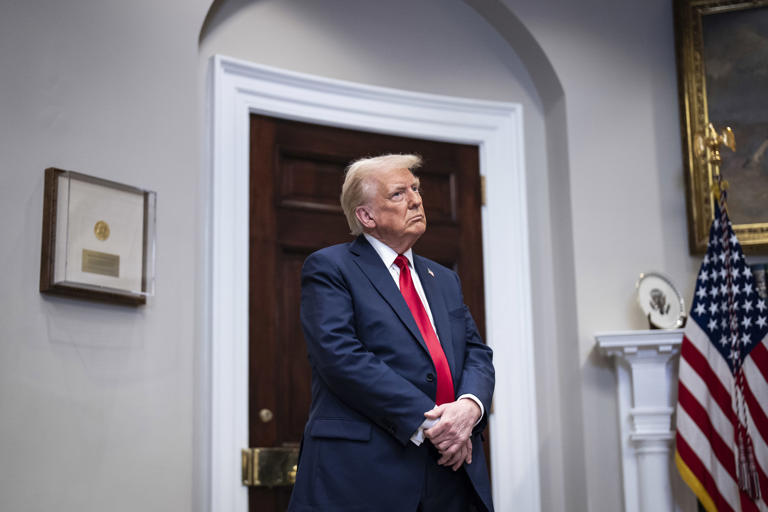
    President Donald Trump on Saturday imposed tariffs on imports from Canada, Mexico and China, the nation’s three largest trading partners, invoking emergency economic powers in high stakes bid to compel them to crack down on illegal immigration and drugs reaching the United States.

    The president signed three executive orders establishing the measures, the first official actions of his second-term trade war, according to a White House official who briefed reporters.

    They drew immediate opposition from business and labor groups, who warned of profound upheaval throughout the economy.

    Effective Tuesday at 12:01 a.m. Eastern time, American importers will pay a new 25-percent tax on goods from Canada and Mexico and a 10-percent levy on products from China, the president said. Most products from Canada and Mexico currently face no tariffs, under a trade deal Trump signed during his first term, while many Chinese goods incur taxes of up to 25 percent. The new tariffs are in addition to those fees.

    Energy products, including crude oil from Canada, will suffer a 10 percent charge.

    If any of the three countries retaliate with their own tariffs on U.S. goods — as is likely — the president threatened to increase the applicable tariff rate in response.

    “A Nation without borders is not a nation at all. I will not stand by and allow our sovereignty to be eroded, our laws to be trampled, our citizens to be endangered, or our borders to be disrespected anymore,” the president wrote.

    The president complained that Chinese fentanyl shipments are making their way to the United States via Mexico and Canada. He criticized the Chinese government for failing to fulfill its promises to reduce fentanyl output. And in remarkably blunt and almost hostile terms, he assailed two of the closest U.S. allies for their role in facilitating the drug trade.

    Canada’s failure to take tougher action against fentanyl operations, he said, constituted an “unusual and extraordinary threat” while the Mexican government maintained “an intolerable alliance” with the drug cartels in that country.

    The tariffs will remain in place until the president determines that Canada “has taken adequate steps to alleviate this public health crisis.”

    The president also suspended de minimis rules for Canada that allow small packages valued at less than $800 to enter the United States on a duty-free basis.

    Representatives of business and labor were quick to voice their concerns.

    “The USW has long called for systemic reform of our broken trade system, but lashing out at key allies like Canada is not the way forward,” said David McCall, president of the United Steelworkers union. “These tariffs don’t just hurt Canada. They threaten the stability of industries on both sides of the border.”

    The sweeping presidential actions were welcomed, however, by longtime critics of U.S. trade policies that concentrated on removing barriers to cross-border commerce

    “President Trump’s decision to impose universal tariffs is a bold and necessary step toward reversing decades of failed trade policies and rebuilding America’s manufacturing and agricultural industries,” said Zach Mottl, chairman of the Coalition for a Prosperous America.

    Today’s actions focused on Trump’s concerns about illegal immigration and drugs flowing across U.S. borders. But his complaints about Canada and Mexico are far broader.

    In the past, he also has lashed out over the large U.S. trade deficits with each country. Steep U.S. tariffs are aimed at incentivizing manufacturers to make their products in the United States with American workers rather than ship them here from aboard.

    Many economists are skeptical about prospects for success. In Trump’s first term, factory employment rose by 462,000 before flatlining in the year before the pandemic.

    For the typical American household, the tariffs will mean a loss of about $1,200 in annual purchasing power, according to the Budget Lab at Yale University, a nonpartisan research center.

    American companies and consumers purchased about $1.3 trillion worth of merchandise from those three countries, including food, electronics, cars and car parts, and clothing, according to the Census Bureau.

    Trump’s abrupt imposition of steep tariffs on goods moving across U.S. borders threatens significant disruption for regional supply chains that have become deeply intertwined over the past three decades. The auto industry in particular could soon be plunged into enormous upheaval.

    There is no provision in the president’s orders for companies to seek an exemption from the tariffs for items that are unavailable from suppliers outside of North America, according to the White House official, who spoke under on condition of anonymity to share details on the orders.

    Apart from the tariffs’ economic impact, Trump’s action is notable for calling into question one of the signature achievements of his first term in office: the United States-Mexico-Canada Agreement (USMCA).

    By placing tariffs on Canada and Mexico, Trump is effectively ripping up that deal, which replaced the North American Free Trade Act (NAFTA) and took effect less than five years ago. Trump initially proclaimed his NAFTA rewrite “the most modern, up-to-date, and balanced trade agreement in the history of our country.”

    The agreement included a provision for the three countries to review the deal on July 1, 2026, make recommendations for its improvement or begin a 10-year countdown to ending the pact. Today’s tariffs may be just a negotiating tactic, designed to wring concessions over border controls from Mexico and Canada, many Wall Street analysts believe.

    But if they are wrong and the tariffs become permanent fixtures, “it would practically implode the USCMA trade deal,” economist Wilson Ferrarezi of TS Lombard wrote in a client note Friday.

    Ken Salazar, who served as U.S. ambassador to Mexico under President Joe Biden, wrote on the social media site X that the tariffs “threaten billions in trade, weaken national security, and won’t solve the fentanyl or migration crises.”

    Trump campaigned on a promise to impose the stiffest trade barriers since the 1930s. He first spoke of the measures he announced today on the first full day of his second term before expanding his tariff plans Friday to include the European Union as well as specific goods such as semiconductors, pharmaceuticals, steel, cement and oil and gas.

    The president’s announcement Saturday capped a prolonged administration debate. At issue were the legal rationale for tariff action; the timing; potential exemptions; and measure of success, according to two people familiar with the deliberations who spoke on the condition of anonymity.

    Since USMCA went into effect, U.S. trade with Mexico has grown especially fast.

    U.S. reliance on Mexico as a source of imports has increased over the past several years. Through November 2024, almost 16 percent of the $3 trillion in merchandise that the United States purchased from other countries came from Mexican factories, according to Census Bureau data.

    In 2017, before Trump’s first tariffs on Chinese products began reshaping global supply chains, around 13 percent of imports came from Mexico.

    IBC Bank in Laredo, Texas, which specializes in servicing cross-border commerce has seen its assets grow by more than $3 billion or 27 percent since the new agreement took effect.

    From his office window, Gerald Schwebel, the bank’s executive vice president, can see the steady flow of trucks carrying goods back and forth between the United States and Mexico, little more than five miles away. On the other side of the bank’s headquarters, freight trains belonging to the Canadian Pacific Kansas City Railway haul grain, lumber, fuel, chemicals, steel, cement, cars, food and appliances along a corridor that links the three nations.

    Before NAFTA took effect in 1994, the unemployment rate in Laredo topped 10 percent. It’s hovered around 4 percent for the last few years, according to the Bureau of Labor Statistics.

    “Laredo is a prime example of the benefits of North-South trade as a result of USMCA and NAFTA,” said Schwebel.

    Indeed, jobs in the city — home to the nation’s largest inland port — have grown slightly faster than the national average since the new trade deal was implemented.

    In other respects, USMCA has been less impressive.

    Robert E. Lighthizer, Trump’s first-term trade negotiator, designed the deal to promote more domestic manufacturing than its predecessor.

    Tougher “rules of origin” required 40 percent of passenger cars to contain parts produced by workers making an hourly wage of at least $16, far more than Mexican factories pay.

    The most recent International Trade Commission assessment in 2023 found, however, that the new rules “had a negligible impact on GDP and aggregate employment in the U.S. economy.”

    In the treaty’s first two-and-a-half years, only 35 new jobs in U.S. vehicle production were created, the ITC said.

    For Trump administration officials, including Secretary of State Marco Rubio, a key concern is the growing presence in Mexico of Chinese manufacturers. Many are there to serve Mexican customers. But U.S. officials worry that some Chinese companies, especially makers of electric vehicles, may hope to use Mexico as a tariff-free backdoor to the U.S. market.

    As the first North American trade war begins, some analysts say Mexico and Canada stand to lose more than the United States. The impact on those economies of a three-way tariff conflict could be several times larger than in the United States, which is much less dependent on trade, according to an analysis by S&P Global Ratings.

    Mexican manufacturers in the auto and electrical equipment sectors could see significant output declines once tariffs take hold, according to a S&P Global Ratings analysis.

    In Canada, the biggest losers are likely to be makers of paper products, rubber and plastics.

    Featured tariffsm Mexico trade USA
    Share. Facebook Twitter Pinterest LinkedIn Tumblr Email
    HotspotorlandoNews
    • Website
    • Facebook
    • X (Twitter)
    • Instagram
    • LinkedIn

    Related Posts

    A Conservative Perspective on Applying the Lessons of Reagan, Thatcher, and John Paul II to Brazil

    23 de June de 2026

    China’s Economic Aggression: Beijing Bans American Defense

    22 de June de 2026

    Qatari Delegation Delivers Jaw-Dropping Snub to Vice President JD Vance

    22 de June de 2026
    Leave A Reply Cancel Reply

    Our Picks

    Shakira in Rio: the biggest party of the year

    3 de May de 2026

    Lula is Desperate and Panics as Flávio Bolsonaro Surges to Victory

    15 de April de 2026

    The Storm Brewing in Brasília: Vorcaro’s Imminent Confession and the Elite’s Panic

    21 de March de 2026

    Moraes’ Vicious Snub: Bolsonaro Rushed to Hospital in Ambulance as Judicial Coup Claims Another Victim

    13 de March de 2026
    Stay In Touch
    • Facebook
    • Twitter
    • Pinterest
    • Instagram
    • YouTube
    • Vimeo
    Don't Miss

    The Danger of Denying Divine Sovereignty: How Pride Can Lead Nations to Ruin

    Behavior 24 de June de 2026

    The Danger of Denying Divine Sovereignty: How Pride Can Lead Nations to Ruin By Hotspotnews…

    The Cost of Costly Vanity: How the Pursuit of Expensive Popularity Led One Banker to Ruin

    24 de June de 2026

    Brazilian Media’s Lazy Spin Exposed: No ‘Victory’ for Censorship Judge Moraes in U.S. Court

    24 de June de 2026

    BRAZIL SHAME! The Nation Can’t Afford This Abuse

    24 de June de 2026

    Subscribe to Updates

    Get the latest creative news from SmartMag about art & design.

    Facebook X (Twitter) Instagram
    • Home
    • Brazil
    • Business
    • Financial
    • Education
    • Elections
    • ECONOMY
    • Media & Culture
    • Events
    • Lifestyle
    • Politics
    • Sports
    • LOCAL
    • Gastronomy
    • USA
    • World
    Grupo CALONE® Todos os direitos reservados. DBIPro© Copyright 2026.

    Type above and press Enter to search. Press Esc to cancel.