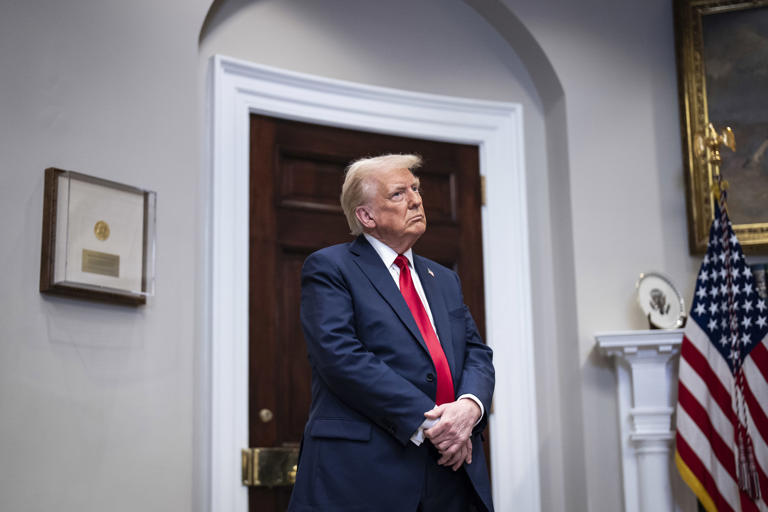
Today’s actions focused on Trump’s concerns about illegal immigration and drugs flowing across U.S. borders. But his complaints about Canada and Mexico are far broader.
In the past, he also has lashed out over the large U.S. trade deficits with each country. Steep U.S. tariffs are aimed at incentivizing manufacturers to make their products in the United States with American workers rather than ship them here from aboard.
Many economists are skeptical about prospects for success. In Trump’s first term, factory employment rose by 462,000 before flatlining in the year before the pandemic.
For the typical American household, the tariffs will mean a loss of about $1,200 in annual purchasing power, according to the Budget Lab at Yale University, a nonpartisan research center.
American companies and consumers purchased about $1.3 trillion worth of merchandise from those three countries, including food, electronics, cars and car parts, and clothing, according to the Census Bureau.
Trump’s abrupt imposition of steep tariffs on goods moving across U.S. borders threatens significant disruption for regional supply chains that have become deeply intertwined over the past three decades. The auto industry in particular could soon be plunged into enormous upheaval.
There is no provision in the president’s orders for companies to seek an exemption from the tariffs for items that are unavailable from suppliers outside of North America, according to the White House official, who spoke under on condition of anonymity to share details on the orders.
Apart from the tariffs’ economic impact, Trump’s action is notable for calling into question one of the signature achievements of his first term in office: the United States-Mexico-Canada Agreement (USMCA).
By placing tariffs on Canada and Mexico, Trump is effectively ripping up that deal, which replaced the North American Free Trade Act (NAFTA) and took effect less than five years ago. Trump initially proclaimed his NAFTA rewrite “the most modern, up-to-date, and balanced trade agreement in the history of our country.”
The agreement included a provision for the three countries to review the deal on July 1, 2026, make recommendations for its improvement or begin a 10-year countdown to ending the pact. Today’s tariffs may be just a negotiating tactic, designed to wring concessions over border controls from Mexico and Canada, many Wall Street analysts believe.
But if they are wrong and the tariffs become permanent fixtures, “it would practically implode the USCMA trade deal,” economist Wilson Ferrarezi of TS Lombard wrote in a client note Friday.
Ken Salazar, who served as U.S. ambassador to Mexico under President Joe Biden, wrote on the social media site X that the tariffs “threaten billions in trade, weaken national security, and won’t solve the fentanyl or migration crises.”
Trump campaigned on a promise to impose the stiffest trade barriers since the 1930s. He first spoke of the measures he announced today on the first full day of his second term before expanding his tariff plans Friday to include the European Union as well as specific goods such as semiconductors, pharmaceuticals, steel, cement and oil and gas.
The president’s announcement Saturday capped a prolonged administration debate. At issue were the legal rationale for tariff action; the timing; potential exemptions; and measure of success, according to two people familiar with the deliberations who spoke on the condition of anonymity.
Since USMCA went into effect, U.S. trade with Mexico has grown especially fast.
U.S. reliance on Mexico as a source of imports has increased over the past several years. Through November 2024, almost 16 percent of the $3 trillion in merchandise that the United States purchased from other countries came from Mexican factories, according to Census Bureau data.
In 2017, before Trump’s first tariffs on Chinese products began reshaping global supply chains, around 13 percent of imports came from Mexico.
IBC Bank in Laredo, Texas, which specializes in servicing cross-border commerce has seen its assets grow by more than $3 billion or 27 percent since the new agreement took effect.
From his office window, Gerald Schwebel, the bank’s executive vice president, can see the steady flow of trucks carrying goods back and forth between the United States and Mexico, little more than five miles away. On the other side of the bank’s headquarters, freight trains belonging to the Canadian Pacific Kansas City Railway haul grain, lumber, fuel, chemicals, steel, cement, cars, food and appliances along a corridor that links the three nations.
Before NAFTA took effect in 1994, the unemployment rate in Laredo topped 10 percent. It’s hovered around 4 percent for the last few years, according to the Bureau of Labor Statistics.
“Laredo is a prime example of the benefits of North-South trade as a result of USMCA and NAFTA,” said Schwebel.
Indeed, jobs in the city — home to the nation’s largest inland port — have grown slightly faster than the national average since the new trade deal was implemented.
In other respects, USMCA has been less impressive.
Robert E. Lighthizer, Trump’s first-term trade negotiator, designed the deal to promote more domestic manufacturing than its predecessor.
Tougher “rules of origin” required 40 percent of passenger cars to contain parts produced by workers making an hourly wage of at least $16, far more than Mexican factories pay.
The most recent International Trade Commission assessment in 2023 found, however, that the new rules “had a negligible impact on GDP and aggregate employment in the U.S. economy.”
In the treaty’s first two-and-a-half years, only 35 new jobs in U.S. vehicle production were created, the ITC said.
For Trump administration officials, including Secretary of State Marco Rubio, a key concern is the growing presence in Mexico of Chinese manufacturers. Many are there to serve Mexican customers. But U.S. officials worry that some Chinese companies, especially makers of electric vehicles, may hope to use Mexico as a tariff-free backdoor to the U.S. market.
As the first North American trade war begins, some analysts say Mexico and Canada stand to lose more than the United States. The impact on those economies of a three-way tariff conflict could be several times larger than in the United States, which is much less dependent on trade, according to an analysis by S&P Global Ratings.
Mexican manufacturers in the auto and electrical equipment sectors could see significant output declines once tariffs take hold, according to a S&P Global Ratings analysis.
In Canada, the biggest losers are likely to be makers of paper products, rubber and plastics.