



Brazil’s gold stock is 30th in the world.
Brazil’s two gold-buying rounds were both central-bank decisions, but they were not the same size or the same price. Together they lifted the country to a modern high of 172.4 tonnes. That is still only about 30th among official holders.
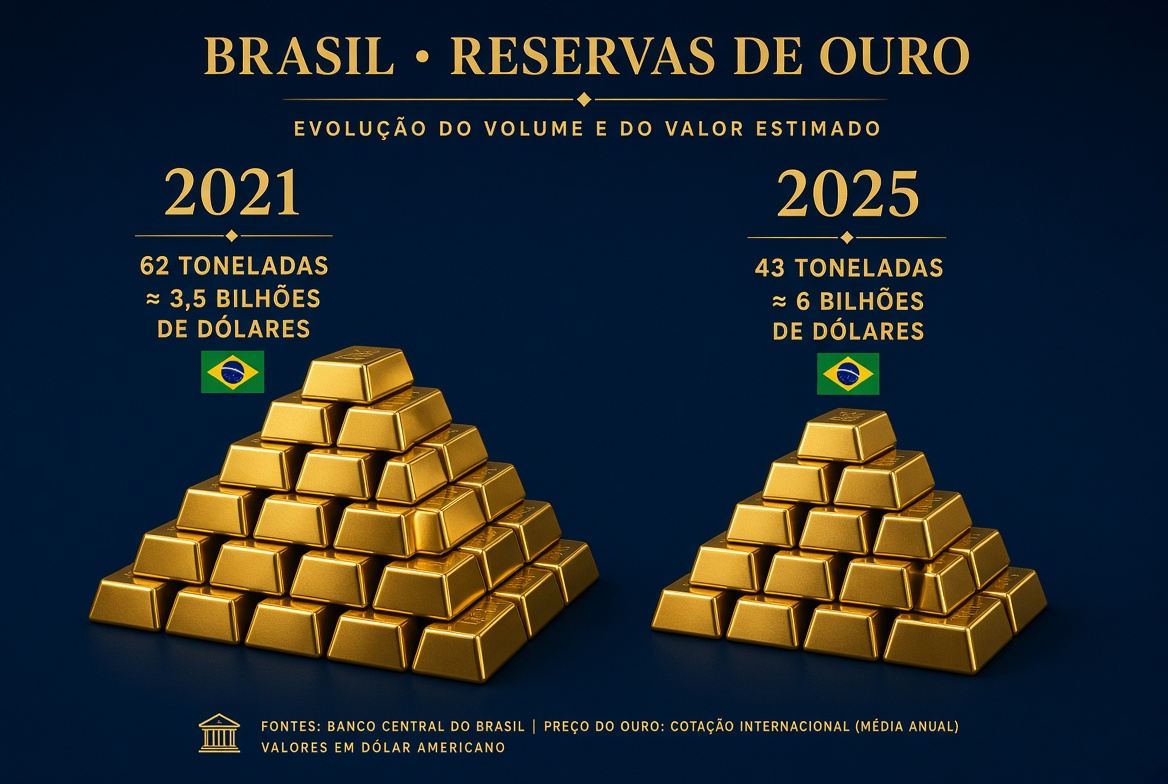
The larger stack was added while Jair Bolsonaro was president. Between May and July 2021 the Banco Central do Brasil bought about 62.3 tonnes, lifting official holdings from roughly 67 tonnes to 129.7 tonnes. June alone accounted for 41.8 tonnes, the biggest monthly purchase in the series that starts in December 2000. Roberto Campos Neto was central-bank president. After those three months, the gold stock was worth about $7.6 billion. At mid-2021 prices near $1,800 an ounce, the new metal itself was on the order of $3.5 billion.
The smaller stack was added during Luiz Inácio Lula da Silva administration. Between September and November 2025 the central bank bought about 42.8 tonnes, taking holdings from 129.6 tonnes to 172.4 tonnes. That was the first net buying since 2021. Gabriel Galípolo was central-bank president by then. At late-2025 prices around $4,300 an ounce, those 43 tonnes were worth about $6 billion. The market value of the whole gold position nearly doubled over 2025, from about $11.7 billion in January to $23.3 billion in November, because price did as much work as tonnage.
Weight favors the Bolsonaro-era round by roughly 20 tonnes. Cost favors the Lula-era round: fewer bars, a much higher invoice. Gold’s share of reserves also tells the story. It was about 1–2% after the 2021 buys and about 6.5–7.2% after the 2025 buys, the highest share since the central bank’s current reserve series began in 2016. The dollar’s share fell to about 72%, a low for that series.
Rank is the other half of the picture. In the IMF’s latest compiled table, Brazil’s 172.4 tonnes place it about 30th in the world, just behind Algeria and Iraq, and first in Latin America. That is roughly 0.5% of all official gold. The top of the same list is still the United States at 8,133.5 tonnes, then Germany, the IMF, Italy, and France. China’s reported stock, about 2,410 tonnes after its September 2026 addition, is more than 14 times Brazil’s.
Neither purchase was a presidential order. Brazil’s central bank allocates reserves. Both rounds were made abroad, and neither administration has published the seller. What the record does show is pace, price, and place: 62 tonnes in a cheaper market in 2021, 43 tonnes in a much dearer market in 2025, and a national stock that is a domestic record and still a mid-table holding.
Sources: Banco Central do Brasil reserve reports; IMF International Financial Statistics and World Gold Council reserve tables; reporting by Estadão, CNN Brasil, and Reuters.
#Gold #Brazil #Bolsonaro #Lula #CentralBank #Reservas #Bullion #BCB


