


Brazil’s Shameful Betrayal: The Brutal X-Ray of Lula’s Treacherous Sell-Out to the Chinese Communist Regime and the Catastrophic Peril of Beijing’s Takeover of Latin America
By Hotspotnews
In the halls of power in Brasília, a quiet but catastrophic betrayal is unfolding—one that threatens not just Brazil’s hard-won sovereignty but the entire Western Hemisphere and, by extension, the free world’s strategic balance against the Chinese Communist Party. While conservatives like Eduardo Bolsonaro sound the alarm by sharing raw footage of U.S. Southern Command warnings, the Lula administration marches forward as Beijing’s eager cheerleader, peddling “multipolarity” and “Global South solidarity” as noble ideals while handing over critical infrastructure, economic lifelines, and military partnerships to an authoritarian regime that answers only to Xi Jinping. This is no benign trade partnership. It is a calculated erosion of national independence, a debt-fueled Trojan horse that positions Latin America as a forward operating base for Chinese power projection. The stakes could not be higher: if unchecked, this escalation risks turning the backyard of the United States into a Chinese sphere of influence, endangering global supply chains, military readiness, and the very foundations of democratic sovereignty.
The evidence is stark and irrefutable, laid bare in recent congressional testimony by U.S. Marine Gen. Francis Donovan, commander of Southern Command. On March 17, 2026, Donovan told the House Armed Services Committee that the U.S. military is actively tracking 23 Chinese-linked port projects across Latin America, along with at least 12 space-enabling facilities. Every single one is viewed as a potential dual-use asset—civilian today, but readily convertible to military logistics, intelligence gathering, cyber operations, or resupply hubs in a crisis. These are not abstract concerns. Chinese state-owned enterprises dominate these projects, giving Beijing operational control over chokepoints vital to commodity exports like soy, iron ore, oil, and critical minerals. Ports are not neutral commercial ventures when run by companies that report directly to the Chinese Communist Party. They become footholds for surveillance, denial of access, or even forward basing—exactly the kind of “military-civil fusion” strategy the CCP has perfected elsewhere.
Brazil stands at the epicenter of this creeping domination, its size, resources, and BRICS platform making it the prize Beijing covets most. Under Lula’s watch, bilateral trade has exploded to record levels, with China now accounting for nearly 30 percent of Brazil’s foreign commerce. Brazilian exports—primarily raw commodities like soybeans, iron ore, beef, and oil—flow eastward in massive volumes, generating short-term surpluses that Lula’s government touts as proof of “pragmatic” success. Yet this dependence is a one-way street. China floods Brazil with manufactured goods, machinery, and low-tech “green” investments while extracting maximum leverage. Chinese firms have poured tens of billions into energy, agribusiness, mining, and now logistics. Power China alone claims over $4 billion already invested and is aggressively studying new highways, railways, and energy projects to help Brazil boost its freight rail share from a dismal 20 percent to 35 percent. That means auctions for over 9,000 kilometers of rail concessions worth more than $25 billion—projects Chinese state giants are lining up to dominate.
The crown jewel of this strategy is the bi-oceanic railway corridor, a transcontinental megaproject linking Brazil’s Atlantic ports directly to Peru’s Chancay deep-water megaport. Chancay, inaugurated with fanfare by Xi Jinping himself, is 60 percent controlled by COSCO Shipping, a state-owned behemoth that answers to the Party. When fully operational, it slashes shipping times and costs for Brazilian commodities straight to Asian markets—bypassing the Panama Canal and traditional Western routes. Brazilian officials celebrate it as economic salvation. In reality, it locks Brazil into a Chinese-controlled logistics artery, where decisions on operations, data flows, and upgrades serve Beijing’s interests first. Add in growing Chinese stakes at key Brazilian ports like Santos and Açu—where firms like China Merchants and Shanghai International Port are modernizing terminals and eyeing majority control—and the picture is clear: Brazil’s export economy is increasingly at the mercy of CCP-linked operators.
This infrastructure capture extends to critical minerals, the lifeblood of the 21st-century economy. Chinalco has seized majority control of bauxite and alumina assets. CMOC dominates gold and nickel plays. Brazil holds the world’s largest reserves of rare earths outside China, yet Lula’s government has snubbed U.S. overtures for partnerships that would prioritize Western buyers and transparent standards. Instead, deals favor Beijing, ensuring China maintains its stranglehold on global supply chains for batteries, electronics, and defense technologies. The result? Brazil exports raw materials and imports finished Chinese products, hollowing out domestic industry and deepening technological dependence. Labor controversies swirl around Chinese factories—BYD’s EV plants in Bahia have drawn complaints about imported workers and opaque practices—yet the government looks the other way in the name of “investment.”
Even more disturbing is the military dimension, where Lula’s Brazil has positioned itself as a willing stage for Chinese power projection. In 2024, the Formosa multinational amphibious exercise—hosted by Brazil—marked the first time PLA Marines trained alongside (if not jointly with) U.S. forces. The optics were a propaganda win for Beijing. Washington, rightly alarmed, boycotted subsequent iterations involving Chinese troops and has signaled it will return only when the PLA is excluded. Yet Lula’s administration continues to host Chinese hospital ship visits and deepen defense dialogues, all while preaching “active non-alignment.” This is not balance; it is complicity. By embedding Chinese military elements into regional drills and infrastructure, Brazil normalizes the PLA’s presence in the Western Hemisphere, eroding interoperability with traditional U.S. partners and signaling to smaller neighbors that cozying up to Beijing carries no cost.
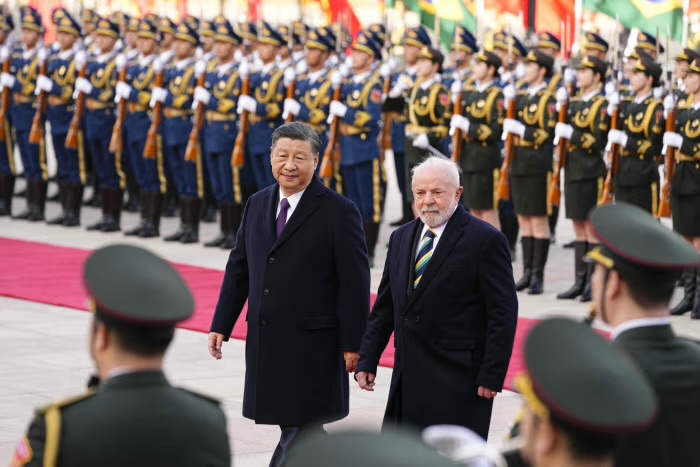
Lula’s rhetoric amplifies the danger. In repeated summits and calls with Xi—most recently in early 2026—the Brazilian leader echoes Beijing’s talking points verbatim: “upholding multilateralism,” “opposing hegemony,” “building a community with a shared future,” and pushing de-dollarization through BRICS. Visa exemptions for Chinese citizens, local-currency trade deals, and resistance to Western scrutiny of these projects are sold domestically as defending sovereignty. In truth, they accelerate the very erosion of it. Brazil’s government frames heavy reliance on opaque Chinese loans and concessions as “filling infrastructure gaps” left by bureaucratic inertia and underinvestment. But gaps exist because successive leftist policies prioritized ideology over sound governance. Now, the cure—Chinese state capital—comes with strings attached: political alignment, limited tech transfer, and the risk of debt leverage that has ensnared smaller nations elsewhere.
The threat is not confined to Brazil. Across Latin America, the pattern repeats with chilling consistency. Chancay is the Pacific gateway for the broader Chinese vision. Ports in Argentina, Chile, and Colombia face similar bids. Space facilities in Argentina, Venezuela, Bolivia, and elsewhere enable intelligence collection and PLA warfighting capabilities. Total Chinese lending to the region exceeds $120 billion since 2005, much of it tied to energy and infrastructure that could flip to dual-use overnight. In a Taiwan contingency or broader Indo-Pacific conflict, these assets become launchpads for disruption: blocking U.S. resupply, monitoring naval movements, or holding economic hostages through port control. The U.S. National Defense Strategy rightly identifies this as a core challenge, demanding denial of strategic geography to adversarial powers. Yet while Washington pushes back—through exercises like Southern Seas 2026 and scrutiny of Chinese bids—Lula’s Brazil acts as the regional amplifier, legitimizing Beijing’s advance and pressuring neighbors to follow suit.
Conservatives have warned for years that this is the CCP’s long game: patient, state-directed capitalism that masks imperial ambition. Unlike genuine free-market partners, Chinese firms operate under Party directives, blending commerce with espionage and coercion. The “debt-trap” label is sometimes overstated, but the asymmetry is undeniable—Brazil runs surpluses today while ceding control over tomorrow’s chokepoints. Environmental and labor standards suffer. Domestic industries stagnate. And in a crisis, leverage flows to Beijing: export halts, contract renegotiations, or outright political pressure. This is not partnership; it is vassalage dressed in diplomatic language.
The world stands in peril because Latin America is no peripheral theater. It is the strategic rear of the United States, home to vital sea lanes, resources, and democratic bulwarks. Chinese domination here would encircle freedom-loving nations, strain U.S. defense resources, and embolden aggression from the South China Sea to the Taiwan Strait. Global trade would face new vulnerabilities. Supply chains for food, energy, and technology would tilt toward authoritarian control. And the ideological contagion—authoritarian governance sold as efficient development—would undermine free societies everywhere.
The 2026 Brazilian elections offer a narrow window to reverse course. Voters must demand rigorous national security reviews for foreign state-owned stakes in ports, rail, minerals, and space. Congress must enforce transparency, reciprocity, and diversified partnerships—ratifying stronger EU and Western deals, attracting private investment with clear safeguards, and prioritizing domestic rail and port upgrades. Military neutrality must mean no PLA entanglements. Rhetoric must match reality: sovereignty is not preserved by aligning with the world’s leading authoritarian power.
Brazil is too great a nation to become Beijing’s bridgehead. Its people deserve leaders who put national interests first—not ideological fantasies of multipolarity that mask one-party dominance. The hard X-ray reveals a grim reality: without urgent awakening and pushback, Lula’s cheerleading will deliver not prosperity, but subjugation. The free world cannot afford to look away. The time to inform, mobilize, and reclaim sovereignty is now—before the red dragon’s grip becomes unbreakable.