


Flávio Bolsonaro’s Diplomatic Engagement Offers Hope Amid Lula’s Blame Game on U.S. Tariffs
By Hotspotnews
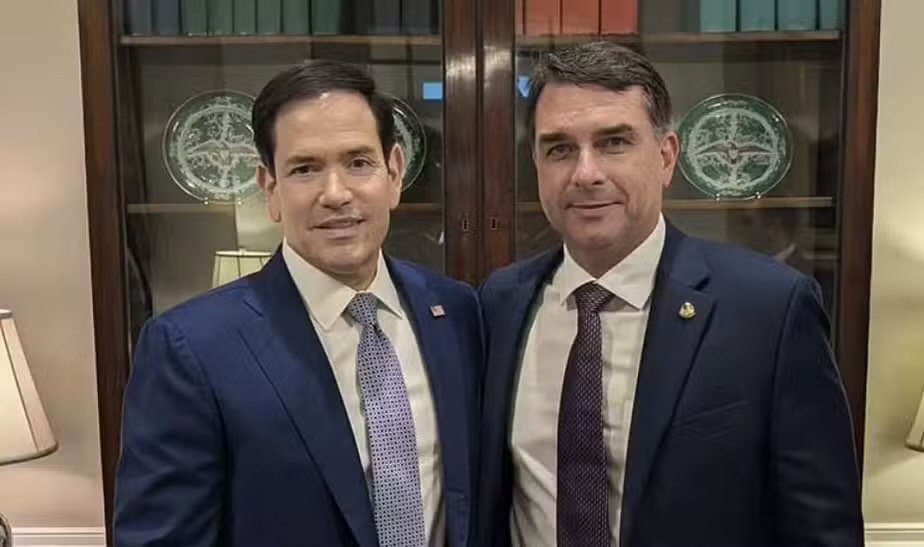
In a striking display of proactive statesmanship, Senator Flávio Bolsonaro has received a direct and respectful response from U.S. Secretary of State Marco Rubio regarding Brazil’s trade tensions with Washington. The letter, dated June 23, 2026, underscores Flávio’s constructive role while exposing the Lula administration’s defensive posturing and failure to address the root causes of the looming tariffs.
Rubio’s Letter: A Signal of Respect and Partnership
Rubio’s correspondence thanks Flávio for his recent visit to Washington and his support for designating Brazil’s notorious criminal factions—Comando Vermelho and the Primeiro Comando da Capital (PCC)—as global terrorist organizations. This acknowledgment highlights shared priorities on hemispheric security and transnational crime, areas where a Bolsonaro-aligned government has historically delivered results.
Crucially, the letter addresses Flávio’s request to delay or mitigate proposed tariffs stemming from the U.S. Trade Representative’s (USTR) Section 301 investigation. While reaffirming the investigation’s findings on issues like digital trade barriers, preferential tariffs, intellectual property protection, ethanol access, anti-corruption enforcement, and illegal deforestation, Rubio explicitly invites Brazilian stakeholders—including those aligned with Flávio—to participate in the public hearing scheduled for July 6, 2026, in Washington. Comments are open until July 1.
Most tellingly, Rubio notes Flávio’s optimism about Brazil’s October elections and his offer of a transition team should he prevail. The U.S. stands ready to work cooperatively with leaders “chosen by the Brazilian people” for a “broad, fair, and mutually beneficial framework of trade and investment.” This is not vague diplomacy—it is a clear signal that a change in Brazilian leadership could reset relations strained under the current government.
Flávio’s Participation: Positive, Principled, and Patriotic
Flávio Bolsonaro’s decision to formally register to testify at the July 6 USTR hearing is a masterstroke of responsible opposition leadership. Rather than retreating into nationalist rhetoric or anti-American posturing, he is engaging directly with the process to defend Brazilian producers, consumers, and the historic U.S.-Brazil partnership that has endured for over 80 years.
His planned testimony—opposing the 25% tariffs on behalf of both nations’ economic interests—demonstrates maturity and strategic vision. Flávio understands that tariffs hurt Brazilian exporters (farmers, manufacturers, and agribusiness) far more than abstract sovereignty arguments. By participating, he positions himself as a bridge-builder capable of negotiating from strength, leveraging personal relationships in Washington built on mutual respect for security cooperation and free-market principles.
This approach contrasts sharply with isolationist or victimhood narratives. It shows a leader willing to confront uncomfortable truths—such as genuine concerns over deforestation and trade practices—while advocating for Brazil’s interests within the rules-based system. For conservative Brazilians weary of economic self-sabotage, Flávio’s engagement offers a credible path to de-escalation and renewed partnership under a future administration committed to rule of law, property rights, and hemispheric alignment against crime and authoritarian influences.
Lula’s Response: Blame-Shifting, Division, and Diplomatic Failure
In stark contrast, President Lula da Silva and his allies have responded with predictable finger-pointing and personal attacks. Rather than owning the policy shortcomings that triggered the Section 301 investigation—ongoing issues with illegal deforestation tied to agricultural expansion, barriers in digital services and payments, weak IP enforcement, and preferential tariff distortions—Lula has branded Flávio a “traitor to the homeland,” an “idiot,” and accused him of soliciting foreign interference to influence the October election.
This rhetoric serves a transparent purpose: deflect blame from a government whose ideological priorities and governance failures have strained relations with a key trading partner. By attacking Rubio personally (“a frustrated Latin American,” “mortal enemy of Latin America”) and tying tariffs directly to Flávio’s Washington meetings, Lula prioritizes electoral narratives over substantive diplomacy. The result? Brazilian businesses and workers face potential economic pain while the administration postures as a victim of external conspiracy rather than addressing internal reforms.
Such blame games erode national unity at a critical moment. They ignore that the U.S. concerns predate recent events and reflect long-standing frustrations with practices that disadvantage American commerce. A mature government would engage constructively in the hearing process, propose credible reforms on deforestation enforcement and trade barriers, and seek negotiated relief. Instead, Lula’s camp frames Flávio’s legitimate diplomatic outreach as betrayal—further alienating potential partners and underscoring a pattern of prioritizing ideology and politic survival over pragmatic national interest.
The Stakes for Brazil
The July 6 hearing represents a genuine opportunity for Brazil to make its case. Flávio’s participation injects a pro-engagement, results-oriented voice that aligns with conservative principles of strong borders (against crime), secure property rights, and mutually beneficial trade. It signals to Washington that not all Brazilians share the current administration’s confrontational stance.
Under Lula, Brazil risks deeper economic friction, higher costs for consumers, and lost investment at a time when global competition demands competitiveness and reliability. Flávio’s approach—combining security cooperation with economic advocacy—offers a proven alternative rooted in the successful elements of prior conservative governance.
As Brazil heads toward October, the contrast could not be clearer: one side engages constructively to protect the economy and build alliances; the other blames opponents and foreign partners while dodging accountability for policies that invited scrutiny. Rubio’s letter is more than a reply—it is an invitation to a better future. Flávio Bolsonaro is answering the call. Brazil deserves leadership that does the same.
This article reflects a conservative perspective emphasizing national sovereignty through strength, rule of law, economic pragmatism, and alliances grounded in shared values rather than ideological grievance.