

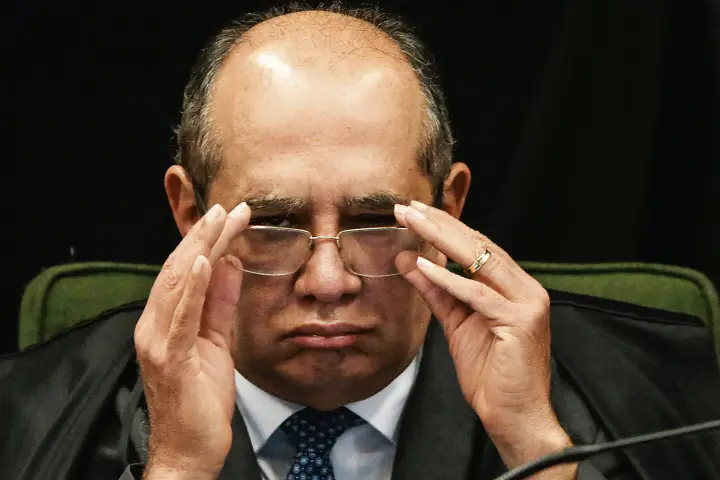

STF Dean Gilmar Mendes Crosses the Line: Public Attacks on Fellow Justices Violate Judicial Ethics Law
By Hotspotnews
In a striking display of institutional discord, Supreme Federal Court (STF) Minister Gilmar Mendes used his appearance on the TV Cultura program Roda Viva this week to launch pointed criticisms at fellow justices handling active cases. Legal experts across Brazil are now calling these remarks a clear breach of the Lei Orgânica da Magistratura Nacional (LOMAN), the very statute designed to uphold the dignity, impartiality, and decorum of the Brazilian judiciary.
Mendes, the longest-serving member of the STF, did not hold back. He singled out Minister André Mendonça’s conduct in the Banco Master investigation—an ongoing matter before the Court’s Second Chamber—labeling aspects of the process a “gross error.” He questioned Mendonça’s role in plea bargain discussions, preventive arrests, and what he portrayed as excessive pressure tactics reminiscent of past Lava Jato controversies. Mendes further weighed in on Minister Kassio Nunes’ decision regarding the suspension of an electoral poll, injecting his public commentary into live proceedings.
Such statements fly directly in the face of LOMAN Article 36, which explicitly bars magistrates from expressing opinions on pending cases or issuing depreciative judgments about the decisions or conduct of other judges outside the official court records. The law exists for a reason: to prevent the erosion of public confidence in the judiciary, avoid prejudgment, and maintain the separation between personal views and institutional duty. When the dean of the Court himself appears to flout these rules on national television, it sends a troubling message—that some rules apply only to lesser mortals.
This episode is particularly noteworthy given the political context. Minister Mendonça, appointed by former President Jair Bolsonaro, has often represented a more measured and originalist-leaning voice on the bench compared to the activist tendencies that have dominated STF rulings in recent years. Critics argue that Mendes’ broadsides reflect not just personal disagreement but a deeper resistance to any shift away from the Court’s entrenched patterns of broad interpretation and institutional overreach. For years, Brazilians have watched as the STF has expanded its influence into legislative and executive terrain—issuing decisions on topics from elections to economic policy—while shielding itself from meaningful accountability.
Respected jurists interviewed by major outlets have been blunt. Former judges and constitutional scholars describe Mendes’ comments as incompatible with the ethical obligations of the magistracy. The prohibition exists precisely to stop one justice from publicly undermining another while a case remains unresolved, which risks influencing outcomes, public perception, and even the behavior of lower courts. Yet enforcement against STF ministers remains notoriously weak. The Conselho Nacional de Justiça (CNJ), tasked with judicial oversight, has historically shown little appetite for disciplining the apex court’s own members.
This is not an isolated incident but part of a pattern that has fueled growing public skepticism toward Brazil’s highest court. When justices lecture society on the rule of law while appearing to exempt themselves from basic restraints, trust erodes. Conservative voices have long warned that an unaccountable judiciary—insulated by lifetime appointments and limited checks—threatens the democratic balance envisioned in the Constitution. Free speech has its place, but a sitting minister’s platform is not a debate club; it is a position of immense power that demands restraint.
Gilmar Mendes’ office has so far offered no public response to the mounting criticism. Whether this leads to any formal proceeding remains uncertain—history suggests such episodes often fade without consequence. Nevertheless, the damage to institutional credibility is real. Brazilians deserve a judiciary that models the impartiality and self-discipline it demands from others. When even the dean appears unwilling to abide by the rules, the call for genuine reform—greater transparency, term limits, or stronger external oversight—grows louder.
The rule of law cannot survive if those entrusted to guard it treat its boundaries as optional.