

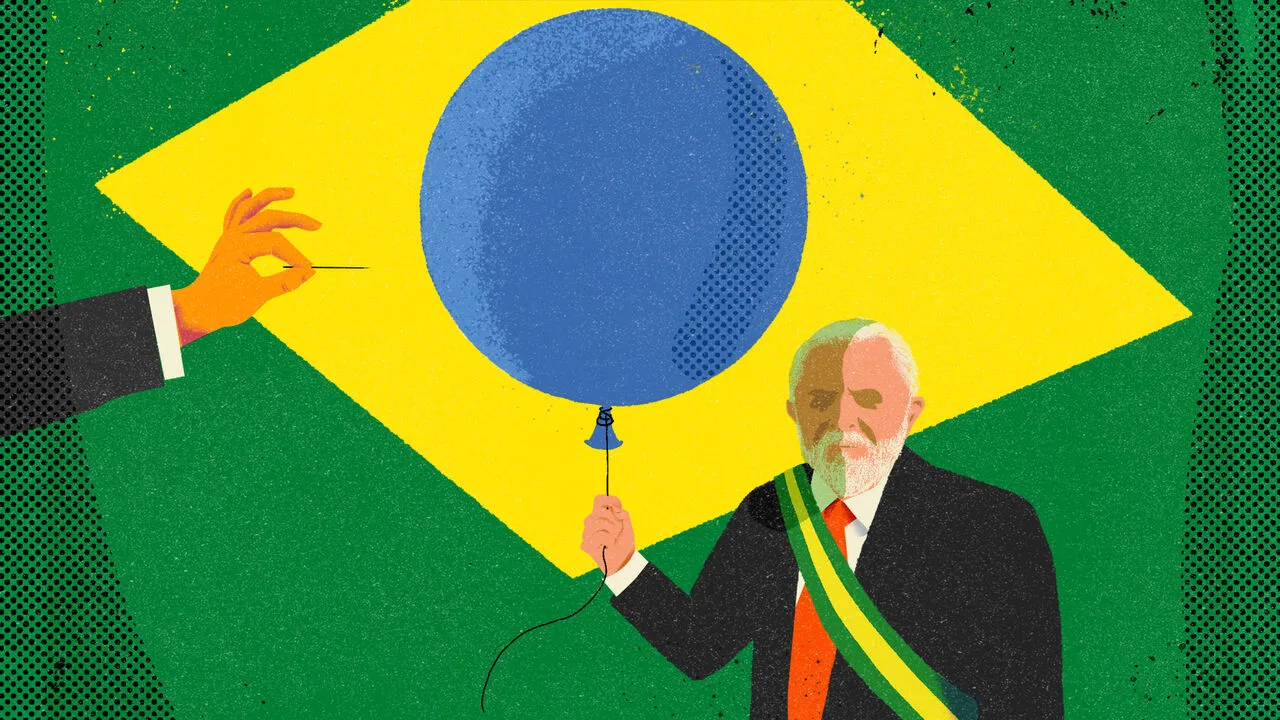

Brazil Under Lula: A Conservative Critique of Declining Leadership
By Hotspotorlando News-
As of July 1, 2025, Brazil finds itself at a crossroads, with President Luiz Inácio Lula da Silva’s administration stumbling both domestically and on the global stage. Once hailed as a champion of the working class, Lula’s third term, begun in January 2023, has devolved into a troubling display of economic mismanagement, political overreach, and environmental hypocrisy—trends that conservative observers have long warned about. The recent critique from The Economist, published on June 30, 2025, rightly points to his “increasingly incoherent” foreign policy and slipping popularity at home, raising serious questions about the direction of this South American giant.
A Foreign Policy in Disarray
Lula’s decision to “strongly condemn” U.S. strikes on Iranian nuclear sites on June 22, 2025, stands as a stark example of his administration’s missteps. This bold stance, which isolated Brazil from Western allies like the U.S. and EU, reflects a troubling alignment with authoritarian regimes rather than democratic partners. Conservatives have long argued that such moves signal a dangerous pivot toward China, evidenced by a 20% surge in bilateral trade in early 2025, while Brazilian exports to the U.S. plummeted by 15% in the first quarter. This reorientation, lacking a coherent strategy, undermines Brazil’s historical role as a stabilizing force in the Western Hemisphere and emboldens adversaries.
Economic Mismanagement at Home
Domestically, Lula’s economic policies have faltered, with inflation hitting 4.2% in May 2025 and GDP growth stalling at a meager 1.8% in 2024—well below the anticipated 2.5%. His reliance on increased taxation to fund expansive social programs like Bolsa Família has overburdened the middle class, eroding the economic vitality that once defined Brazil’s rise. Conservatives contend that this approach prioritizes short-term populism over sustainable growth, a pattern consistent with Lula’s past tenure. The resulting decline in his approval rating to 38% in June 2025 underscores a growing public disillusionment with his inability to deliver prosperity.
Political Overreach and Lawfare
Perhaps most alarming is Lula’s apparent use of political power to silence opposition. Allegations that his administration is engaging in lawfare against former President Jair Bolsonaro—culminating in police claims on June 25, 2025, of Bolsonaro sanctioning a spy ring—suggest a troubling slide toward authoritarianism. This mirrors tactics seen in Venezuela under Nicolás Maduro, a regime Lula once praised. Conservatives argue that such actions, coupled with efforts to ban Bolsonaro from future elections, threaten Brazil’s democratic institutions, turning a once-promising democracy into a battleground of political retribution.
Environmental Hypocrisy
Lula’s environmental promises have also unraveled, with deforestation in the Amazon surging 14% in 2024, reversing gains from his earlier terms. His commitment to end illegal deforestation by 2030 rings hollow as enforcement of the Forest Code weakens, driven by political pressures to appease agricultural interests. This backtracking not only betrays his international climate pledges but also jeopardizes Brazil’s credibility with global markets, particularly as the European Union Deforestation Regulation looms. Conservatives view this as evidence of Lula’s inability to balance economic development with environmental stewardship, a failure that harms both Brazil and the world.
A Call for Accountability
The polarized reactions on social media, from memes mocking Lula’s leadership to cries of “SOS Brazil,” reflect a nation divided yet increasingly aware of his shortcomings. Conservatives maintain that Brazil needs a return to principled governance—rooted in free-market policies, respect for democratic norms, and a clear-eyed foreign policy that prioritizes alliances with democratic nations. Lula’s tenure, now marked by economic stagnation, political vendettas, and environmental neglect, serves as a cautionary tale of what happens when populist ideals outpace practical leadership.
As Lula prepares to address the United Nations later this month, the world will watch closely. For Brazil’s sake, and for the sake of its conservative values of liberty and responsibility, it is time for a reckoning. The Economist’s assessment is a wake-up call: Lula’s leadership has lost its way, and only a decisive shift can restore Brazil’s standing.
**Sources:**
– The Economist, “Brazil’s president is losing clout abroad and unpopular at home,” June 30, 2025
– Recent polls on Lula’s approval rating, June 2025
– Brazilian economic data, including inflation and GDP growth, May-June 2025
– Reports on U.S.-Brazil trade and China-Brazil trade, Q1 2025
– Police allegations regarding Jair Bolsonaro, June 25, 2025
– Deforestation statistics for the Amazon, 2024