

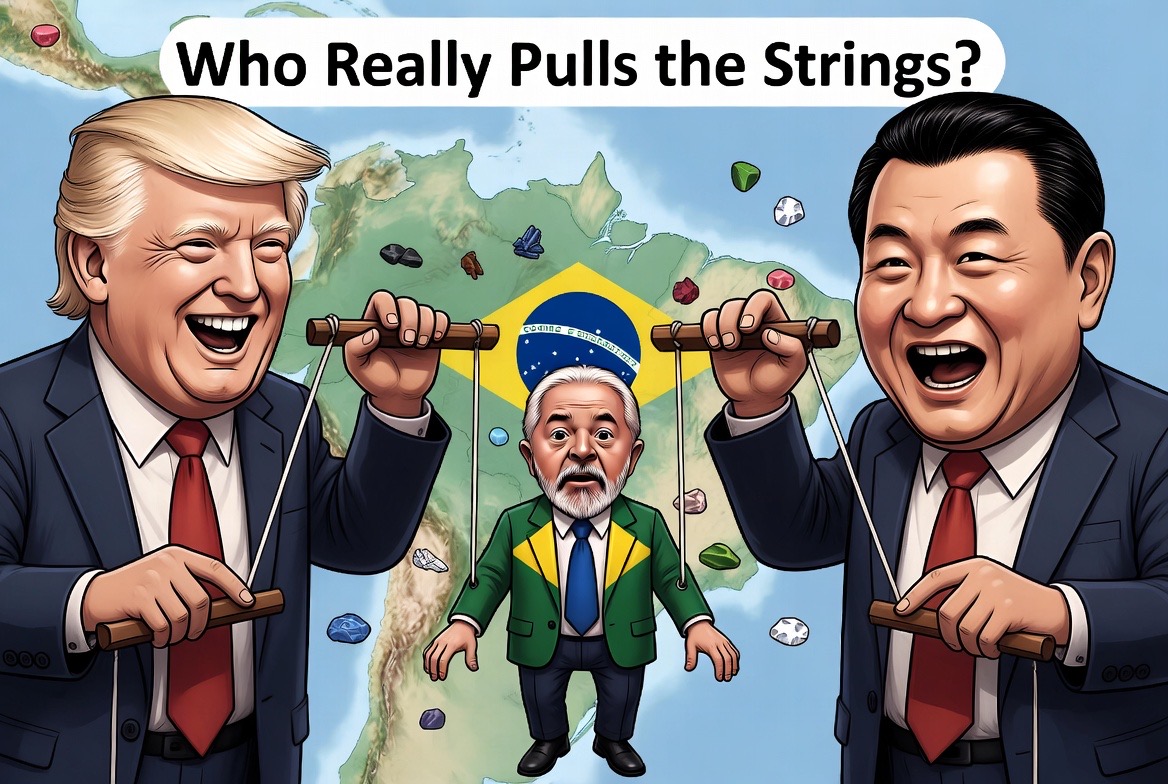

Lula’s Empty Boasts on Mineral Sovereignty: America and China Pull the Strings While Brazil’s President Pretends to Lead
By Hotspotnews
In the high-stakes global contest for rare earth minerals — the lifeblood of modern defense systems, electric vehicles, and advanced technology — President Luiz Inácio Lula da Silva talks a tough game of Brazilian sovereignty. He repeatedly vows that Brazil will not repeat the mistakes of the past, exporting raw iron ore, gold, or bauxite while foreign powers reap the rewards. “We will not allow anyone to take our critical minerals,” he declares, positioning himself as the fierce guardian of the nation’s wealth.
Yet the facts on the ground expose a different reality: Lula’s control is far weaker than his fiery rhetoric suggests. While he stalls and lectures, powerful players from the United States and China are advancing their strategic interests in Brazil’s vast mineral reserves — often bypassing Brasília entirely.
Consider the latest bombshell. On April 20, 2026, American company USA Rare Earth announced its $2.8 billion acquisition of Serra Verde Group, owner of the Pela Ema mine in Goiás. This is no minor deal. Serra Verde operates the only large-scale rare earth mine outside Asia capable of producing the four critical magnetic elements — neodymium, praseodymium, dysprosium, and terbium — essential for high-performance magnets in everything from fighter jets to wind turbines. The transaction includes $300 million in cash plus millions of new shares, backed by U.S. government financing through agencies like the Development Finance Corporation. A long-term offtake agreement ensures much of the early production flows into American supply chains.
This move directly strengthens America’s push to break free from China’s stranglehold on rare earth processing, which still dominates over 90 percent of global refining and magnet production. USA Rare Earth is building a fully integrated “mine-to-magnet” chain across the Americas and Europe. The deal closes in the third quarter of 2026, pending routine approvals, but the momentum is clear: U.S. capital and strategy are securing a vital foothold in Brazil’s resources.
Lula’s response? More speeches about “value addition” and domestic processing. He insists Brazil must refine and industrialize these minerals at home rather than ship raw ore abroad. Yet the Serra Verde sale — a private transaction involving Brazilian owners — proceeded without his administration driving the terms. Federal bureaucracy moves slowly, while American investors and supportive state leaders act decisively.
The pattern repeats at the state level. In March 2026, Goiás Governor Ronaldo Caiado, a political rival to Lula, signed a memorandum of understanding directly with U.S. officials for cooperation on rare earth exploration, mapping, technology transfer, and local processing. The U.S. Embassy hosted a critical minerals summit in São Paulo — which senior Lula officials notably skipped. American diplomats made it plain: they had proposed a federal deal but were not willing to wait indefinitely for Brasília’s approval. Goiás, home to Serra Verde and significant reserves, positioned itself as open for business. Lula’s team privately fumed at the “bypass,” accusing opponents of undermining national sovereignty. Publicly, Lula warned that careless actors “are going to sell Brazil.”
This federal-state tension highlights Lula’s limited grip. Brazil’s constitution grants the Union authority over the subsoil and mining concessions, but private companies can sell assets, and opposition governors can pursue non-binding cooperation agreements that attract investment and create political pressure. A proposed national critical minerals policy remains in discussion, with ideas like a state-owned entity floating among Lula allies — yet no decisive action has locked down terms that truly prioritize Brazilian industrialization over foreign supply needs.
China’s influence looms large as well. Beijing maintains overwhelming dominance in processing and has long eyed Brazilian minerals. While the U.S. deal grabs headlines for diversification, China’s established trade ties and refining capacity mean it remains a formidable player. Brazil’s hesitation to fully align with either side leaves it vulnerable — talking sovereignty while production and downstream value often flow outward.
Even in niobium, where Brazil enjoys near-total global dominance (over 90 percent of reserves and production), control rests primarily with the private CBMM in Minas Gerais (led by the Moreira Salles family) in partnership with the state government there. Lula cites niobium as a success story but still pushes for more domestic upgrading beyond ferroniobium exports. No foreign “takeover” has occurred here, yet the broader critical minerals picture shows the same dynamic: Brazilian rhetoric meets foreign capital and geopolitical reality.
Lula’s narrative — that he alone defends Brazil from foreign extraction — rings increasingly hollow. The United States, under President Trump’s clear-eyed focus on reducing dependence on adversarial supply chains, is securing access through direct investment and state-level partnerships. China continues leveraging its processing monopoly. Meanwhile, Brazil’s federal government dithers, skips key forums, and issues warnings instead of delivering a coherent, pro-growth strategy that welcomes responsible investment while demanding real value addition.
True sovereignty requires more than speeches. It demands policies that unleash private enterprise, cut bureaucratic red tape, and prioritize national interests without ideological delays. As America and China maneuver for advantage in the minerals that will shape the 21st century, Lula’s boasts only underscore how little control he actually wields. Brazil deserves leadership that matches its immense resource potential — not empty promises that leave the nation playing catch-up in a world where strength and decisiveness win.