




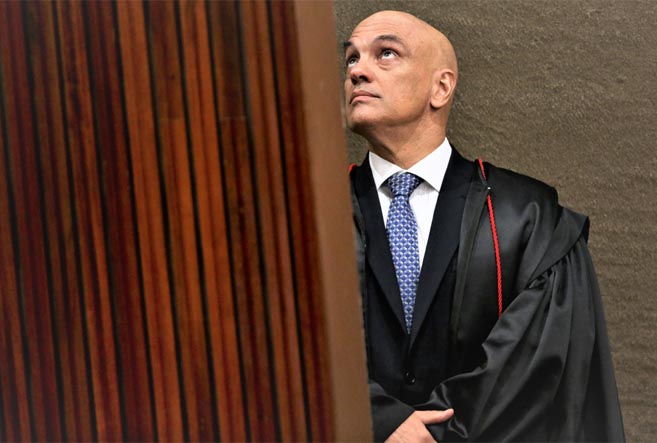
The Blacklist of a Justice: How Alexandre de Moraes Turned Brazil’s Highest Court into an Engine of Political Control
This analysis is based on the exclusive investigation by David Ágape, originally published on Public.news as part of Vaza Toga 5:
https://www.public.news/p/brazilian-supreme-court-justice-moraes
In the quiet corridors of Brazil’s Supreme Federal Court, power has been concentrated in the hands of one man for far too long. Justice Alexandre de Moraes, a key ally of President Luiz Inácio Lula da Silva, has spent years expanding judicial authority far beyond its constitutional limits. His latest revelation is the most alarming yet: internal court documents show that Moraes directed a nationwide sweep of judicial employees, cross-checking them against a list of more than two thousand names tied to the January 8, 2023 protests in Brasília. That list included not only people arrested during the chaos, but hundreds who were never charged with any crime—and even a fellow Supreme Court justice.
This is not the behavior of a neutral magistrate. It is the behavior of a political operator using the machinery of the state to intimidate, silence, and control.
A Pattern of Overreach
Moraes has long operated as the de facto sheriff of Brazilian public speech. Through the so-called Fake News Inquiry and related proceedings, he has ordered the suspension of hundreds of social media accounts. Many of those accounts belonged to supporters of former President Jair Bolsonaro, journalists, and ordinary citizens who criticized the court or the government. A substantial portion of these orders were issued under seal, meaning the public and even the targets themselves often had no clear explanation for why their speech was erased.
In 2024, the confrontation reached a new peak when Moraes ordered a nationwide blockade of the platform X. The company refused to fully comply with demands to remove accounts and appoint a local legal representative under threat of personal liability. For roughly forty days, Brazilians lost access to one of the world’s most important free-speech platforms. Only after X paid multimillion-real fines and accepted the court’s terms was the blockade lifted. The episode demonstrated something fundamental: when a single justice can shut down a global communications network inside a major democracy, the ordinary checks and balances have already failed.
Supporters of Moraes insist these measures protect Brazilian democracy from “disinformation” and “anti-democratic” forces. Yet the pattern is unmistakable. The targets are consistently those on the political right. The secrecy surrounding many decisions prevents meaningful scrutiny. And the remedies—permanent account bans, massive fines, and platform suspensions—are disproportionate and irreversible.
The Blacklist That Included His Own Colleague
The newest documents, revealed in mid-August 2026, show how far this machinery has reached inside the judiciary itself. In late 2023, Moraes’ office extracted 2,119 identification numbers from January 8-related cases and petitions. These names were then circulated to courts across the country with instructions to check whether any of their employees or magistrates appeared on the list. Courts were required to respond even when the search returned nothing.
The list was not limited to people who had been charged or convicted. Hundreds of individuals appeared solely as “respondents.” One of those names belonged to Flávio Dino, then the Minister of Justice and later appointed to the Supreme Court itself. At the time the list was distributed, Dino had already been confirmed by the Senate but had not yet taken his seat on the court. His inclusion illustrates the indiscriminate nature of the operation: a sitting cabinet minister and future colleague was subjected to the same dragnet applied to ordinary protesters.
Legal experts consulted about the documents describe the process as a “witch hunt” that falls outside constitutional, legal, and moral boundaries. Brazil’s civil service rules exist precisely to protect public employees from politically motivated investigations. Creating a centralized list of names—many of people never accused of wrongdoing—and circulating it for employment checks creates an atmosphere of suspicion that can destroy careers without due process. Article 5 of the Brazilian Constitution guarantees individual rights and protections against arbitrary state action. What Moraes ordered appears to treat those guarantees as optional.
The Larger Threat to Free Societies
What is happening in Brazil should concern every conservative who values limited government and free expression. When courts abandon neutrality and begin treating political opposition as a security threat, the result is not the defense of democracy but its slow erosion. Secret proceedings, extrajudicial blacklists, platform shutdowns, and the targeting of speech critical of the judiciary itself are hallmarks of institutional capture, not constitutional governance. The courage of @david_agape has to be recognized for the investigation work.
The January 8 events in Brasília were chaotic and, in some cases, criminal. Those who committed violence or vandalism should face ordinary criminal process with full due process. But sweeping up hundreds of uncharged citizens, monitoring speech across platforms, and then turning the judiciary’s own personnel system into a loyalty screening mechanism is something else entirely. It is the logic of political purification.
Conservatives in the United States and elsewhere have watched similar trends with growing alarm: pressure campaigns against social media platforms, the selective enforcement of speech rules, and the willingness of elite institutions to treat dissent as danger. Brazil offers a clearer warning because the concentration of power has gone further. One justice has accumulated investigative, prosecutorial, and adjudicative authority in ways that would be unthinkable in a healthy separation-of-powers system.
Accountability Is Not Optional
The documents now circulating do not appear to show the final results of the employee checks. That absence itself is telling. Once a blacklist exists inside a powerful institution, the chilling effect begins immediately. Careers are put at risk. Self-censorship spreads. Loyalty becomes safer than independence.
Brazil’s political class, its bar associations, and its remaining independent voices should demand full transparency. The public has a right to know how many employees were flagged, what disciplinary steps followed, and under what legal authority a Supreme Court justice directed a national personnel sweep based on a mixed list of defendants, respondents, and uncharged individuals. The inclusion of a future colleague only underscores how unbounded this power has become.
Free societies do not survive when the highest court becomes an instrument of political discipline. Alexandre de Moraes has spent years demonstrating that he is willing to use every tool available to shape the boundaries of acceptable speech and association. The blacklist of judicial employees is simply the latest evidence. Conservatives who still believe in the rule of law, rather than the rule of a single judge, should treat this episode as a clear warning: when the judiciary decides that certain political enemies must be monitored, listed, and potentially purged, no one’s rights remain secure for long.
SOURCE:
“Per the exclusive by David Ágape (@david_agape_) …”


