

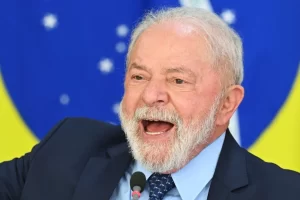


Brazil’s political climate remains highly polarized and tense, a legacy of the 2022 presidential election where Luiz Inácio Lula da Silva narrowly defeated Jair Bolsonaro. Lula’s return to power in January 2023 marked a shift from Bolsonaro’s far-right policies to a center-left agenda, but it hasn’t quelled the deep divisions in Brazilian society. The January 8, 2023, storming of government buildings in Brasília by Bolsonaro supporters—echoing the U.S. Capitol riot—underscored the fragility of democratic norms and the intensity of partisan loyalty. This event, coupled with ongoing judicial actions, has kept political tensions simmering. 
Eduardo Bolsonaro, a federal deputy and son of the former president, has faced scrutiny that fuels the narrative of persecution among conservatives. In late 2024, reports surfaced of potential legal actions against him, including the seizure of his passport as part of investigations into alleged misinformation and anti-democratic activities linked to his father’s administration. Nikolas Ferreira, a staunch ally and fellow conservative, has framed these moves as evidence of a biased judiciary, particularly targeting Supreme Court Justice Alexandre de Moraes. Moraes has been a lightning rod for criticism, accused by the right of overreach in his efforts to combat disinformation and extremism, including ordering arrests and social media bans.
The judiciary’s role has intensified this climate. Moraes, leading probes into alleged “digital militias” and the January 8 riots, has been painted as a dictator by Bolsonaro’s base, who see his actions as politically motivated. Meanwhile, Lula’s administration pushes forward with policies—reversing environmental deregulation, boosting state-led development, and tackling inequality—that alienate the right while struggling to unify a fragmented Congress. The “Centrão,” a bloc of centrist and right-leaning parties, holds significant sway, complicating governance and forcing Lula into pragmatic alliances.
Public sentiment reflects this divide. Posts on X and broader discourse suggest a conservative backlash, with claims of “political prisoners” and a “politicized Supreme Court” gaining traction among Bolsonaro supporters. Conversely, Lula’s base sees these judicial moves as necessary to safeguard democracy against authoritarian remnants. The 2024 municipal elections hinted at a resilient conservative bloc, though Lula’s Workers’ Party (PT) faces challenges heading into the 2026 presidential race.
In short, Brazil’s political climate is a volatile mix of ideological warfare, judicial activism, and institutional distrust, with figures like Eduardo Bolsonaro and Nikolas Ferreira amplifying the ideas of a system at war with itself.
Recently President Bolsonaro said on X:
The claim that the possible seizure of Eduardo Bolsonaro’s passport is intended to embarrass him or prevent him from assuming leadership of the Foreign Relations Committee has been circulating on platforms like X, reflecting current sentiment among some users. Eduardo Bolsonaro, a prominent Brazilian politician and son of former President Jair Bolsonaro, has been a vocal figure in Brazilian politics and chairs the International Affairs and National Defense Committee (often referred to as the Foreign Relations Committee). Any move to seize his passport could indeed have political ramifications, especially given his influence and the committee’s role in overseeing international agreements.
-
Loan from CDB to BNDES in Chinese Currency (5 billion Renminbi):
During the G-20 summit, the Brazilian National Bank for Economic and Social Development (BNDES) and the China Development Bank (CDB) signed a loan agreement for 5 billion renminbi (approximately USD 691 million). This three-year credit line, denominated in Chinese currency, aims to finance infrastructure and industrial projects in Brazil, marking a shift toward using renminbi in bilateral financial dealings. -
Nuclear Technology:
Brazil and China have a history of cooperation in science and technology, including space-related projects like the China-Brazil Earth Resources Satellite program. While no specific G-20 agreement explicitly mentions nuclear technology, broader science and technology collaboration was emphasized, which could potentially encompass nuclear-related discussions in the future, given China’s expertise and Brazil’s interest in energy diversification. -
Satellite Telecommunications:
Cooperation in satellite telecommunications was highlighted as part of the G-20 agreements. This builds on existing Brazil-China space partnerships and could involve enhancing satellite internet services, potentially reducing reliance on systems like Starlink, as noted in some analyses of Brazil’s telecom strategy. -
Cooperation in the Digital Economy:
The agreements include collaboration in emerging areas like the digital economy, alongside artificial intelligence and energy transition. This reflects Brazil’s push to modernize its technological infrastructure with Chinese support, a priority for the Lula administration. -
Sustainable Development of Mining:
Sustainable mining, often referred to as “green mining,” was part of the G-20 accords. China, a major consumer of Brazilian minerals like iron ore, and Brazil aim to align mining practices with environmental goals, a key focus of bilateral talks. -
Secom and China Media Group:
While specific details about an agreement between Brazil’s Secretariat of Social Communication (Secom) and China Media Group are less prominent in public reports, cooperation in media and information-sharing was noted as part of broader cultural and economic ties. This could involve joint ventures or content-sharing initiatives, though exact terms remain unclear from available sources.
In summary, the potential seizure of Eduardo Bolsonaro’s passport could be a strategic move to limit his influence over the Foreign Relations Committee, where he’d oversee significant Brazil-China agreements from the G-20.To be continuedThe Hotspotorlando News


