





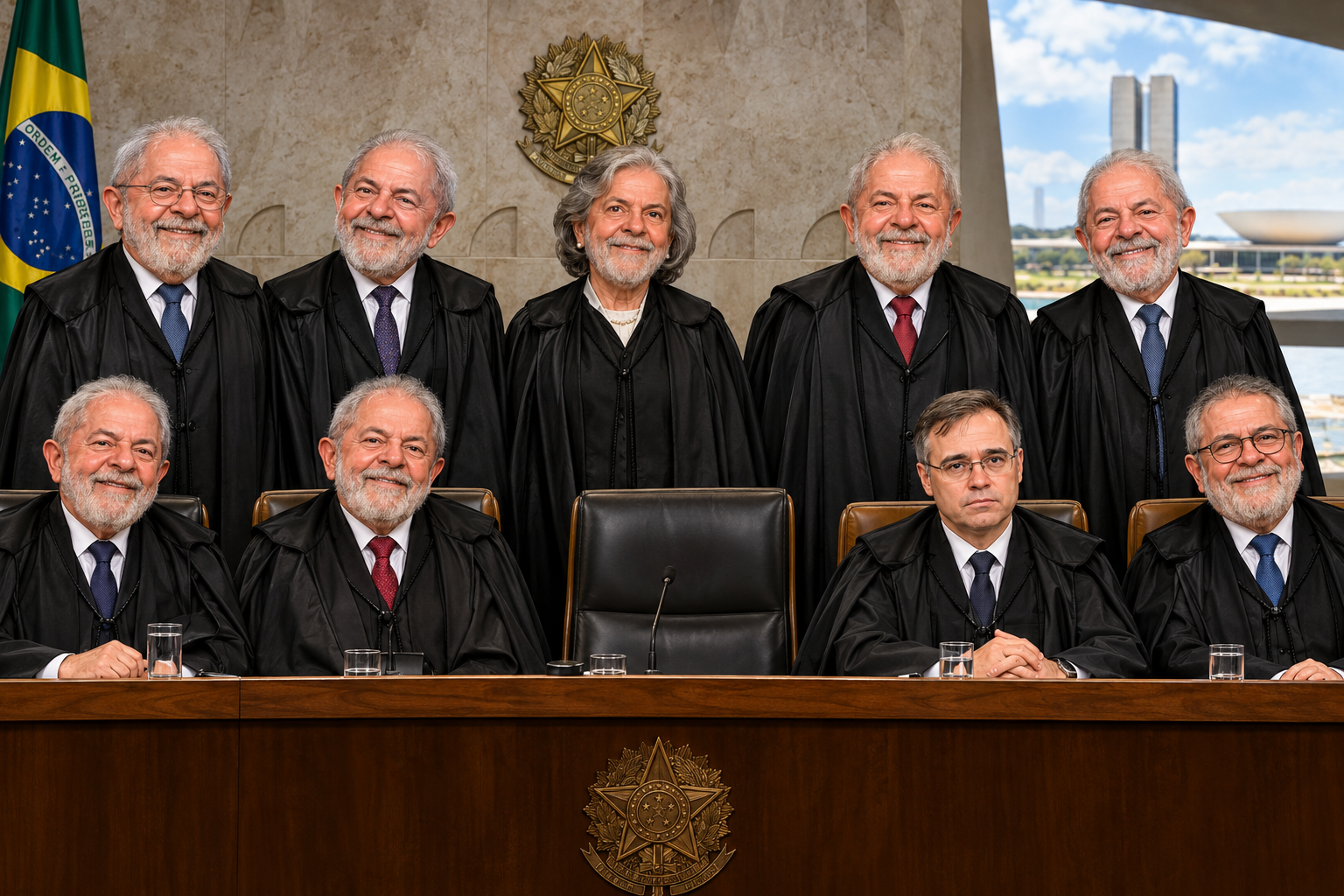
When the Highest Court Starts Looking Like Another Faction
By Hotspotnews
There is a particular kind of institutional decay that does not announce itself with a single scandal. It arrives as a series of small, visible exceptions. One minister is hauled before the full court for alleged misconduct. Another, more powerful, continues operating with the same tools and the same insulation. Over time the public stops asking whether the law was applied correctly and starts asking a simpler question: who does the law actually bind?
That is the atmosphere surrounding the current crisis inside Brazil’s Supreme Federal Court.
André Mendonça, the minister appointed by former president Jair Bolsonaro and rapporteur of the Banco Master investigations, made public a set of messages between Alexandre de Moraes and banker Daniel Vorcaro. From one side of the political spectrum this was treated as a minister doing the job the Court claims to value: transparency when evidence of possible improper contact surfaces. From the other side it was treated as an act that itself required investigation. President Edson Fachin then scheduled — and later postponed — a plenary session to decide whether Mendonça should face a formal inquiry for possible abuse of authority, administrative improbity, and political favoritism. The accusations rest on Federal Police intelligence reports whose evidentiary weight remains contested.
The sequence is what many Brazilians find corrosive. A sitting justice is placed in the position of defending himself before his colleagues for having disclosed communications involving another sitting justice. Meanwhile the minister whose contacts triggered the disclosure remains on the Court, continues to exercise enormous institutional power, and has not been subjected to an equivalent public reckoning in the same timeframe. Whether one believes Moraes acted improperly or not, the optics are of two different speeds of accountability inside the same building.
This is how standards lower. Not by a formal vote that says “the law no longer applies,” but by repeated demonstrations that procedure is elastic when the target is convenient and rigid when the target is not. Courts lose authority the moment citizens conclude that the rules are mainly for people without robes. Once that conclusion spreads, every later decision — on elections, on speech, on investigations — is read as factional rather than legal.
Critics of Mendonça argue he overstepped as rapporteur and that the Police reports raise legitimate questions about impartiality. Supporters of Moraes argue he is simply using the instruments the Court has long used against threats to institutions. Both arguments can be made in good faith. What cannot be made in good faith is the claim that the spectacle itself is healthy. A supreme court that spends weeks publicly litigating whether one of its own members should be investigated, while another remains untouched by the same glare, teaches the country a lesson the Court will later regret: there are people the law reaches quickly, and people it reaches slowly, if at all.
The danger is not only unfairness to Mendonça or protection of Moraes. The danger is the normalization of a two-tier Court. When that becomes the working assumption, the institution does not recover with one careful ruling. It recovers only after years of looking boring, consistent, and indifferent to who holds power. Right now it is doing the opposite in public view.
That is why this moment feels smaller than a constitutional crisis and larger than a personnel dispute. It is the sound of an institution teaching the public that limits are optional at the top.
#STF #CriseNoSTF #AndréMendonça #AlexandreDeMoraes #Fachin #EstadoDeDireito #JustiçaSeletiva #Brasil
Sources referenced in reporting: G1, BBC News Brasil, O Globo, JOTA, Agência Brasil, Consultor Jurídico, and public STF session records from September 2026 concerning Petitions 16.662 and 16.704 and the Banco Master investigations.


