

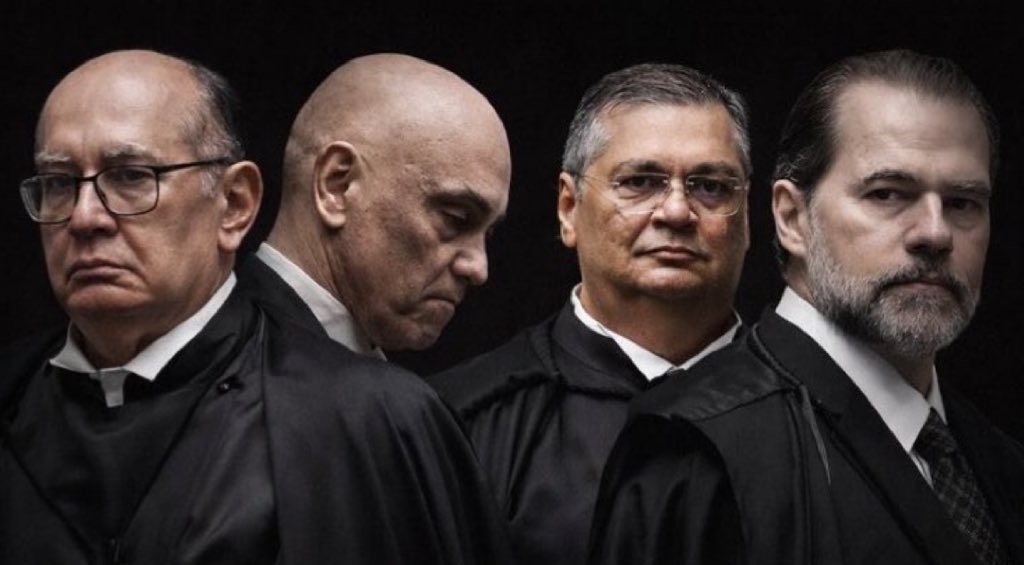

The Supreme Court’s Self-Protection Racket: How Brazil’s STF Has Turned Justice into a Shield for Its Own Power
By Hotspotnews
#4`~qqs
Since 2019, the notorious “Inquérito das Fake News” has served as the cornerstone of this troubling trend. Opened by the Court itself—without formal provocation from the Public Prosecutor’s Office—the inquiry handed Minister Alexandre de Moraes the roles of victim, investigator, prosecutor, and judge in cases involving alleged offenses against the STF and its justices. What began as an investigation into threats and disinformation quickly morphed into a powerful tool for silencing critics, ordering content removals from social media, imposing fines, and even authorizing arrests. The Court became prosecutor of speech it disliked, often targeting journalists, politicians, and ordinary citizens who dared question its actions.
Conservatives have long warned that such concentration of power violates core principles of due process and separation of powers. The Brazilian system is accusatorial: an impartial judge should preside over cases brought by an independent prosecutor. When the STF assumes all three roles, the result is predictable—biased proceedings that prioritize institutional self-preservation over constitutional guarantees. Even former STF Justice Marco Aurélio Mello, a respected voice across the ideological spectrum, famously labeled this the “inquérito do fim do mundo”—an inquiry without limits, born dead, and dangerous to liberty.
This pattern of exceptional measures has not faded with time. Recent events surrounding the Banco Master scandal illustrate how deeply entrenched the instinct for self-protection has become. When reports surfaced linking family members of STF justices to financial dealings at the embattled bank, the response was swift: new inquiries opened by the Court itself, targeting not the underlying allegations of fraud or misconduct, but those who exposed them. Once again, the STF positioned itself as both the aggrieved party and the arbiter of truth, extending the same playbook used in the Fake News inquiry to quash uncomfortable questions about potential conflicts of interest.
These are not isolated incidents but part of a broader erosion of democratic norms. When the highest court in the land routinely bypasses normal legal channels to investigate its own critics, it undermines public trust in the entire judicial system. Citizens expect courts to defend freedom of expression, not police it. They expect impartiality, not favoritism toward those in robes. And they expect accountability, especially from those who wield immense power with lifetime tenure.
True conservatives value institutions that serve the people, not themselves. The STF’s actions risk transforming Brazil’s highest court from a pillar of democracy into a fortress against dissent. Restoring balance requires courage: congressional oversight, legislative reforms to curb judicial overreach, and a renewed commitment to the rule of law that applies equally to everyone—including those who sit on the bench.
Until then, the message is clear: in today’s Brazil, questioning the Supreme Court can be treated as a greater offense than the very abuses it claims to combat. That is not justice. That is power protecting itself at the expense of freedom.