

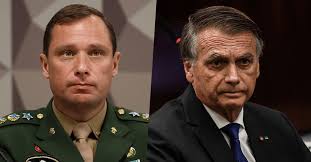

Bolsonaro Labels “Coup Plot” a Fabricated Narrative After Veja Report on Mauro Cid Messages
By Hotspotnews
In mid-June 2025, former Brazilian President Jair Bolsonaro published a strongly worded statement on social media reacting to an exclusive report by the magazine Veja. The cover story, titled “ELE MENTIU” (“He Lied”), featured a photograph of Lieutenant Colonel Mauro César Barbosa Cid and detailed alleged private messages that, according to the magazine, showed the former presidential aide-de-camp contradicting key aspects of his own testimony and plea agreement in the ongoing investigations into an alleged attempt to overturn the results of the 2022 presidential election.
Bolsonaro argued that the messages confirmed what he and his supporters had long maintained: that the so-called “trama golpista” (coup plot) was a manufactured story designed to persecute political opponents. He quoted passages attributed to Cid in which the delator allegedly stated that “Bolsonaro wasn’t going to do anything,” that investigators did not need proof but only a narrative, that “the script was already ready,” that “the sentence was already written,” and that failure to “deliver someone’s head” or say what authorities wanted would prevent release by the supervising minister. Bolsonaro described the process as political persecution and a “witch hunt” rather than genuine justice, demanded the immediate annulment of Cid’s plea deal (delação premiada), the release of General Walter Braga Netto and other defendants, and an end to what he called a political action disguised as a criminal proceeding. He closed with an appeal to Brazilians, institutions, parliamentarians, and serious journalism to reflect on the costs of what he termed an authoritarian escalation, insisting that a country cannot be built on lies, vengeance, and arbitrariness.
Mauro Cid had served as Bolsonaro’s aide-de-camp during the final years of the presidency, giving him close access to the former president and senior military and civilian officials. After the 2022 election defeat and the violent events of 8 January 2023 in Brasília, Cid became a central figure in multiple investigations conducted by the Federal Police and overseen by Supreme Federal Court (STF) Justice Alexandre de Moraes. In 2023 he entered a plea agreement in which he provided detailed accounts of meetings, draft decrees, discussions of states of defense or siege, pressure on military commanders, and other alleged preparations aimed at preventing Luiz Inácio Lula da Silva from taking office. Those statements formed a significant part of the evidentiary basis for the formal charges eventually brought against Bolsonaro and several high-ranking associates.
According to Veja, the messages in question were exchanged between late January and early March 2024 via an Instagram profile bearing a name linked to Cid’s wife. In them, the speaker complained about prolonged interrogations, claimed investigators repeatedly tried to steer testimony toward a “coup” framing that did not match what he had said, expressed despair about the process, and voiced the belief that convictions of Bolsonaro, Braga Netto, and others were predetermined. The magazine presented the material as evidence that Cid had violated the terms of his collaboration agreement, which required truthfulness, confidentiality, and restrictions on external communications, and that he had lied under oath when questioned about social-media use during a recent STF hearing.
Cid’s defense team immediately rejected the report, characterizing the screenshots as a fabrication or montage. They noted the absence of clear timestamps in some images and argued that the writing style did not match Cid’s. Bolsonaro’s legal team, by contrast, seized on the material and formally requested that the plea agreement be declared null, arguing that it undermined the credibility of the entire case. Supporters of the former president amplified the story, while critics of Bolsonaro dismissed the messages as either inauthentic or insufficient to overturn a broader body of evidence that included documents, other testimonies, and digital records.
The episode occurred against the backdrop of formal interrogations of the main defendants in the so-called “Nucleus 1” of the case, which included Bolsonaro, Cid, Braga Netto, and several former ministers and military commanders. Despite the controversy generated by the Veja report and subsequent legal filings challenging the delation, the STF First Panel proceeded with the trial. In September 2025 the panel convicted all defendants on multiple charges, including participation in an armed criminal organization, attempted violent abolition of the democratic rule of law, and attempted coup d’état. Bolsonaro received a sentence of 27 years and three months; Braga Netto received 26 years. Cid, benefiting from the terms of his plea agreement, was sentenced to two years in an open regime. Challenges to the validity of the delation were rejected by the rapporteur, who maintained that the collaboration remained valid and that any inconsistencies did not nullify the agreement or the overall body of evidence.
By late 2025 the conviction against Cid had become final after his defense declined to appeal, and the case moved into the execution phase. As of 2026, Bolsonaro was serving his sentence under house-arrest conditions related to health issues, while other convicted figures faced prison terms or remaining appeals in related nuclei of the broader investigation. Parallel military justice proceedings were also initiated seeking the stripping of ranks and pensions from several of the military officers involved.
The June 2025 exchange of accusations surrounding the Veja report illustrated the deep polarization that continued to mark Brazilian politics years after the 2022 election. For Bolsonaro and his base, the alleged messages provided confirmation of institutional bias and the use of the justice system as a political weapon. For those who supported the investigations and convictions, the episode represented a failed attempt to discredit a key witness whose cooperation had helped illuminate a serious threat to democratic institutions, and the subsequent judicial outcomes demonstrated that the case rested on more than a single delation. The episode remains a reference point in ongoing debates about the boundaries between legitimate accountability for alleged anti-democratic acts and the risks of politicized justice in a highly divided society.