

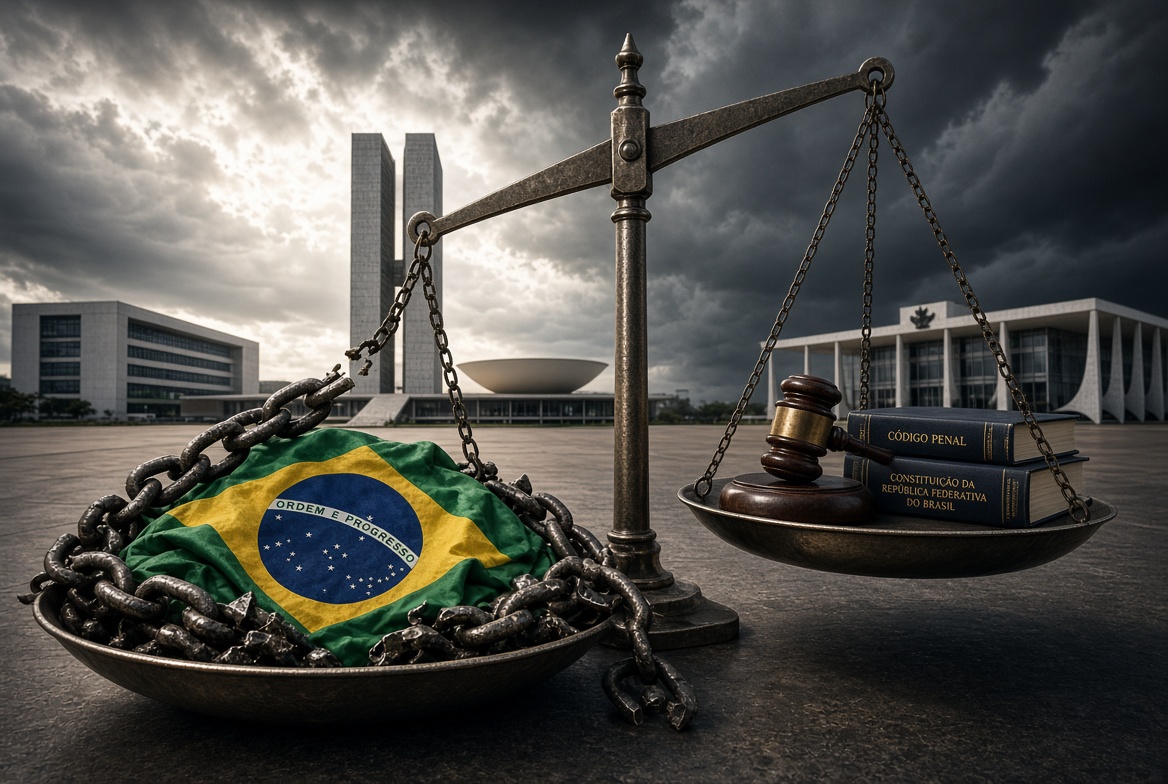

Selective Justice and the Two Faces of Democracy in Brazil
By Hotspotnews
On January 8, 2025, Senator Rogério Marinho of the PL party from Rio Grande do Norte issued a pointed statement highlighting what he and many conservatives describe as a profound double standard in the application of Brazilian law. When unionists and movements aligned with the Workers’ Party (PT) previously set fire to ministries, vandalized public buildings, injured people near the Praça dos Três Poderes, and contributed to deaths, those actions were largely minimized and never framed as existential threats to democracy. Today, those who question the government or the judiciary face prison, prolonged inquiries, and selective enforcement. Democracy, Marinho argued, has become relative under a government that embraces certain foreign authoritarians while normalizing patterns of corruption, all while institutions pursue endless cases against political opponents.
The historical record supports the core of this contrast. In May 2017, during large protests organized by the Central Única dos Trabalhadores (CUT) and allied left-wing social movements against then-President Michel Temer, tens of thousands of demonstrators occupied the Esplanada dos Ministérios in Brasília. Protesters set fires in the Ministries of Agriculture, Planning, and Culture, broke windows, vandalized offices, and caused widespread damage. Injuries occurred, including from fireworks. Contemporary accounts note that only a small number of participants were arrested, and the episode was not treated by authorities or much of the media as a coordinated assault on democratic institutions requiring mass prosecutions or special judicial measures. Similar patterns appeared in other left-aligned actions, including land occupations and urban protests in which property damage and confrontations with police were often framed as legitimate social expression rather than criminal threats to the state.
A clearer illustration of uneven accountability is the 2014 death of television cameraman Santiago Andrade. While covering protests in Rio de Janeiro against public transport fare increases, Andrade was struck in the head by a flare launched by demonstrators associated with more radical protest tactics. He died days later. Two young men were charged with murder involving an explosive. Yet the case moved slowly through the courts for years, with delays, habeas corpus filings, and no swift, high-profile resolution comparable to later political cases. Families and observers noted the absence of the intense institutional focus later applied to other episodes of political violence.
By contrast, the events of January 8, 2023 produced an immediate and expansive judicial response. Supporters of the previous administration invaded and damaged the National Congress, the Planalto Palace, and the Supreme Federal Court (STF). Property was destroyed, including artwork and furnishings. Authorities arrested more than two thousand people in connection with the day. Under the reporting of Justice Alexandre de Moraes, the STF pursued charges that included violent abolition of the democratic rule of law, attempted coup, criminal association, and aggravated damage. By early 2025, official tallies from the court and agencies such as Agência Brasil recorded 371 convictions, with sentences ranging from three to seventeen years for the most serious cases; hundreds more had entered non-prosecution agreements involving fines, community service, and restrictions on social media or travel. Later updates showed the total number of people held accountable rising well above one thousand when including agreements and additional judgments. Many ordinary participants received long prison terms or restrictive measures, and critics have pointed to the scale of pre-trial detentions, the concentration of authority in a single justice as both investigator and adjudicator in related inquiries, and the comparatively limited attention paid to violence or property destruction by groups aligned with the current government.
Marinho and others argue that this disparity undermines equal protection under the law—the foundational principle that the same conduct should draw the same consequences regardless of political affiliation. When left-aligned groups damaged federal buildings and caused injuries or death, the institutional response was restrained and the narrative rarely escalated to “threat to democracy.” When right-aligned protesters engaged in similar destruction, the response became rapid, expansive, and framed as an existential crisis requiring exceptional measures. The result, in this view, is a judiciary that appears to calibrate its rigor according to the political identity of the actors, eroding public confidence. Endless inquiries into speech and association further chill dissent, while the government maintains cordial relations with leaders widely described as authoritarian elsewhere in the region.
Conservatives maintain that genuine democratic restoration requires consistent rules, not selective enforcement. Pacification cannot occur while one side’s violence is contextualized as social struggle and the other side’s is treated as terrorism. Equality before the law, transparent due process, and an end to the concentration of investigative and punitive power in the hands of those who also define the political boundaries of acceptable speech are prerequisites for normal institutional life. The January 8 cases and the contrasting treatment of earlier protests illustrate the gap between that ideal and current practice. Until the same standard is applied to all, claims that Brazilian democracy is fully secure remain open to serious doubt.
Sources
Senator Rogério Marinho’s public note, 8 January 2025; Agência Brasil and STF reports on January 8 convictions and case tallies (2025 updates); contemporary accounts of the May 2017 Esplanada dos Ministérios protests (Gazeta do Povo, Revista Oeste); coverage of the Santiago Andrade case (G1, BBC, Committee to Protect Journalists); historical analyses of 2013–2017 protests (Estadão and related reporting).
#JusticaSeletiva #IgualdadePeranteALei #8deJaneiro #DemocraciaRelativa #Brasil #Liberdade #STF #EstadoDeDireito #Pacificação #RogérioMarinho