

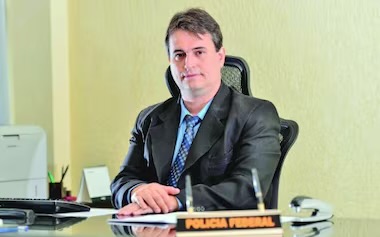

High-Ranking Lula-Era Police Official Linked to Major Corruption Probe May Flip, Raising Fresh Questions on Past High-Profile Cases
By Hotspotnews
In a development sending ripples through Brazil’s justice system, Federal Police delegate Rodrigo de Melo Teixeira — once a rising star in the institution under the current administration — is reportedly negotiating a plea bargain in Operation Rejeito, the sweeping investigation into alleged corruption, illegal mining, and environmental license fraud in Minas Gerais.
Teixeira, who climbed to the third-highest position in the Federal Police hierarchy as Director of Administrative Police, now finds himself at the center of allegations that could expose deeper rot in public institutions. According to investigative reporting, authorities extracted handwritten organograms from his phone detailing an intricate scheme of influence peddling, facade companies, and illicit mineral extraction in protected areas like Serra do Curral. Prosecutors claim he stood to gain roughly R$27 million through a company registered in his wife’s name, with zero personal investment — a classic hallmark of the crony arrangements that erode public trust.
This is no ordinary bureaucrat. In 2018, as superintendent of the Federal Police in Minas Gerais, Teixeira oversaw the investigation into the knife attack on then-presidential candidate Jair Bolsonaro in Juiz de Fora. The probe quickly concluded that lone attacker Adélio Bispo acted alone, a narrative Bolsonaro and many supporters have long viewed with deep skepticism amid unanswered questions about potential networks and motives. Years later, the same official coordinated early phases of the Brumadinho dam disaster inquiry following the 2019 tragedy that claimed 270 lives — a catastrophe tied to mining operations in the region now under fresh scrutiny in the very probe targeting Teixeira.
Operation Rejeito has already ensnared businessmen, agency officials, and others in what authorities describe as a sophisticated criminal organization preying on environmental regulators and mining rights. Teixeira’s reported willingness to cooperate could represent the first crack from within the alleged leadership core, potentially reshaping indictments and dragging in higher figures who have so far escaped full accountability. His trajectory — from key investigator in politically charged cases to appointee on a Petrobras safety committee under Minister Alexandre Silveira — underscores longstanding conservative concerns about institutional capture, revolving doors between regulators and industry, and selective enforcement that appears to shield the powerful.
For those who have watched Brazil’s institutions bend under political pressure, Teixeira’s situation is emblematic of a broader pattern: ambitious officials entangled in the same industries they once policed, while high-stakes investigations into attacks on opposition figures and environmental disasters yield convenient conclusions with lingering doubts. A successful plea deal might finally illuminate connections long dismissed as conspiracy, from the facada probe to the human and ecological costs of unchecked mining interests.
As details emerge, one thing is clear — the Brazilian people deserve full transparency, not another layer of protection for insiders. True justice requires scrutinizing every link in these chains of influence, regardless of who occupies the Planalto.