


Learn the most beautiful words in the Portuguese language, according to the creator of ‘Dicionário Aurélio’
In a 1976 interview, Aurélio Buarque de Holanda, who gives name to the Aurélio Dictionary, elected the three most beautiful words in the Portuguese language, in his opinion.
The answer came after Araken Távora – journalist at the head of the program “Os Mágicos”, shown by the old TVE, and responsible for interviewing writers such as Clarice Lispector, Ruth de Souza, Ariano Suassuna and much more – asked what is the most beautiful word in the language. He then listed three:
Dragonfly – Libélula
Dawn-Alvorada
Murucututu
“I have a deep love for words, that’s true. There are still some that are taken as ugly – like the very synonym of the word “dragonfly”, which I myself do not say is [a word] beautiful, but the beauty of the words is a relative thing -, some that are considered dirty, but some beautiful; some considered immoral that are beautiful too. Because everything is creation, everything is a proof of human activity. It’s proof of this mind job,” said Aurélio Buarque from Holland.
Below, check out what the teacher and lexicographer said about his favorite words, and what his dictionary says about them.
 Dragonfly-Libélula
In his answer, Aurélio explained the relationship with the word:
“One of the most beautiful words in the Language, in my opinion, is Libélula, translated dragonfly. This word is a flight, it’s a winged thing, of immense poetry. It looks like something that is in an uncertain flight, a trembling flight, and in large part, it represents the reality of that,” said Aurélio Buarque de Holanda.
Aurélio still says that it is synonymous with the insect, also called Lava-bunda, “wash ass”, – which refers to its behavior of laying eggs in the water -: “it’s unfortunate. But the language is really full of these things.”
“The truth is that Libélula-dragonfly is a word of my deep enchantment.”
Originating in French, the word is a feminine noun of zoology and alludes to the glided flight of the insect. In the dictionary, it is described as:
Genus of odonate insects, with a narrow body, endowed with two pairs of membranous wings, transparent, generally, brightly colored, whose larvae, carnivorous and voracious, develop in running waters, in stagnant or even inside bromeliads.
The word is also used to designate any species and any specimen of this genus.
Murucututu
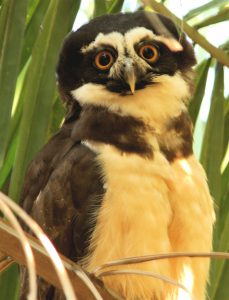 “Still in the zoological domain, a very beautiful word that is murucututu. Five syllables in a row, all ending in ‘u’. This seems like a wonderful thing to me,” Aurélio Buarque de Holanda.
Murucututu, also known as owl, is a species of owl in the Strigidae family.
In the dictionary, it is described as a masculine noun that originates from the Tupi, and is a Brazilianism of zoology.
Strigiform bird, strigid (Pulsatrix perspicillata), from South America. Brown color; forehead, eyebrow and spot on the throat, white; chin and chest, brown; the rest of the abdomen, yellow-ocher; feeds on birds and mammals, especially rodents.
Dawn- Alvorada
“We have a word that is a clarine: dawn,” said Aurélio Buarque de Holanda.
 Formed from Alvo + the suffix -ada, the word is a feminine noun and has the following definitions:
Morning twilight; the clarity that precedes the break of the Sun; ray, diluculus.
Bird song at dawn.
Military touch in the barracks, at dawn, to wake up the soldiers.
Play any song at dawn.
[In the figurative sense] Beginning, beginning, beginning, dawn, dawn.