

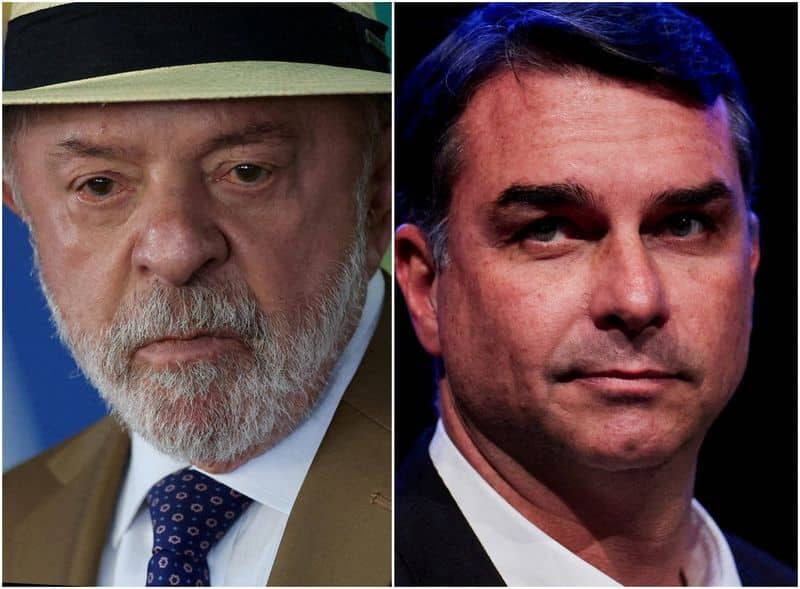

Lula’s Lawfare Gambit: Threatening Flavio Bolsonaro Days Before Brazil’s Decisive Vote
By Hotspotnews
The timing is unmistakable. The runoff is set for October 25. Flavio Bolsonaro, the eldest son of former President Jair Bolsonaro, has campaigned on restoring order, confronting crime, and seeking amnesty for his father, who remains under house arrest after a 27-year sentence tied to post-2022 election events that supporters view as a political prosecution. Markets and many voters reacted positively to Flavio’s first-round result, which exceeded pre-election polling and positioned the right-wing candidate as the favorite heading into the second round. Against that backdrop, an incumbent’s public suggestion that investigations will accelerate if the challenger prevails reads less like routine law enforcement and more like a message to voters and institutions alike.
Brazil’s recent history makes the distinction between legitimate inquiry and lawfare especially sharp. Lula himself spent more than a year and a half in prison on corruption convictions that were later annulled on procedural grounds. Operation Car Wash produced convictions against figures across the political spectrum, yet many on the right argue that subsequent judicial actions have been applied with greater vigor against Bolsonaro-aligned politicians and less urgency against allies of the Workers’ Party. Alexandre de Moraes, the Supreme Court justice who has handled high-profile cases involving the Bolsonaro family and related matters, has become a focal point of criticism for what opponents describe as expansive interpretations of judicial power over speech, elections, and investigations. A new Federal Police probe into Flavio Bolsonaro concerning alleged money-laundering links to lawyer Willer Tomaz was recently assigned by lottery to Moraes; a separate inquiry examines financing of the film Dark Horse, a biographical project about Jair Bolsonaro for which Flavio sought private support from banker Daniel Vorcaro. Flavio has denied irregularities, describing the film funding as private sponsorship and stating that he has nothing to hide. Whether those cases ultimately yield evidence of wrongdoing is a question for courts applying ordinary standards of proof and due process. What the debate exchange highlighted was the incumbent’s willingness to frame ongoing inquiries as political consequences of an election outcome.
Both candidates traded accusations of corruption during the debate. Flavio pressed Lula on matters involving the president’s son and related business relationships; Lula focused on Vorcaro and other claims against the Bolsonaro family. Such mutual charges are common in polarized contests. What stands out is the explicit linkage of future prosecutorial activity to the election result and the loss of immunity. Justice requires evidence, independent investigation, and adherence to procedural safeguards regardless of who holds office. When a sitting president signals that inquiries will “move forward” once a rival loses parliamentary protection, the practical effect is to place a cloud over the mandate of whoever the voters choose. That is the classic mechanism of lawfare: converting legal jeopardy into a standing constraint on political authority.
Conservative observers have long warned that Brazil’s institutions have drifted toward selective enforcement that treats certain political families and movements as permanently suspect. The same judiciary and police apparatus that once pursued Lula and his allies now sits in judgment of Flavio Bolsonaro while he seeks the presidency. Supporters of the Bolsonaro movement see continuity with the proceedings against Jair Bolsonaro himself, which they regard as disproportionate and driven by political objectives rather than neutral application of law. Voters appear to share some of that skepticism; the first-round result showed resilience for the right despite years of legal pressure on the family name. Polling and turnout will decide the runoff, but the debate exchange has given Flavio’s campaign an additional argument: that a vote for him is also a vote against allowing courts and investigators to retain an informal veto over the electorate’s choice.
History in Brazil and elsewhere shows that attempts to intimidate candidates or voters through the threat of prosecution often produce the opposite of the intended effect. Citizens recognize the difference between ordinary law enforcement and the use of the justice system to discipline political outcomes. Every public suggestion that investigations will intensify after an election supplies a concrete reason for undecided or low-propensity voters to turn out. In the present case, that dynamic favors the candidate who has already demonstrated stronger-than-expected support and who has made the restoration of institutional balance a central theme.
Brazil’s democracy will be stronger if the October 25 result is accepted as the free choice of its citizens, subject only to ordinary legal processes that apply equally and without regard to partisan advantage. Threats issued from the debate stage, however framed, erode the separation between campaign rhetoric and the impartial administration of justice. Flavio Bolsonaro’s voters, and many who simply want their ballot to be decisive, will have the final word on Sunday.
#MakeBrazilFreeAgain #Lawfare #FlavioBolsonaro #NoToLawfare #BrazilElections2026 #Vote22 #RuleOfLaw
Sources
Valor Econômico and Valor International reporting on the October 18 debate and subsequent Federal Police inquiries; Reuters coverage of the debate and first-round results; Al Jazeera accounts of the debate exchanges; Estadão and Folha de S.Paulo reporting on the new money-laundering probe assigned to Justice Alexandre de Moraes; R7 transcript details of Lula’s statements regarding immunity and advancing inquiries; BBC and Reuters summaries of the first-round vote and runoff context; public statements by Flavio Bolsonaro denying irregularities in the film financing; and the analysis posted by Martin De Luca on X.