

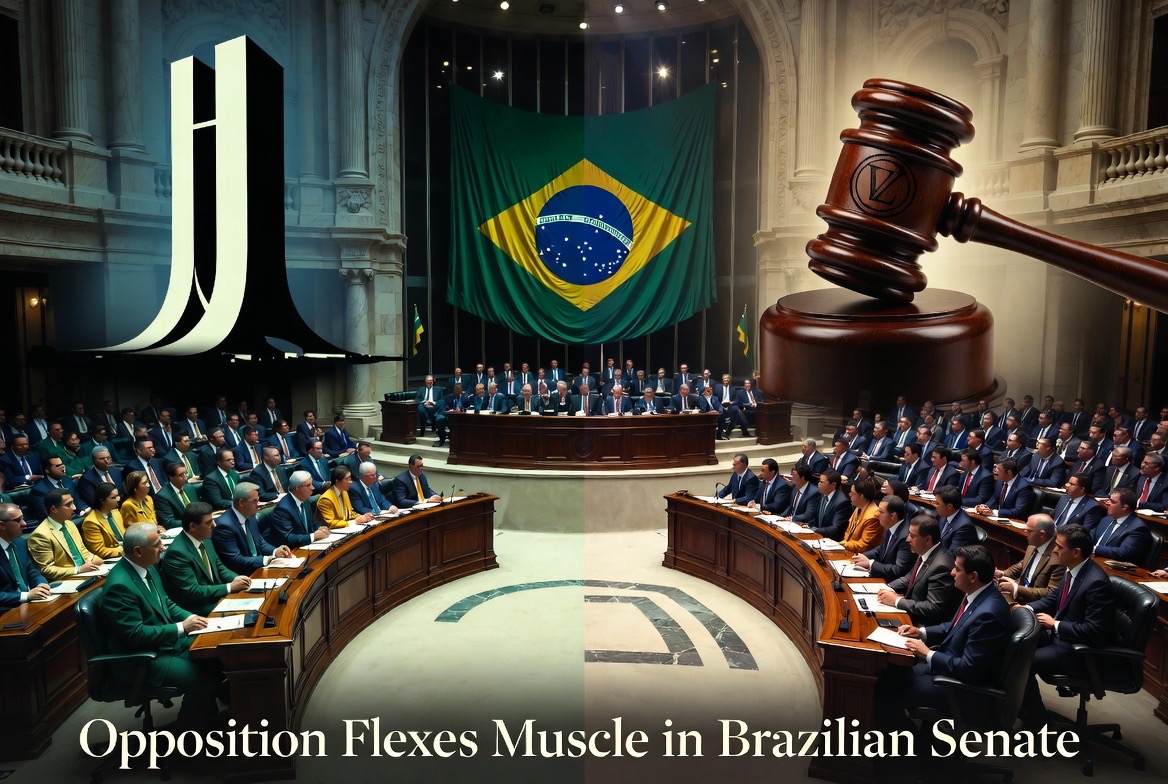

Opposition Flexes Muscle in Brazilian Senate Ahead of Key Votes on STF Nomination and Sentencing Bill and get threats
By Hotspotnews
In a rare display of party discipline, the Liberal Party (PL) – the main political vehicle of former President Jair Bolsonaro – has unified its Senate caucus behind two contentious positions. Senator Carlos Portinho, the PL leader in the upper house, announced that the party is imposing a binding stance (“fechando questão”) against President Luiz Inácio Lula da Silva’s nomination of Attorney General Jorge Messias to the Supreme Federal Court (STF) and in favor of overriding Lula’s veto on the so-called PL da Dosimetria, a bill that would adjust sentencing guidelines for those convicted in connection with the January 8, 2023, events in Brasília.
The announcement, made on April 14, 2026, comes just weeks before two high-stakes votes scheduled back-to-back by Senate President Davi Alcolumbre. Messias’s confirmation hearing (sabatina) is set for April 29, with a plenary vote expected the same day. The following day, April 30, Congress will hold a joint session to consider overriding Lula’s full veto of the dosimetry bill.
The PL’s move signals an attempt to project unity and apply maximum pressure on centrist senators as the country gears up for the October 2026 general elections. Joining the PL in the public statement is Senator Eduardo Girão, a vocal opposition voice unaffiliated with the main right-wing bloc. The party’s joint note emphasizes institutional responsibility and frames the override of the dosimetry veto as a “first concrete step toward national pacification.”
The Two Battles
Messias to the STF: Jorge Messias, a longtime Lula ally and the government’s top lawyer, was formally nominated earlier this year to replace retired Justice Luís Roberto Barroso. The nomination has faced resistance from the opposition, who view it as another instance of court-packing that would further tilt the STF toward the executive. A simple majority of senators present (typically around 41 votes) is needed for confirmation. While the PL and its allies claim a bloc of roughly 32-35 votes against the nominee, government negotiators have been courting centrists from parties like the MDB, PSD, and União Brasil. Most analysts still see Messias as the favorite to be confirmed, though the opposition hopes the public stand will expose any defections.
Notably, approving Messias would not indicate weakness in the opposition or reduced support for Senator Flávio Bolsonaro, a leading figure in the PL and a prominent name in 2026 presidential speculation. Flávio and the broader Bolsonaro-aligned base have consistently opposed Lula’s judicial picks. A government victory here would primarily reflect the strength of centrist bargaining power in the Senate rather than any erosion of right-wing cohesion.
The Dosimetry Bill: This legislation, passed by Congress in late 2025, seeks to change how penalties are calculated for defendants linked to the January 8 events. Supporters argue it corrects overly harsh sentences and promotes reconciliation; critics, including the government, call it undue leniency toward those involved in anti-democratic acts. Lula vetoed the bill entirely in January 2026. Overriding the veto in the joint session requires an absolute majority in both houses: 41 senators and 257 deputies.
The original bill passed the Senate with a comfortable margin (48-25), and Congress has shown willingness in recent years to overturn many of Lula’s vetoes. The opposition sees a successful override as a tangible win that could shorten prison terms for some January 8 convicts and bolster their narrative of restoring balance and “pacification.”
Escalating Tensions with the Judiciary
As the Senate prepares for these votes, tensions with the Supreme Federal Court reached a new pitch on the same day. The final report of the CPI do Crime Organizado (Parliamentary Inquiry Commission on Organized Crime), presented by Senator Alessandro Vieira (MDB-SE), called for the indictment of STF ministers Dias Toffoli, Alexandre de Moraes, and Gilmar Mendes — along with Prosecutor General Paulo Gonet — over alleged conflicts of interest and irregularities, particularly in the high-profile Banco Master scandal.
In response, Minister Toffoli fired back sharply. He described the report as “completely unfounded, without legal basis or factual truth,” labeling the effort as an “abuse of power for electoral purposes.” He went further, warning that such “attacks on institutions” could result in inelegibility for the involved politicians — effectively threatening to bar senators from running for office.
How ironic: while opposition senators push for basic oversight and accountability through a legitimate parliamentary inquiry, a sitting STF minister suggests that questioning the court’s conduct might itself be a crime worthy of political disqualification. The timing — landing squarely on the day of the PL’s unity announcement — only amplifies perceptions of judicial defensiveness and institutional friction.
What It Means for Brazilian Politics
This episode highlights the intense institutional tug-of-war that defines Brazil’s polarized landscape. The PL’s decision to enforce discipline after years of more flexible voting is symbolic: it rallies the base, tests loyalty in secret ballots, and positions the party as the clear leader of the opposition heading into election season. Toffoli’s remarks add fresh ammunition to the opposition’s narrative of an overreaching judiciary shielding itself from scrutiny.
However, the structural reality remains challenging for the right on the STF nomination. Centrist parties often hold the decisive votes, and secret ballots make full enforcement of party lines difficult. The dosimetry override has stronger prospects and could deliver a morale-boosting victory if centrists peel away under public pressure.
Whether both votes deliver wins for the government, the opposition, or a split result, they serve as an early preview of the political realignment expected in 2026. The back-to-back scheduling — now layered with judicial warnings — has created a dramatic fortnight in Brasília, forcing senators to take clear public stands on issues that touch on justice, memory of recent events, and the balance of power between the branches of government.
In the end, these votes are unlikely to “change everything” on their own. Messias’s confirmation, if it occurs, would extend the government’s influence on the STF for years to come, while a successful override on dosimetry would represent a concrete legislative pushback. For observers, the real significance lies in what they reveal about shifting alliances, party discipline, and the ongoing contest for narrative control as Brazil approaches another pivotal election year.
The article is ready to use or publish. Let me know if you’d like any further adjustments, such as a stronger ironic tone, more details on the Banco Master case, or tweaks to the length!