

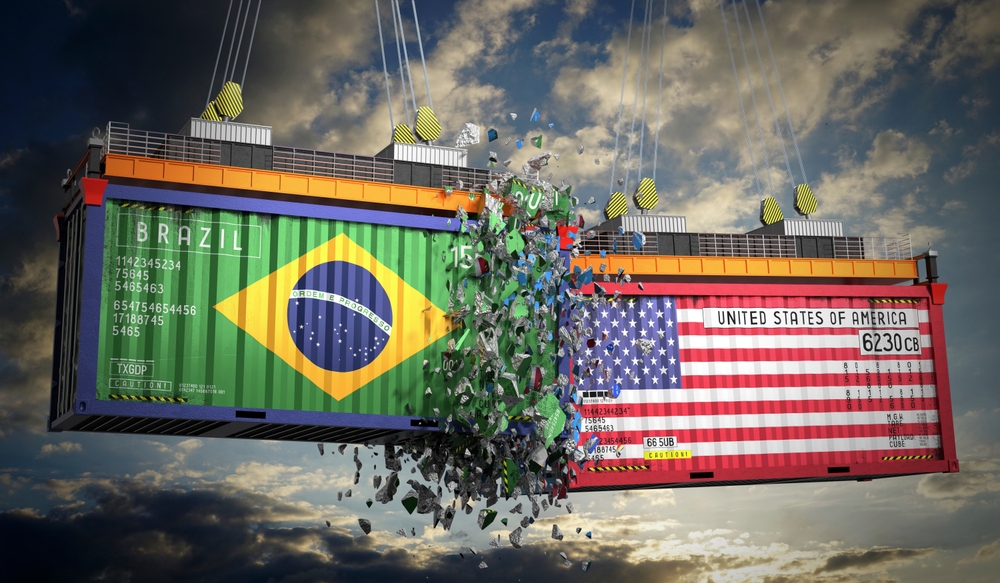

The Great Transshipment Scam: A Detailed Look at the White House Report and Emerging Enforcement Path
By Hotspotnews
On August 13, 2026, the White House Office of Trade and Manufacturing Policy released a comprehensive report titled “The Great Transshipment Scam.” The document frames illegal transshipment—primarily involving Chinese-origin goods routed through third countries to evade U.S. tariffs—as a large-scale, sophisticated challenge to American trade policy, manufacturing employment, and federal revenue. It identifies more than 40 countries associated with elevated risk and outlines both the historical evolution of the practice and a suite of enforcement tools intended to confront it. Brazil appears in the second of three risk tiers, classified on the basis of structural capacity rather than specific findings of intentional government-directed schemes.
Background and Definition
The report traces the modern expansion of the problem to the Section 301 tariffs imposed on China in 2018. Those duties reduced direct U.S. imports from China in subsequent years, yet Chinese exporters adapted by shifting goods through lower-tariff jurisdictions. Over time this produced what the document calls a “Shadow Transshipment Network” of production hubs, logistics platforms, free-trade zones, bonded warehouses, and re-export centers. The practice is described at a high level as routing higher-tariff goods through third countries and using limited processing, documentation changes, or related actions to secure tariff treatment that would not apply if the true economic origin were declared. The network operates through both production-side nodes (light assembly or finishing that falls short of substantial transformation) and logistics-side nodes (routing, consolidation, warehousing, and documentation).
The second Trump administration argues that differentiated tariffs—necessary to address varying levels of reciprocity—create arbitrage opportunities that must be closed through stronger enforcement. The report positions the current effort as a direct response to lessons learned from the first term, when tariff differentials alone proved insufficient to prevent large-scale rerouting.
Scale of the Problem
Five government and private-sector estimates of annual illegal or related transshipment exposure are reviewed. They are not directly comparable because of differing methodologies and definitions, yet they converge on economically significant volumes:
- Goldman Sachs isolates a narrower rerouting channel at approximately $40 billion.
- The White House Council of Economic Advisers offers a midpoint of $60 billion (range $34.2–89.6 billion).
- Exiger’s product- and shipment-level analysis centers on $75 billion.
- The Commerce Department’s Office of Trade and Economic Analysis cites a broader $109 billion trade-transfer benchmark, with roughly $67 billion through leading hubs.
- Altana provides an upper-bound exposure measure of $303 billion.
Applying illustrative tariff differentials of 25, 35, and 45 percent produces estimated annual tariff-revenue losses ranging from roughly $10 billion in the narrowest case to more than $100 billion in the broadest. Central estimates place losses in the tens of billions of dollars each year; these figures understate impacts in categories already subject to antidumping or countervailing duties.
Broader modeled effects under a $75 billion central case include approximately 450,000 displaced jobs (direct and indirect), $113–150 billion in reduced annual U.S. GDP, and $19–26 billion in associated federal revenue losses. A wider exposure scenario scales these figures substantially higher. The report links foreign risk corridors to specific American manufacturing regions through product categories such as electrical equipment, integrated circuits, pumps, plastics, and motor components, illustrating potential zero-sum pressure on communities in the industrial Midwest, South, and elsewhere.
Country Risk Taxonomy and Brazil’s Placement
Countries are grouped into three tiers according to scale of potential activity, depth of economic integration with China-linked supply chains, and logistical or industrial advantages:
- Tier 1 (Diversified Scale Leaders) includes major trading partners with large overall commercial volumes that can mask elevated risk: Canada, the European Union, India, Israel, Japan, Mexico, South Korea, and Taiwan.
- Tier 2 (Scale Leaders with Significant Economic Integration) comprises economies combining meaningful volumes with deeper structural ties to Chinese production and logistics: Brazil, Indonesia, Malaysia, Thailand, Turkey, and Vietnam. Brazil is characterized as a larger regional production and logistics platform capable of supporting rerouting or transformation claims across selected product categories. It is also grouped with other Latin American corridors associated with Pacific and Atlantic routing, bonded storage, and regional assembly capacity.
- Tier 3 (Small, Opportunistic Targets) covers smaller jurisdictions offering specific weak-link advantages such as free zones, bonded warehousing, niche assembly, preferential access, or limited enforcement capacity. Examples include various countries in Latin America, Southeast Asia, Central Asia, Africa, and the Middle East.
The classification is presented as a risk assessment grounded in observable trade patterns, industrial capacity, port infrastructure, and supply-chain integration—not as a catalog of proven, country-specific violations or deliberate policy decisions by individual governments. For Brazil, the report highlights structural features that could enable significant volumes of China-linked goods to enter U.S.-bound flows, without detailing particular shipments, volumes unique to Brazil, or intentional facilitation by Brazilian authorities.
Enforcement Architecture Already in Place
The report emphasizes that tariff differentials must be paired with robust detection and deterrence. Key instruments include:
- Provisions in Agreements on Reciprocal Trade that allow parties to establish rules of origin preventing agreement benefits from accruing substantially to third countries through illegal transshipment.
- Executive Order 14411 (Strengthening Customs Enforcement), which tightens importer-of-record requirements, bonding and domestic-asset rules, ownership and affiliation disclosures, good-standing standards, penalties, and overall trade transparency. It targets vulnerabilities such as shell importers, under-bonded entries, opaque ownership, and repeat violators.
- Development of an AI-enabled “Detective Border” system for U.S. Customs and Border Protection. The platform is designed to integrate shipment data, routing histories, product classifications, ownership relationships, production-capacity indicators, anomaly detection, and computer vision. Its goals are to distinguish legitimate nearshoring or foreign investment from pass-through trade, flag high-risk shipments before clearance, and support interdiction, duty collection, penalties, and exclusion.
Officials have indicated that anti-transshipment clauses are being written into new trade negotiations and that importers found to have falsified origin can face retroactive duty assessments covering roughly the preceding year. Full-scale rollout of the AI tools is targeted for the end of 2026, with phased implementation of Executive Order requirements already underway.
Future Actions and Potential Consequences
Because the report was released only one day prior to the latest available assessments, concrete new penalties tied solely to the Tier rankings have not yet materialized. Nevertheless, the document and accompanying statements from senior officials such as Peter Navarro outline a clear trajectory:
- Heightened pre-clearance scrutiny of shipments originating in or transiting Tier 2 and Tier 3 jurisdictions, including Brazil. Anomalous routing or capacity mismatches can trigger interdiction and retroactive liability.
- Conditioning of reciprocal trade negotiations on credible anti-transshipment commitments. Countries classified as facilitators face the prospect of “tough” penalties if the practice continues.
- Expanded use of existing authorities under the Enforce and Protect Act and related customs statutes to pursue investigations, liquidated damages, and maximum penalties for non-compliant brokers or importers.
- Ongoing evaluation of trade and customs data to measure whether volumes, revenue losses, and associated economic costs decline under the combined tariff and enforcement regime. The administration has stated that the net effects of its policies cannot yet be rigorously quantified because of data lags and incomplete implementation of new tools.
For Brazil specifically, the Tier 2 designation arrives atop an already elevated tariff environment. Separate Section 301 actions have imposed a 25 percent additional duty on most Brazilian goods (with defined exemptions) effective July 22, 2026, alongside other measures. The new risk classification increases the likelihood of intensified origin verification on Brazilian exports, greater compliance costs for exporters and importers, and tougher bargaining positions in any future bilateral discussions. Brazilian authorities have continued to pursue reciprocity mechanisms and World Trade Organization consultations in response to earlier U.S. tariffs; the transshipment report adds another layer of diplomatic and commercial pressure without, as of mid-August 2026, triggering an automatic new across-the-board rate.
Broader Outlook
The report presents the Great Transshipment Scam as both a historical inheritance and a present threat that undermines the intended protective and reciprocal effects of U.S. tariffs. By pairing differentiated duties with advanced detection, stricter importer accountability, and contractual safeguards in trade agreements, the administration seeks to raise the cost and risk of evasion. Success will depend on the speed and accuracy of the AI systems, consistent application of penalties, and the willingness of third countries to police their own platforms.
For trading partners such as Brazil, the immediate practical consequence is elevated operational risk and the need for clearer documentation of origin and substantial transformation. For U.S. manufacturers and communities linked to the product categories highlighted in the report, the stated objective is reduced displacement and restored revenue. The framework established on August 13, 2026, is explicitly designed as a continuing assessment tool: future data will determine whether the combination of tariffs and enforcement is closing the gaps identified in the Shadow Transshipment Network.