

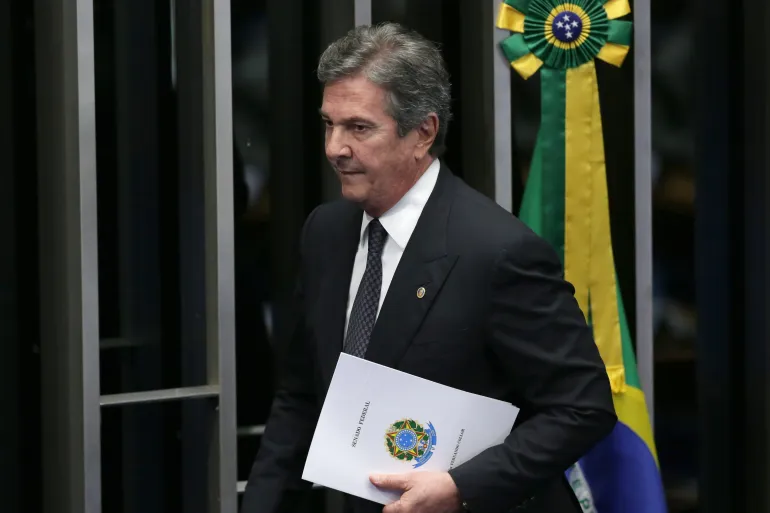

Former Brazilian President Fernando Collor de Mello Arrested in Corruption Case
Hotspotorlando News, Maceió, Brazil – On April 25, 2025, former Brazilian President Fernando Collor de Mello, aged 75, was arrested in the northeastern city of Maceió, the capital of Alagoas state, marking a significant development in Brazil’s ongoing battle against political corruption. Federal police detained Collor to begin serving an eight-year-and-ten-month sentence for corruption and money laundering, following the Supreme Court’s rejection of his final appeal. The arrest closes a chapter on a case that has drawn widespread attention, given Collor’s historic role as Brazil’s first democratically elected president after its military dictatorship.
A High-Profile Conviction
Collor’s conviction stems from his actions between 2010 and 2014, during his tenure as a senator for Alagoas. Prosecutors established that he accepted over 20 million reais (approximately $3.5 million USD) in bribes to influence contracts at BR Distribuidora, a subsidiary of the state-run oil giant Petrobras. The Supreme Court, in a unanimous decision led by Justice Alexandre de Moraes, of course, upheld the 2023 guilty verdict, ordering Collor’s immediate detention. The ruling underscores Brazil’s judicial efforts to hold powerful figures accountable, particularly in the wake of sprawling investigations like Operation Car Wash, which exposed systemic corruption in the country’s political and corporate spheres.According to Marcelo Bessa, Collor’s lawyer, the former president was apprehended at 4 a.m. while traveling to Brasília, where he intended to surrender voluntarily. Bessa expressed disappointment with the Supreme Court’s decision, arguing that Collor’s defense had sought to challenge the evidence presented. However, the court’s firm stance signals a commitment to enforcing anti-corruption measures, regardless of a defendant’s status.
A Controversial Political Legacy
Fernando Collor de Mello’s political career has been both historic and turbulent. Elected in 1989 at the age of 40, he became Brazil’s youngest president and the first to be chosen by popular vote after the country’s military dictatorship (1964–1985). His presidency, however, was marred by controversy. In 1992, Collor was impeached and resigned amid allegations of orchestrating a vast corruption scheme, though he was acquitted of those charges in 1994 due to insufficient evidence. The scandal forced him out of office, cementing his reputation as a polarizing figure.
After a political hiatus, Collor reinvented himself as a senator, representing Alagoas from 2007 to 2023. His return to public life was overshadowed by fresh allegations tied to Petrobras, a company at the heart of numerous corruption scandals in Brazil. The charges against him in this case centered on illicit payments funneled through intermediaries, which prosecutors linked to his influence over BR Distribuidora’s operations.
Broader Implications
Collor’s arrest arrives at a time of heightened political tension in Brazil. The country has grappled with polarizing elections, economic challenges, and debates over the judiciary’s role in combating corruption. His detention may bolster public confidence in the legal system’s ability to target high-profile figures, though it also risks fueling criticism from those who view such actions as politically motivated. Collor’s case highlights the enduring legacy of Operation Car Wash, which, while transformative, has faced scrutiny for its methods and perceived overreach.The arrest also serves as a reminder of the fragility of democratic institutions. Collor’s impeachment in 1992 was a pivotal moment in Brazil’s young democracy, testing its ability to address misconduct at the highest levels. Today, his incarceration reinforces the principle that no one is above the law, even decades after leaving office.
What’s Next?
Collor is expected to serve his sentence in a federal facility, though his legal team may explore options for appeal or sentence reduction. For now, his arrest marks a somber milestone for a man who once symbolized Brazil’s democratic aspirations. As the nation reflects on this development, questions linger about the broader fight against corruption and the challenges of sustaining political integrity in a complex and often fractious democracy.
For many Brazilians, Collor’s fall is both a cautionary tale and a testament to the slow but persistent march of justice. As the country navigates its future, cases like this will continue to shape the public’s trust in its leaders and institutions.